
Structural guidance in this guide is generic industry knowledge. Terms marked as ELAPACK figures are the factory's confirmed 2026 trade terms. Cosmetic product compliance is the brand's responsibility and is not covered here.
This guide is for founders and packaging buyers at beauty subscription boxes — skincare, makeup, haircare or mixed clubs — who are specifying what physically goes in the box: the outer box, the pouches, the inserts and the card. If your question is product curation, vendor selection or pricing, stop here. A beauty box is not a box with things in it; it is four packaging layers — box, pouch, insert, card — and each layer has a job the unboxing exposes within ten seconds. Work through the four layers below and you will finish with a contents spec that makes monthly editions cheap to vary and hard to get wrong.
Why beauty boxes look generic by month six
Beauty is the most crowded subscription category, and its boxes converge: same tuck box, same crinkle fill, same printed card. Not because teams are lazy — because the packaging was bought as one object ("the box") instead of four layers with separate jobs.
- A beauty club orders "a box" for launch and fills it with products each month.
- Small items rattle, liquids leak onto printed surfaces, the theme card looks like an afterthought.
- Every layer was asked to be decorative, so no layer was specified to protect, present or brand — the three jobs subscribers actually film.
- By mid-year the unboxing is indistinguishable, and the theme changes cost full re-orders because variation was never designed in.
- Unboxing is the club's marketing; a generic box is a silent tax on growth.
- The task on this page is to specify each layer's job, so the box system — not just the box — carries the brand.
The four layers of a beauty box
Give every layer a job — hold, present, brand — and buy each on purpose. Each layer ends with the question your edition has to answer.
Layer 1 — The outer box: the only layer everyone sees
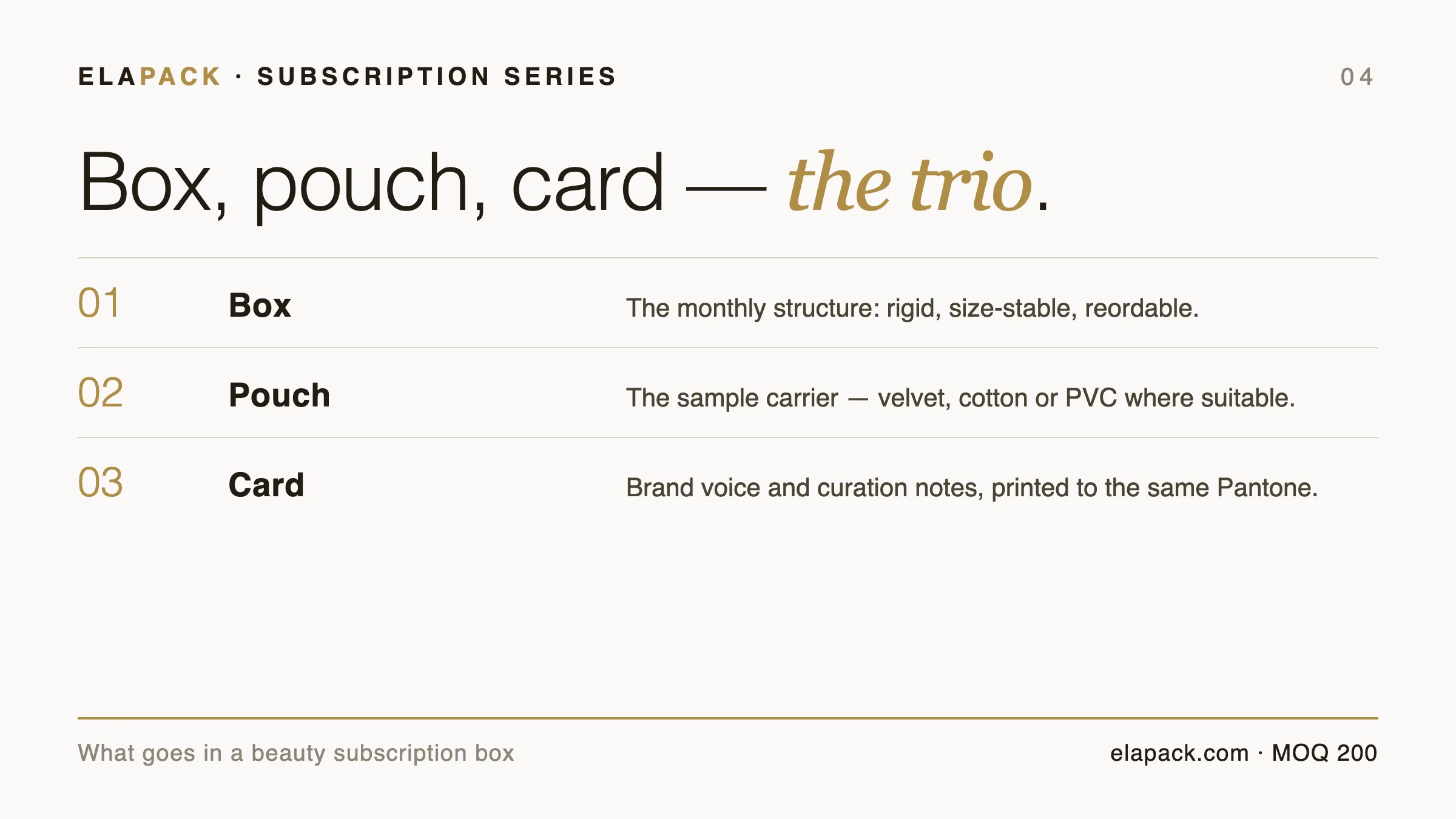
The outer box does the shipping and the first impression. The main structures: a tuck mailer with printed interior — the category workhorse, ships flat, economical at volume; a folding carton with a die-cut interior when products need locking; a magnetic flip-top in greyboard (commonly produced at 800–1,600 g) for the premium tier, where the box doubles as storage and subscribers keep it on a vanity. One beauty-specific fact decides more than appearance: beauty boxes ship liquids, powders and palettes in one parcel, so the interior has to keep a leaking worst case away from the printed surfaces — a lined interior or a sealed product bag is cheaper than a ruined edition. The question: does the box arrive looking like the photos, after parcel handling, with the worst product leaking?
Layer 2 — The pouches and bags: the layer subscribers reuse
Pouches are the beauty box's signature layer — the item that survives the unboxing and carries the brand for months. A velvet pouch (a 0.8–2.0 mm composite) reads keepsake for a jewellery or rollerball item; cotton and muslin (100–400 gsm across the two) read natural for skincare minis; satin (60–120 gsm) reads dressy for fragrance; a clear PVC zip bag (0.12–0.50 mm) is the practical repeat-use option for cosmetics in transit. A monthly colour or fabric change on a stable pouch pattern is one of the cheapest theme mechanics available — the pattern is confirmed once, and each month is a colourway. The question: what does the subscriber keep, and is it branded?
Layer 3 — The inserts: the layer that makes the box film well
The insert is what makes an opened beauty box look composed instead of jumbled: die-cut paper card holding each product in a named slot; EVA foam for glass bottles and droppers; moulded pulp where a natural read matters. Inserts are cut to the products, so an edition's product list locks the insert — and the honest consequence: when the product mix changes, either the insert has multiple slot sizes or the edition gets a new insert while the box stays. That trade (flexible insert versus edition-specific insert) is a cost decision to make on purpose, once, in the spec. The question: when the box is opened on camera, does every product sit where the theme put it?
Layer 4 — The card: the layer that talks
The theme card is the only layer with words: the month, the theme, what the products are, sometimes a code. It prints to the theme, so it changes every month by design — which makes it the natural home of monthly variation while the box, pouches and inserts stay stable. ELAPACK's terms frame the whole system's economics: a 200-piece minimum across all product lines lets each layer run at subscriber count rather than forced volume; production of 15–20 days at 200–20,000 pieces on a monthly cadence; and the recurring-question test — which tooling charges recur when only the card artwork changes — is answered in writing before month one. The question: does the theme live on the card, where changing it is cheap?
Read the four together. A box that films well but ships leaks, or a pouch that reads premium but arrives creased, breaks the system at its weakest layer.
When a beauty box that looks right is still wrong
The flat-lay photo proves the styling; only a packed, shaken, shipped box proves the layers. Three boundaries keep this page honest:
- Beauty boxes ship the leakiest product mix in subscription commerce. A pack test with the actual worst-case product beats any structural promise.
- An insert sized to this month's products is not sized to month four. Decide the flexible-versus-specific insert trade in the spec, not at re-order.
- PVC bags suit cosmetics and jewellery programmes; confirm suitability for any product that is neither. And a quotation that does not name fabric bands or board weights has not fixed the variables that move both cost and hand-feel.
The beauty box contents spec
Nothing on this page collects your data or sends anything. Fill the four-layer spec before you request quotes, so each layer is bought for its job. Copy the lines below into your own note:
- The edition: product list with sizes, weights and the leak/shift risk of each.
- The outer box: structure (tuck mailer, folding carton, magnetic flip-top), finished size in cm, interior lining for leak worst case.
- The pouches: fabric and band (velvet 0.8–2.0 mm composite, cotton 200–400 gsm, muslin 100–200 gsm, satin 60–120 gsm, PVC 0.12–0.50 mm), size, closure.
- The inserts: material (paper card, EVA, pulp), cut to product, and the flexible-versus-specific decision named.
- The card: format, printed sides, and confirmation that monthly theme changes live here.
- The variation plan: what changes monthly (card, pouch colourway, sleeve) and which charges are one-time.
- The terms: quantity per edition against the 200-piece minimum, lead-time band (15–20 days to 20,000 pieces), sample terms — in writing.
Keep the note local, and send it to your supplier through your existing approved contact process — do not send it anywhere this page has not verified. With the four layers specified, a beauty club's month becomes a card print and a pouch colourway on a box system that already works — which is how a box stays on-theme in month twelve without ever re-buying month one.