
Structural guidance in this guide is generic industry knowledge. Terms marked as ELAPACK figures are the factory's confirmed 2026 trade terms; candle-burning and product safety matters belong to the candle maker, not the packaging.
This guide is for founders and packaging buyers at candle brands running — or planning — a monthly candle subscription box, where each edition ships a candle (or a votive set) in packaging that has to protect glass, survive parcel transit and still read new every month. If your question is candle making, scent design or vendor selection, stop here: this page does none of those. A candle subscription box has two jobs a normal box does not: lock a glass vessel completely still, and change its look every month without re-buying the structure. Work through the four decisions below and you will finish with a candle-box spec your supplier can hold across editions.
Why candle boxes fail differently
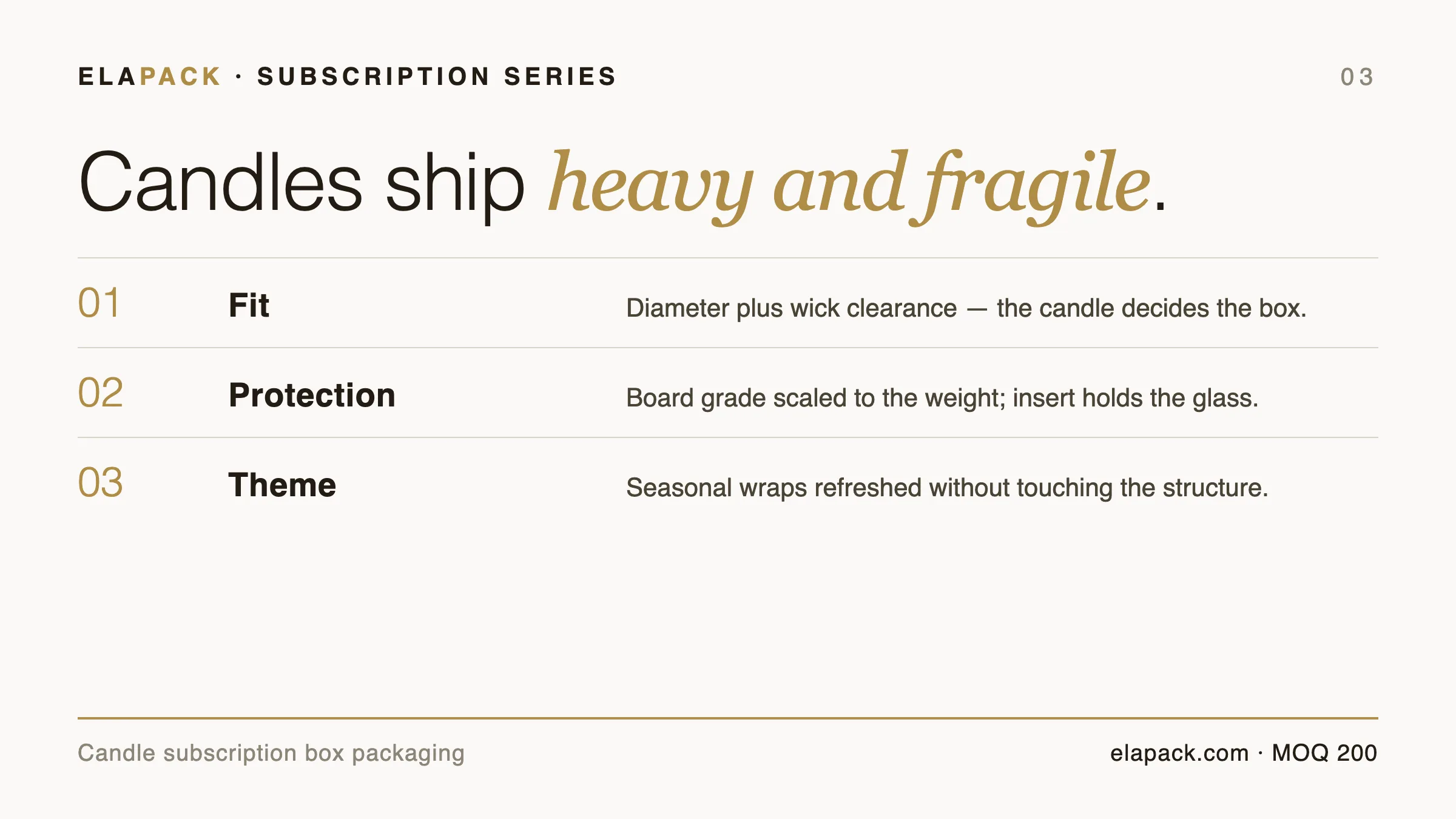
Most subscription packaging failures are cosmetic. Candle packaging failures are broken glass, melted wax and dented tins — returns with photographs. The product is heavy for its size, fragile in one axis, and heat-sensitive in transit, and every one of those facts has to live in the packaging spec.
- A candle club ships month one in a box sized and printed nicely, with the candle held by tissue.
- The glass shifts in parcel handling; in summer lanes the wax softens; the monthly theme forces a new artwork round each time.
- The box was treated as a printed container, when for a candle it is a shipping device with a theme on it — so neither job was specified.
- The programme pays in breakage claims, double-boxed freight, or editions that stop matching their theme.
- Subscribers churn over a single broken glass, which costs the programme far more than the insert would have.
- The task on this page is to specify the hold, the heat plan and the variation mechanic before the artwork.
Four decisions that specify a candle subscription box
Specify the hold first, the heat second, the theme mechanic third, the terms last. Each decision ends with the question your edition has to answer.
Decision 1 — The hold: insert and structure
The candle glass must not move, in any axis, in a parcel dropped from a metre. The main structures: a tuck mailer with a die-cut paper insert that locks the glass — the workhorse for single-candle editions; a folding carton with a moulded pulp or corrugated wrap for sets; a magnetic flip-top or rigid lift-off lid in greyboard (commonly produced at 800–1,600 g) for the gift-tier club, where the box is kept as a candle keeper. The insert is the decision that matters: EVA, paper card and moulded pulp each lock a glass differently, and the insert must be cut to your vessel profile, not to a standard candle size — vessel diameters vary by maker. The question: has this exact glass been drop-tested in this exact box, or is the hold an assumption?
Decision 2 — The heat plan: season and lane
Wax softens in warm transit lanes and parked delivery vans. Packaging cannot cool a parcel, but the spec can respect the physics: a tighter insert that stops a softened candle sliding; a box interior that does not print against the vessel rim where wax can smear; a summer edition that avoids dark outer colours on long warm routes where that matters. Multi-packs of votives or tea lights travel more kindly than one large glass, and several clubs run minis in warm months. The question: what does your warmest shipping month do to this pack, and has anyone asked it before?
Decision 3 — The variation mechanic: theme without re-buying
A candle club changes scent monthly, so the packaging has to change monthly too — the trap is re-buying the whole box each time. The settled pattern: confirm the dieline and insert once, then vary the artwork, a printed sleeve, or a belly band each month. Fabric wraps and pouches carry themes cheaply — a cotton band or velvet pouch in the month's colour re-skins a stable box at a fraction of a new structure. ELAPACK's terms make this mechanic real: a 200-piece minimum across all lines lets a month's variant run at subscriber count, and production of 15–20 days at 200–20,000 pieces keeps the monthly cadence; which plate and tooling charges recur when only artwork changes is the question to hold in writing. The question: does month eleven cost a sleeve, or a whole new box?
Decision 4 — The recurring calendar and terms
A candle club is a dated business: each edition has a pack week, and the packaging has to clear production and freight before it. ELAPACK's confirmed reference points: custom samples at USD 25 plus USD 20 shipping, built in 3–5 days from confirmed artwork — after the first confirmed dieline, sample rounds for artwork-only changes shorten; stock samples are free and dispatched in 2–3 days; runs above 20,000 pieces move to 20–25 days, so a fast-growing club should quote its peak-month volume, not its average month. The question: has the supplier seen the programme's peak month, not just month one?
Read the four together. A box that holds the glass but cannot vary cheaply will fossilise; a box that varies beautifully but lets the glass move will churn the list.
When a candle box that looks right is still wrong
The unboxing photo proves the edition; only a drop test and a warm lane prove the pack. Three boundaries keep this page honest:
- A glass that survives domestic ground shipping may not survive a warm-week international lane. Ask which lanes the packed box has actually travelled.
- An insert cut to a generic candle size will not hold your vessel, because there is no standard vessel. Cut to your measured profile.
- A theme system that requires a full re-order each month is a cost structure, not a design choice — find it in the quotation before month three does.
The candle box spec list
Nothing on this page collects your data or sends anything. Fill the spec before the artwork, so the theme lands on a pack that already works. Copy the lines below into your own note:
- The vessel: measured diameter, height and weight of the candle glass (each SKU in the edition).
- The box: structure (tuck mailer, folding carton, magnetic flip-top, rigid lid), finished size in cm.
- The insert: material (die-cut paper card, EVA, moulded pulp), cut to the measured profile.
- The heat plan: warmest shipping month, lanes that matter, minis versus full-size in warm months.
- The variation mechanic: what changes monthly — artwork, sleeve, band or pouch — and which charges are one-time.
- The wrap: pouch or band fabric and colour (cotton 200–400 gsm, velvet 0.8–2.0 mm composite), if used.
- The terms: quantity per edition against the 200-piece minimum, lead-time band, sample terms — in writing.
Keep the note local, and send it to your supplier through your existing approved contact process — do not send it anywhere this page has not verified. With the hold proven and the variation mechanic settled, a candle club's monthly edition becomes a print order on a structure that already works — which is the only rhythm a dated, recurring programme survives.