
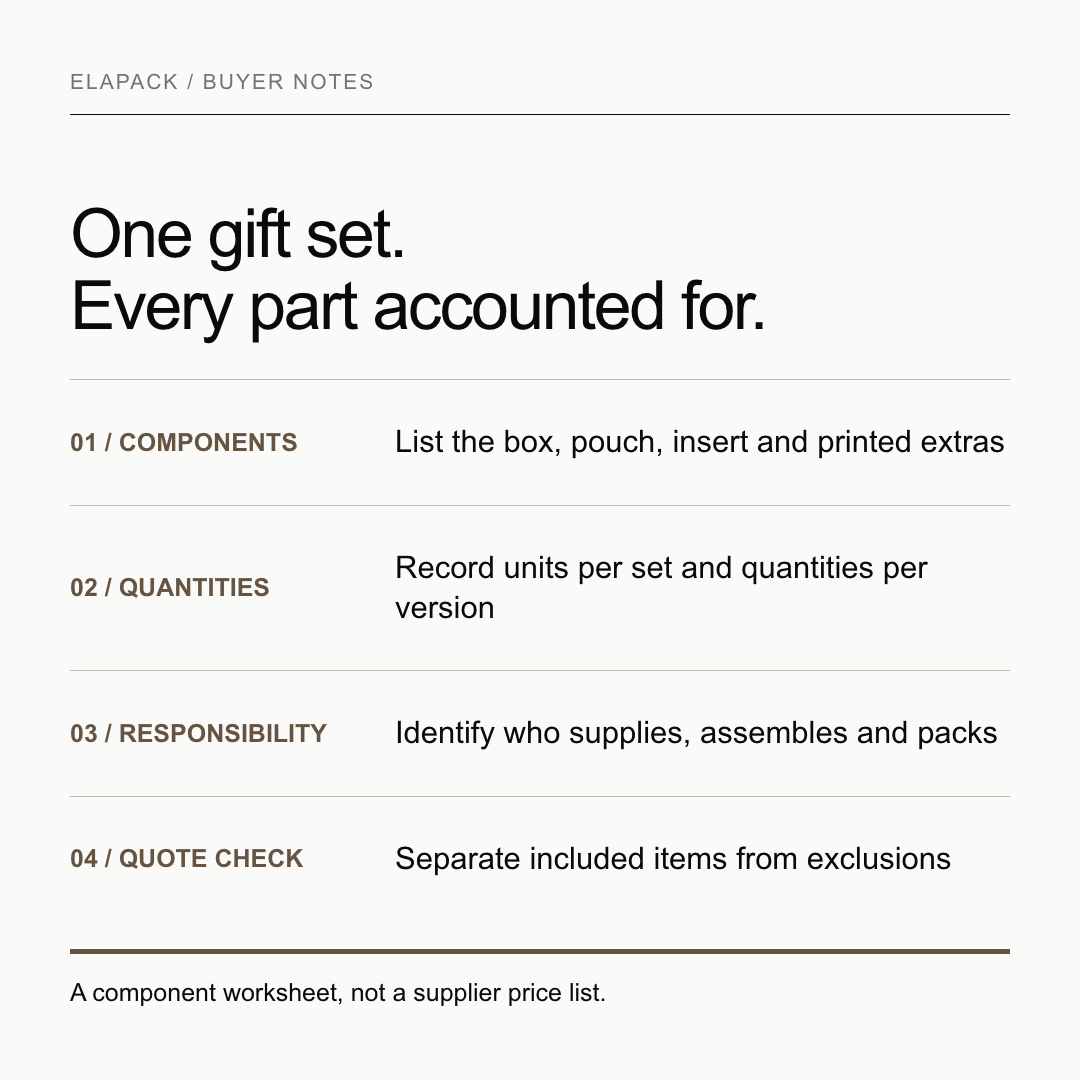
Before comparing prices for a gift set, write down exactly what one finished set contains. Ask each supplier to quote that same component list and identify any exceptions. This guide focuses on coordinating the parts of a set, not on a monthly subscription-box budget or a published price range.
Build a bill of materials
Use a bill of materials, which lists the required components and quantities, to describe the pack. Include the presentation box, insert, pouch, ribbon, card and outer packing only where your project needs them. Mark anything you will supply yourself.
Use complete packaging sets as a starting point, then specify individual custom boxes and pouches and bags. Do not treat every object in a product photograph as included in one quoted unit.
Count what goes into each version
If your gift range has several versions, create a separate column or row for each. Ask suppliers to state how their quoted quantities are split by size, color and artwork. Do not assume that a combined total meets every component’s order requirement.
| Worksheet field | What to enter |
|---|---|
| Component and version | A unique name for the part, size and design |
| Units per finished set | The number required for that version |
| Finished-set quantity | The intended number of that version |
| Component quantity | Units per set × finished-set quantity, plus separately agreed spares |
| Supply responsibility | Your company, this supplier or another supplier |
| Approval reference | Specification and sample revision to be quoted |
Keep spare components in their own line rather than hiding them inside the set count. If a quotation supplies different quantities of boxes and pouches, ask how many complete sets those quantities produce and what remains unassembled. The worksheet is an arithmetic tool, not a recommendation to order a fixed overage.
Name the assembly responsibilities
Assemblies Unlimited's gift-set service lists material sourcing and kit assembly as part of its offering. This is a supplier example of the work that can sit around the components themselves, not a statement that ELAPACK includes those services. Use it to distinguish buying the parts from buying a completed assembly.
Specify who will insert the product, attach tags, tie ribbons and pack the finished sets. If the goods will be assembled at your warehouse, request the shipping arrangement for the loose components. If a supplier will assemble them, ask what work and materials the quoted assembly line includes.
For example, a ribbon gift box can be a reference for a discussion about the ribbon arrangement. Confirm the actual ribbon, tie, insert and assembly details in your proposal rather than assuming the catalog reference settles them.
Distinguish component costs from shipment costs
Ask for a packing list alongside the component quotation: cartons, contents per carton, outside dimensions and gross weights. State whether these figures describe loose parts or completed sets, so the shipment being quoted matches the assembly responsibility you agreed.
| Quote field | Required basis |
|---|---|
| Component production | Quantity and specification per part |
| Assembly | Operations and supplied materials included |
| Shipment | Carton contents, dimensions, weights and quoted service |
| Complete-set count | Components required per set, excluding separately listed spares |
Keep component, assembly and delivery totals separate until each scope is confirmed. A quotation for loose components and one for assembled sets need that reconciliation before their totals are useful for a purchasing decision.
Put inclusions and exclusions side by side
Place setup, sampling, production, assembly and delivery in separate rows. Ask each supplier to mark “included,” “separately charged” or “not supplied.” An empty row should remain a question until answered, not become a zero in your budget.
If you request a lower-cost alternative, ask which component or operation changes. Review whether it still fits the rest of the set before accepting the revised total. Keep the original and revised quotation identifiers so the chosen version is unambiguous.
Approve the set as an assembly
Request a review of the complete proposed assembly, with any unavailable customer-supplied item clearly identified. Record the loaded fit, placement of printed items and the closing arrangement. If one component is changed afterwards, decide whether another assembly review is needed.
Retain the final component list with the approved sample references. For a future reorder, start from that version and list only the requested changes; ask the supplier to confirm any other proposed substitutions.
Send the component list with your enquiry
For a gift packaging project, contact ELAPACK with the list of components, quantities by version, product dimensions and delivery destination. Identify who will perform assembly and which items are still undecided so the quotation can address those gaps.