
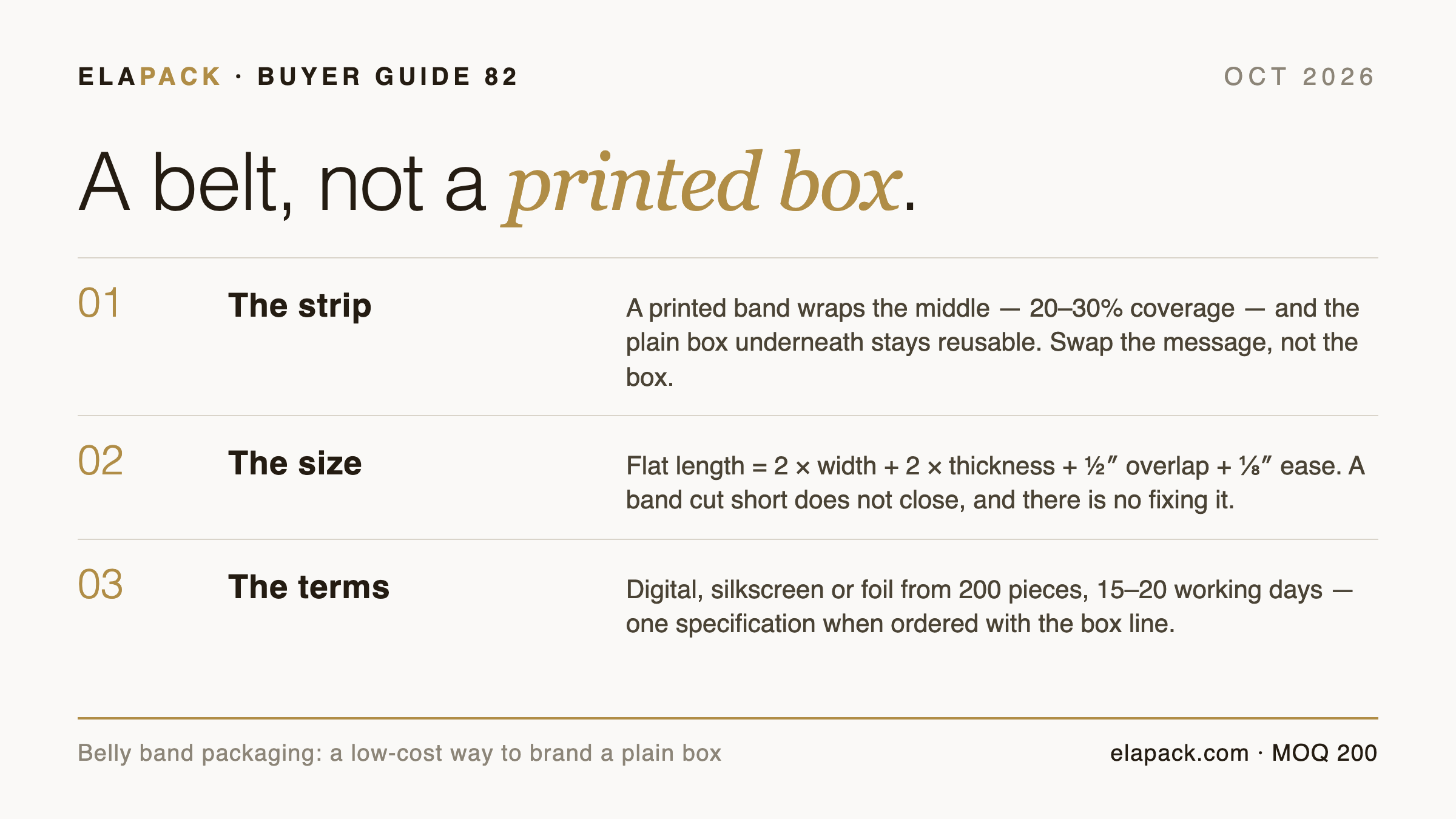
# Belly Band Packaging: A Low-Cost Way to Brand a Plain Box
Not every product needs a fully printed box — sometimes it needs a belt. A belly band is a printed strip of paper or cardstock that wraps around the middle of a book, a candle, a stack of soap bars or a plain gift box, and it delivers branding at a fraction of the material and printing of a full-wrap design. This guide covers what bands are, how they are sized, how the artwork is prepared, and when a band beats printing the box itself.
Key takeaways
A belly band brands a plain box with a printed strip instead of a printed box — less material, less ink, one tooling step, and the box underneath stays reusable.
- Bands wrap the product’s middle — typically covering 20–30 percent of the surface — and are sized by circumference plus band height.
- Published band-height guidance spans 1–4 inches and tracks product size — about a quarter of the piece height is the working proportion; artwork needs about 3 mm bleed and a 5 mm safe zone.
- Bands print in the same processes as boxes: CMYK digital, Pantone-matched spot color, foil and embossing.
- Our factory prints belly bands from 200 pieces with the same spec-confirmation and sample steps as our box line.
Last updated October 2026.
What is a belly band in packaging?
ChinaPrinting4U’s guide defines it cleanly: “a belly band is a printed strip of paper or cardstock that wraps around the middle of a book, notebook, product or packaging” — “much like a belt”. It typically covers part of the front and back faces, usually “about 20–30% of the product”, leaving the packaging underneath visible. That partial coverage is the point: the band carries the print, and the box or product carries the texture.
Bands descend from book publishing — limited editions, awards and promotional messages added “without altering the book cover” — and the publishing logic transfers directly to products: a message that can be added, swapped or versioned without reprinting the base packaging. In packaging the band also does physical jobs: bundling multi-piece mailings into “a neat bundle”, and keeping packages from “opening by accident during shipping or display”, as the same guide notes.
Band versus sleeve versus printing the box
Three escalation levels exist for branding a plain box, and they differ mainly in coverage and cost. A full printed box prints every surface — maximum brand surface, maximum print cost, and the design is committed: change the message, reprint the box. A sleeve wraps more of the box (often a full perimeter panel or a large slide-on panel) on thicker board. A band is the minimal version — one strip around the middle, “made of thinner paper or cardboard” than sleeves in ChinaPrinting4U’s comparison, on the least material.
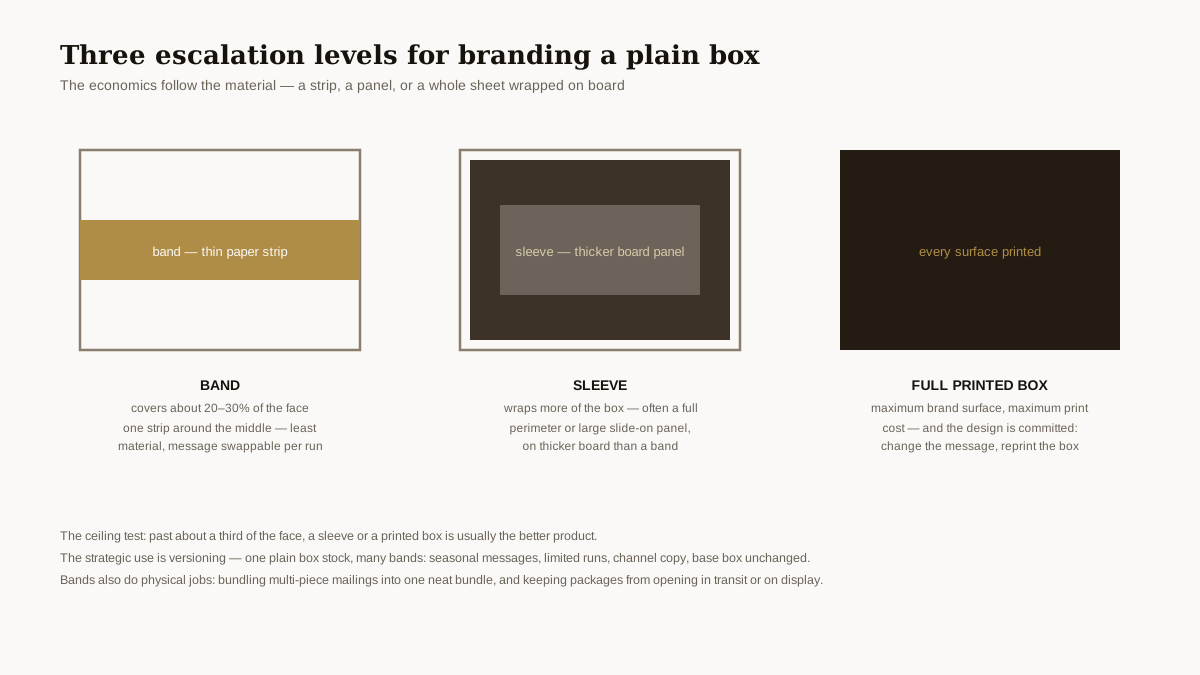
The economics follow the material. A band uses a strip where a sleeve uses a panel and a printed box uses a whole sheet wrapped on board; the same guide’s cost framing is that bands “need nowhere near as much cardstock or paper material”, which cuts production and shipping cost together. The strategic use is versioning: one plain box stock, many bands — seasonal messages, limited runs, channel-specific copy — with the base box unchanged and the band swapped per edition. For brands testing designs, the same logic lets a design live on a band run before committing it to the box.
How is a belly band sized?
Two measurements define a band, and both come from the product it wraps. ChinaPrinting4U frames the length as the circumference of the box or stack with “the circumference and height needed for a snug fit”; 4OVER4 turns the same logic into a working formula: flat length = (2 × piece width) + (2 × stack thickness) + ½ inch glue overlap + ⅛ inch ease. Its worked soap-bar example, 3.5 × 2.25 × 1 inch, resolves to a 9.625-inch flat band — slip-on fits ease to ¼ inch, soft stacks like folded textiles drop the ease to zero — and its warning is worth keeping: “A band cut short does not close, and there is no fixing it after the fact.” A loose band slides and defeats both its branding and its bundling jobs; an over-tight one wrinkles or bowties at the joint.
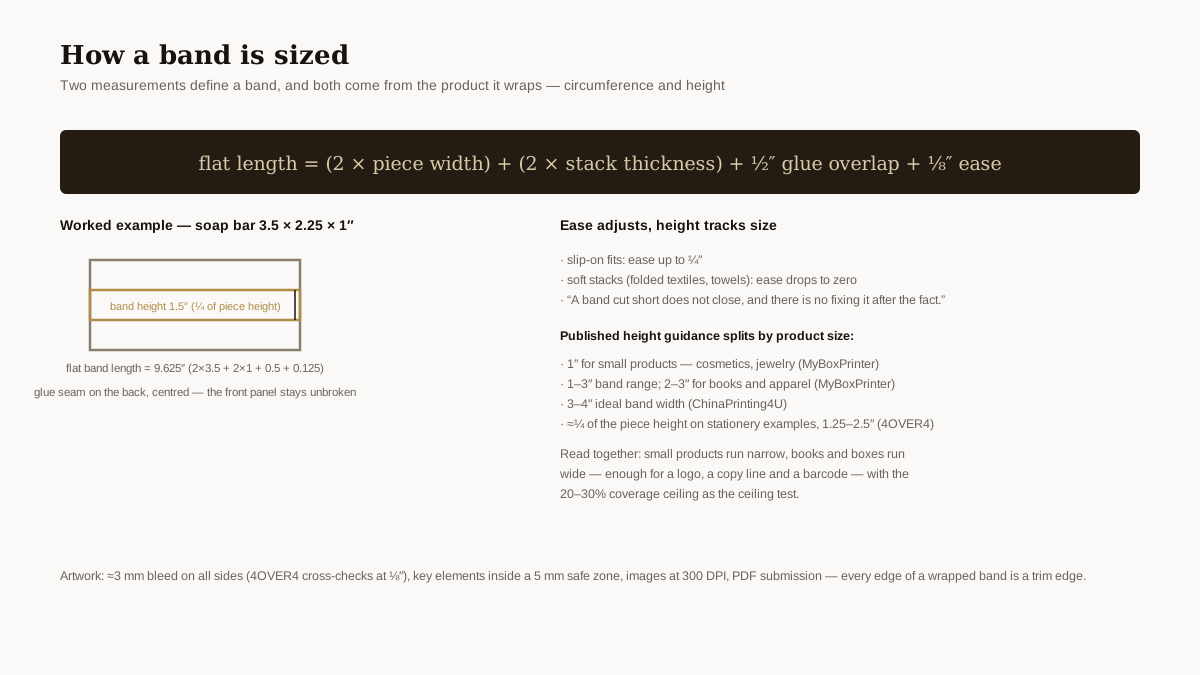
The height — the band’s width across the face — is where published guidance splits by product size, and the split is itself informative. MyBoxPrinter confines bands to 1–3 inches, with “one inch for smaller products — for example: cosmetics or jewelry” and two to three for books and apparel; ChinaPrinting4U puts the ideal at 3–4 inches; 4OVER4 works its stationery examples at about a quarter of the piece height, 1.25–2.5 inches. Read together they converge on one rule: small products run narrow, books and boxes run wide — enough for a logo, a copy line and a barcode — and the 20–30 percent coverage ceiling below arbitrates either way.
Practical sizing notes from ChinaPrinting4U: bands cover “about 20–30% of the product”, which is a useful ceiling test — past a third of the face, a sleeve or a printed box is usually the better product. And for boxed goods the band height is often set relative to the box’s lid seam, straddling or sitting just below it so the band doubles as a tamper-evident closure.
Materials, print and artwork preparation
Bands run on lighter stocks than boxes — the published material list includes glossy and matte art paper, C1S (coated one side, so the printed face is vivid while the reverse side “allows easy writing or glue bonding” — a quiet engineering reason C1S is the band default), uncoated, kraft and vellum. Printing follows the same menu as box work: “most printing services use standard CMYK printing”, with “specific Pantone colors” on request for brand matching, and finishes from lamination to foil stamping in gold, silver and rose gold, spot UV and embossing. Stock choice also carries a mechanical edge: coated stocks “can crack along folds”, 4OVER4 notes, so glossy finishes belong in the flat middle third of the front panel while uncoated and kraft stocks crease cleanly — and because a band bends four times on its way around, every fold is scored before wrapping.
Artwork preparation is where bands are stricter than they look, because the wrap means every edge is a trim edge. The published rules: “3mm bleed extension on all sides to prevent white edges”, images at “at least 300 DPI”, key elements inside “a 5mm ’safe zone’ from the trim edge”, and PDF as the submission format. 4OVER4’s US specification cross-checks the bleed at “⅛ inch” — effectively the same 3 mm — with type held the same ⅛ inch inside trim; keeping key elements to the stricter 5 mm covers both specs. One band-specific rule worth adding from practice: check the artwork’s rotation — a landscape logo wrapped onto a vertical band face rotates with the wrap, so artwork is usually built rotated 90 degrees to the strip.
Two assembly rules separate bands that look produced from bands that look hand-closed. Grain first: “paper folds cleanly along the grain and fights you across it, so on a belly band the grain wants to run parallel to the fold lines” — along the strip’s height, not its length — and the quick check on any stock is to “bend it both ways and keep the direction that curves smoothly” on a scrap. Closure second, in 4OVER4’s assembly terms: “glue dots are faster than tape and hold better on uncoated stock; double sided tape is cleaner on gloss”, with the seam placed “on the back, centred, so the front panel stays unbroken” — and two hard rules after that: “never staple a band, and never glue it while the piece is inside unless you are prepared to lose a few to squeeze-out.”
On our line, bands print with the same three processes as the rest of our packaging — digital for full-color, silkscreen for solid brand color, hot-foil stamping for metallic — and a band ordered with its box runs on one specification: same color references, one proof cycle, one quotation.
When does a band beat a printed box?
Three situations, all involving restraint. Versioning: the message changes more often than the packaging — seasonal editions, collaborations, channel-specific copy — and the box stays constant while the band changes. Budget shape: the brand needs presentation-level packaging at component cost, and a kraft or plain-board box with a foil-stamped band reads more expensive than a fully printed cheap box. Bundling: multiple pieces ship as one — multi-packs, gift sets, kit components — and the band holds the stack while carrying the only print in the set.
The reverse case is equally clear: when the packaging itself is the product’s presentation — retail shelf boxes, gift boxes where the wrap is the gift — a band is a half-measure, and the printed box is the answer. Our gift packaging guide covers that escalation path; the band is the entry rung of it.
Sources
- ChinaPrinting4U — Custom Belly Band Packaging: A Comprehensive Guide — https://www.chinaprinting4u.com/blog/custom-belly-band-packaging
- 4OVER4 — Custom Belly Bands Sizing and Stock Guide — https://www.4over4.com/guide/custom-belly-bands-guide
- MyBoxPrinter — A Detailed Guide on Belly Band Packaging — https://www.myboxprinter.com/blog/2025/07/25/a-detailed-guide-on-belly-band-packaging
Frequently asked questions
What is a belly band in packaging?
A printed strip of paper or cardstock wrapped around the middle of a product or box — “much like a belt” — typically covering 20–30 percent of the surface. It carries print while leaving the packaging underneath visible, and does secondary jobs like bundling multi-piece sets and keeping boxes from opening in transit.
Where can I buy belly band packaging?
Two lanes: US online printers sell configured bands by the small batch — 4OVER4, for instance, routes them through die-cut paper products from $87 per 50 — and packaging factories, including ours, quote bands from 200 pieces with the box line’s full print menu (digital, silkscreen, foil) and one specification when ordered with boxes.
How wide should a belly band be?
It tracks product size: published guidance runs from “one inch for smaller products — for example: cosmetics or jewelry” up to 3–4 inches on books and boxes, with about a quarter of the piece height as the working proportion — and about 20–30 percent face coverage as the ceiling test.
What bleed does belly band artwork need?
About 3 mm on all sides, with key elements inside a 5 mm safe zone from the trim edge and images at 300 DPI or better, submitted as PDF. Because every edge of a wrapped band is a trim edge, band artwork is less forgiving than box-front artwork.
---
We print belly bands from 200 pieces — digital, silkscreen or foil, spec-confirmed on the quotation, production in 15–20 days, custom samples at USD 30 plus USD 25 shipping in 3–5 days, and a free dieline preview before the run so the flat length is checked against your box, not assumed. [Send your box dimensions for a quotation](https://elapack.com/contact/).