
Format, structure and print guidance in this guide is generic industry knowledge, except where ELAPACK's own confirmed trade terms are stated as such. Confirm material and production specifics with the supplier you are evaluating.
This guide is for beauty brand owners, salon line builders and wholesalers who are packaging color cosmetics and beauty tools — lash lines, press-on nails, fragrance and the sets around them — and need to plan the packaging before they request samples or quotes. It covers the four decisions that define a cosmetic packaging program: what the pack holds, whether those contents call for a box or a pouch, the structure and size, and the branding across both materials. If your question is which supplier to choose, what a quote costs, or how fast a factory ships, stop here: this page does not select a supplier, price a quote, or approve a production run. Cosmetic packaging goes wrong when the pack is chosen before the product; the format has to follow the contents. Work through the four decisions below and you will finish with a spec list ready to send for a quote.
Why pack-first planning fails
A cosmetic pack does two jobs: it protects the product through shipping and the shelf, and it teaches the customer the brand at first sight. When the format is picked from a competitor's photo instead of the contents, one of those jobs fails.
- A beauty brand picks a box format because a competitor's looked premium, before mapping what the line actually contains.
- The packaging arrives and the lash trays press against the lid, the nail set rattles, or the pouch fabric pills against the tools it holds.
- Without mapping the contents to the format, the program is guesswork and quotes are not comparable.
- The wrong format means re-sampling, split orders across two suppliers, or a launch where the box and the pouch do not match.
- The rework delays the launch and thins the margin the line was built on.
- The task on this page is to map the line to box, pouch and set, and prepare the specs for a quote.
The fix is not a better reference photo. It is a program that starts from the contents and works outward.
Start from the product
The product names the format. Lash lines run on tray formats — as a working reference, stock lash trays commonly land near 14×10×6 cm for single-tray retail boxes, 15×15×5 cm for square multi-pair formats and 20×18×8 cm for wholesale display packs, with glue and tweezers needing their own wells. Press-on nail sets pack as organized rows that must not shift. Fragrance packs around the bottle — the structure follows the bottle's height and base, not a standard footprint. Tools and applicators run in soft goods. The question your line has to answer: what exactly ships in the pack, in what quantity, and what must not move?
Box, pouch or set
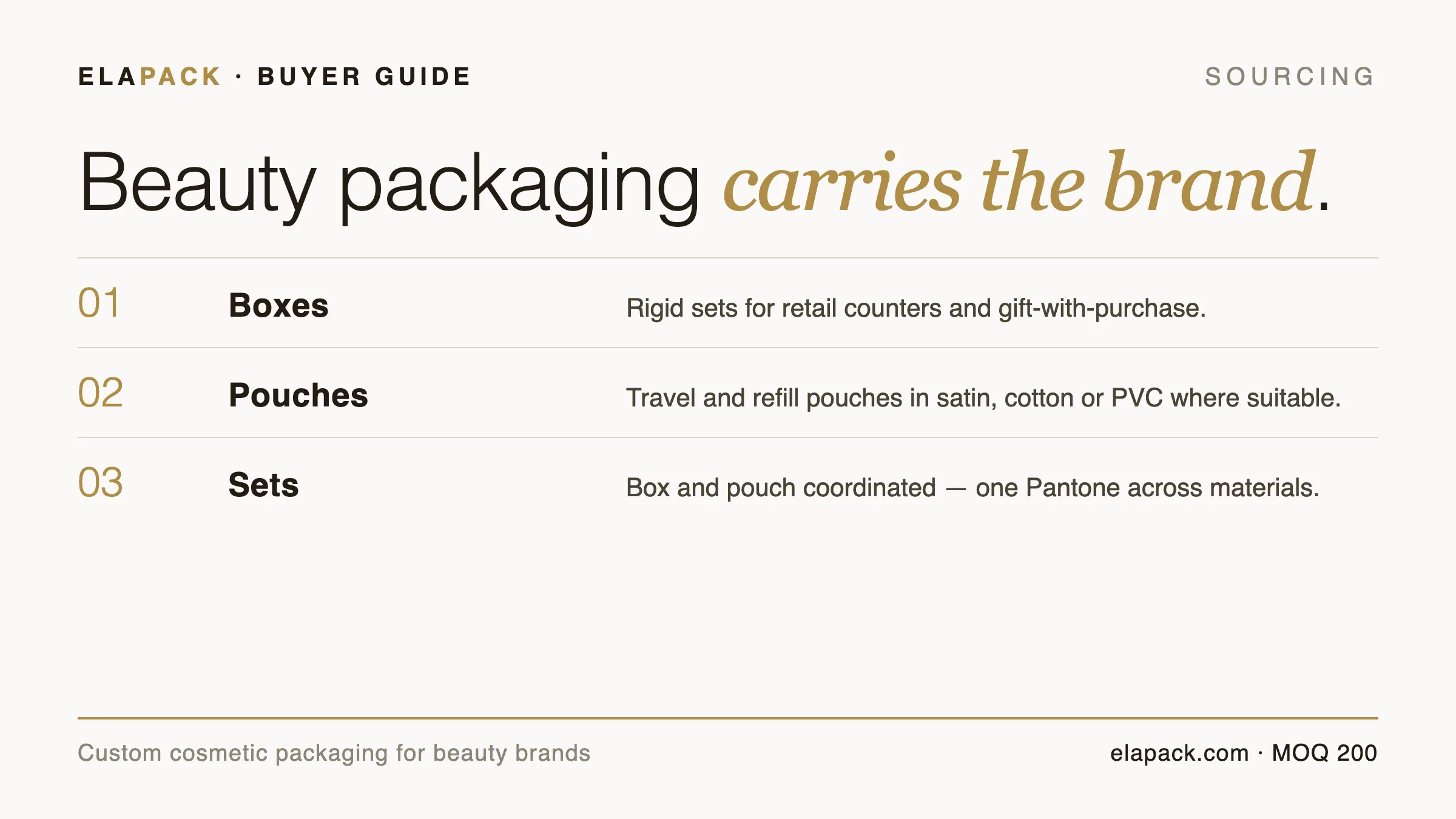
Most cosmetic lines need both formats, and they are different trades. The box side is rigid work: lift-off lid boxes for gift-ready presentation, drawer boxes for layered reveals, magnetic flip-tops for a clean exterior and a slow close. The pouch side is sewn work: drawstring, flap, envelope and zipper styles in cotton, satin, velvet or canvas — for retail attach, travel and refill programs — plus clear PVC zip bags where the product should stay visible. A set program designs the two together: box, pouch and insert as one system, matched in colour and closure. The question: where does each product meet the customer — shelf, unboxing, travel — and which format carries that moment?
Structure and size that survive shipping and the shelf
Rigid structures protect; internal wells organize. Size follows the contents with a little room, settled before pricing because size moves both cost and minimums. Confirm the finished internal dimensions in centimetres in the spec — a pack that is tight presses the product, one that is loose lets it shift and look untidy at unboxing. For anything that ships to a retail counter, the structure also has to arrive true: corners square, lid seated, print undamaged.
Branding across two materials
Board and fabric do not take branding the same way, and a program that ignores this splits in the customer's hand. On boxes: foil stamping, emboss and deboss, spot UV and lamination, with wrap colour matched to a Pantone reference. On pouches: a woven label sewn in, a printed logo, embroidery, or a deboss on velvet. The same Pantone reference can read differently on coated board than on cotton or satin, so confirm the colour on the actual material of each format before the run — this is the most common place a box-and-pouch program stops matching.
Quantities, samples and one spec baseline
As a working reference, ELAPACK's own confirmed terms: a 200-piece minimum across custom boxes and pouches with custom sizes included, 15–20 day production, a free stock sample plus USD 20 shipping, and a USD 25 custom sample plus USD 20 shipping. Typical wholesale programs elsewhere start at 500–1,000 pieces, so a 200-piece entry changes which lines can launch at all. One further practical point: a factory that makes both the box and the sewn pouch gives the program one spec baseline — one sample round, one colour reference, one production calendar — where most carton printers stop at the box and leave the pouch to a second supplier.
Prepare the cosmetic packaging spec list for your quote
Nothing on this page collects your data or sends anything. Fill the spec list from the line, the brand and the quantity. Copy the lines below into your own note:
- The contents: each product in the line, its size and weight, and what must not move in transit.
- The format split: which products run in rigid boxes (lift-off lid, drawer, magnetic flip-top), which in pouches (drawstring, flap, envelope, zipper — cotton, satin, velvet, canvas, or clear PVC zip), and which ship as a designed set.
- The size: finished internal dimensions in centimetres per format, with clearance for the contents.
- The branding: the finish set per format, with the Pantone reference and where each mark sits.
- The quantity: launch quantity per format, and whether samples should be stock or custom.
Keep the note local, and send these specs to your supplier through your existing approved contact process. With the list filled, the quotes compare like with like — and the box and the pouch arrive as one program instead of two orders.