
# Custom Hang Tags: Sizes, Paper Stocks, Strings and Ordering
A hang tag is the cheapest printed surface a brand can put in a customer’s hands — one strip of cardstock doing the work of a label, a story card and a price holder at the same time. This guide compares what the market actually sells — sizes, stocks, holes, strings and finishes — and where a factory order fits against the online printers.
Key takeaways
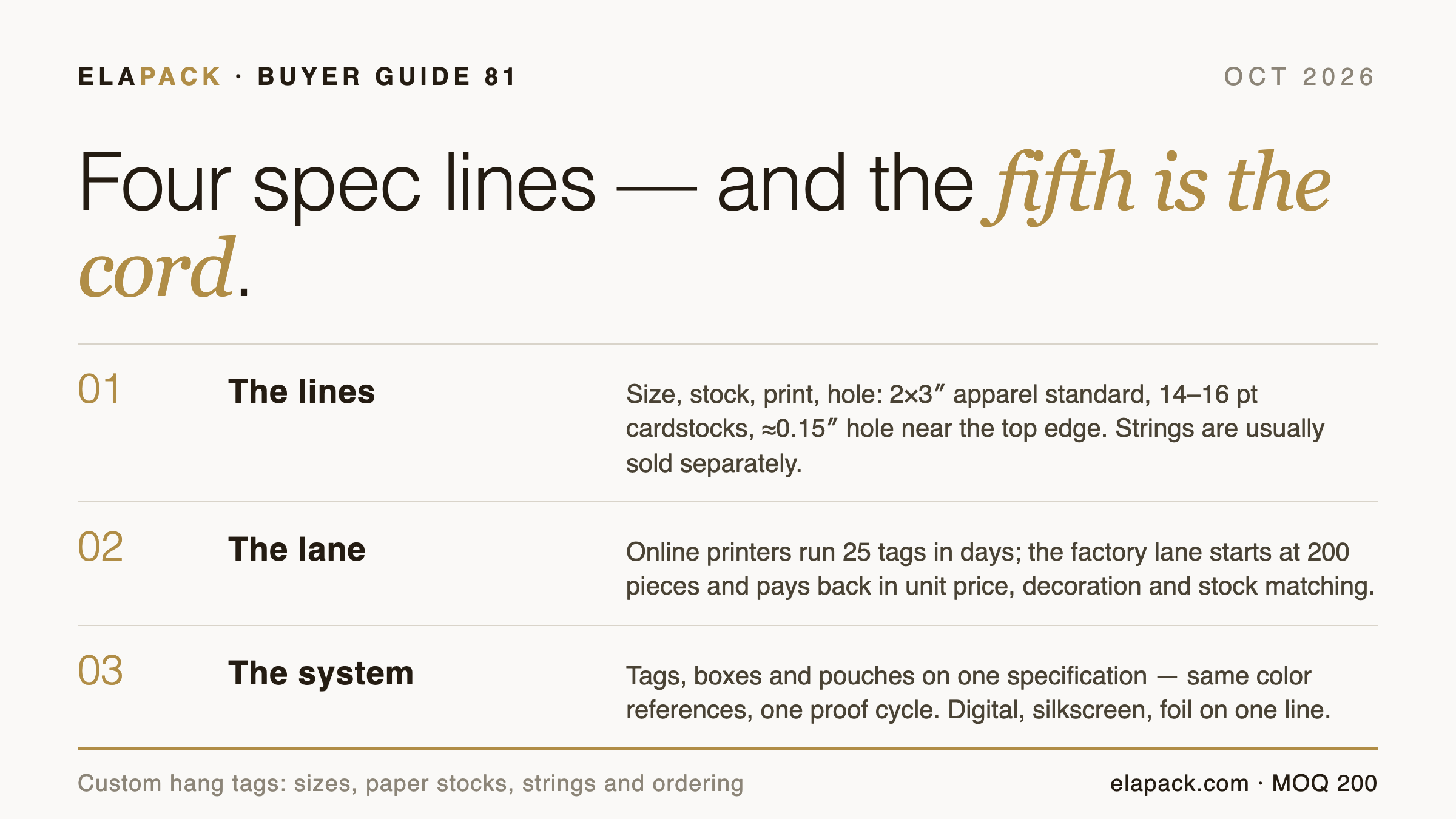
A hang tag is specified by four lines: size, paper stock, hole, string — and the string is the line most buyers forget to ask about.
- Online printers list tag sizes from 2×2 to 8.5×11 inches on 14–18 pt cardstocks; 2×3 inches is the standard apparel size.
- Holes run about 0.15 inch (4 mm), centered near the top edge; factories can usually punch alternatives on request.
- Strings are commonly sold separately — plan the cord (cotton, jute or custom) as its own line, not an assumption.
- Our factory prints hang tags and labels from 200 pieces with silkscreen, digital and foil decoration on one tooling-backed line.
Last updated October 2026.
What a hang tag is, and why it outpunches its size
The tag exists because the garment, the candle and the gift box all carry more information than their packaging wants to print: price, size, barcode, care notes, batch number, the two-line brand story. A tag carries all of it off the product’s surface, hangs there on a cord, and comes off in the customer’s hand — which is the moment it either feels like part of the brand or like a grocery store attachment.
That double life — information carrier at the shelf, brand card in the hand — is what drives every specification in this guide. A tag too thin reads as an afterthought; a tag without the right hole placement fights the string at the fold; a tag on glossy stock takes no pen where the handwritten note was planned.
What size should a hang tag be?
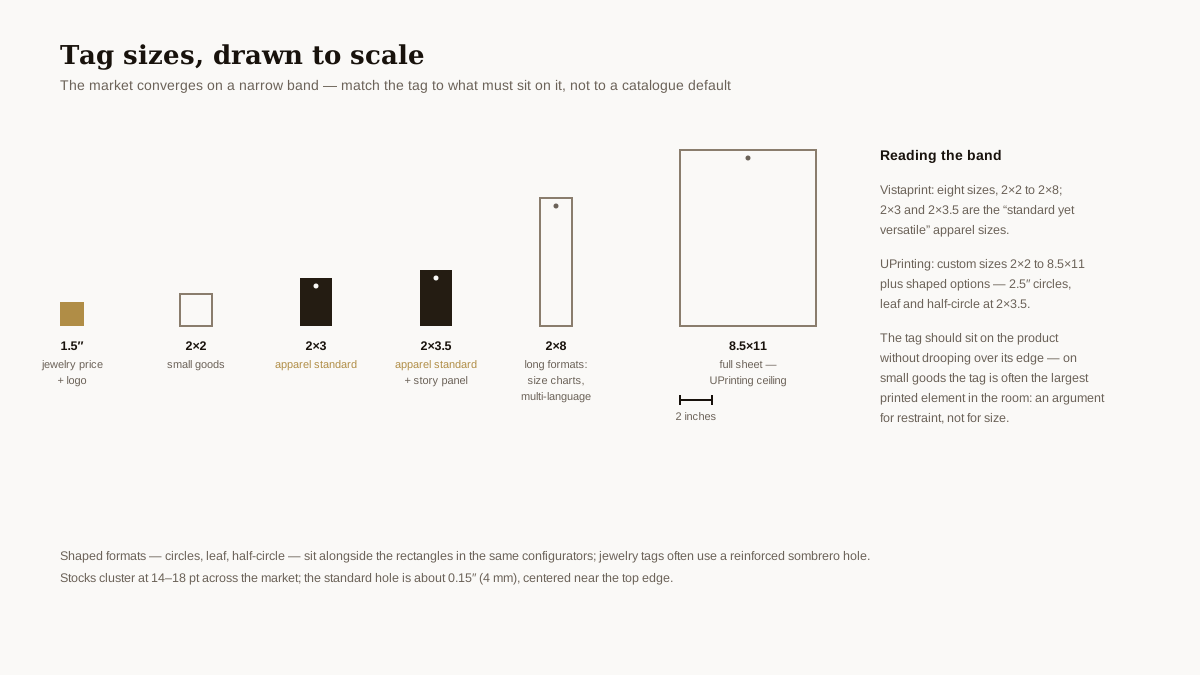
The market has converged on a narrow band. Vistaprint’s list runs from 2×2 up to 2×8 inches across eight sizes, and its own guidance is that 2×3 and 2×3.5 are the “standard yet versatile” apparel sizes, with the long formats reserved for bulky apparel and home textiles. UPrinting sells custom sizes from 2×2 to 8.5×11 alongside shaped options — 2.5-inch circles, leaf and half-circle formats at 2×3.5.
A practical reading for buyers: match the tag to what must sit on it. A price-and-logo tag for jewelry lives at 1.5–2 inches; an apparel brand tag with a story panel wants 2×3 or 2×3.5; anything carrying sizing charts or multi-language care copy goes long. The tag should sit on the product without drooping over its edge — on small goods, the tag is often the largest printed element in the room, which is an argument for restraint, not for size.
Paper stocks: what 14–18 pt actually buys
Online printers cluster tag stocks between 14 and 18 point cardstock, and the differences are functional, not just tactile. Vistaprint’s eight options span premium matte and glossy (14–16 pt), linen (14 pt), kraft (18 pt), natural textured, hemp-blend, pearl and soft-touch stocks; UPrinting’s core tags print on 14 or 16 pt cardstock with uncoated, matte and gloss variants. Two published caveats worth carrying into any specification: Vistaprint notes its pearl stock “isn’t meant to write on” and glossy or soft-touch stocks take “only…a permanent marker” — if the tag carries a handwritten note (handmade brands, market stalls, batch numbering), an uncoated or linen stock is the one that takes a pen. And none of the standard tag stocks are waterproof — Vistaprint states this for its full range — which matters for candles, soaps and anything shipped through condensation.
Our own tags print on cardstocks confirmed per project in the quotation — the stock line is where factories and online printers genuinely differ, since a factory can match the tag stock to the box wrap stock and make the two read as one material system.
How are hang tags holed and strung?
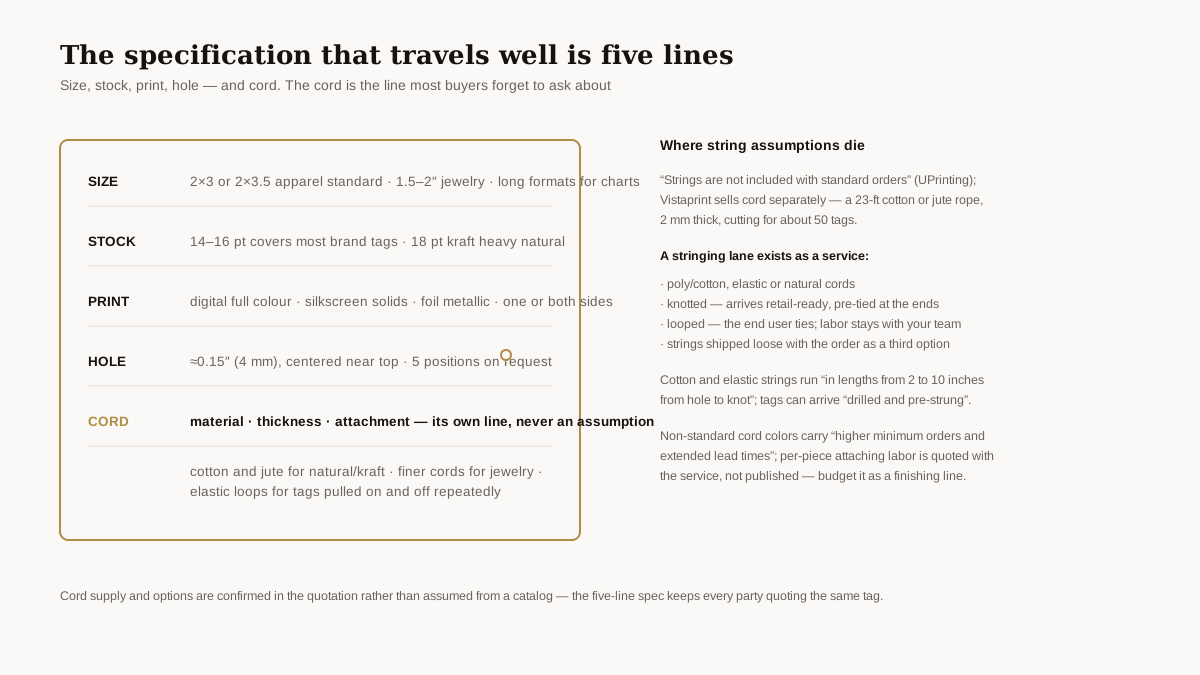
The hole is standard almost everywhere: about 0.15 inch (4 mm), centered, close to the top edge — Vistaprint’s fixed spec, with UPrinting offering punch position across five locations and multiple sizes, including a sombrero (reinforced grommet-style) hole for jewelry tags; a reinforced metal eyelet is the durable variant of the same idea for tags that will be pulled on and off repeatedly — a hardware line confirmed with the supplier rather than assumed. The string is where assumptions die: UPrinting publishes that “strings are not included with standard orders”, and Vistaprint sells its cord separately — a 23-foot cotton or jute rope, 2 mm thick, “can be cut for use for about 50 tags”.
A stringing lane exists if attaching in-house does not. Specialist tag makers offer factory stringing as a service: St. Louis Tag strings tags with poly/cotton, elastic or natural cords — knotted (“looped through the hole and then pre-tied at the ends so end use can hang on the application”) or looped for the end user to tie — and will also ship the strings loose with the order; PrintingForLess offers cotton and elastic strings “in lengths from 2 to 10 inches from hole to knot”, with tags arriving “drilled and pre-strung”. Two practical caveats from their published terms: non-standard cord colors carry “higher minimum orders and extended lead times”, and knotted-versus-looped is a real specification choice — knotted arrives retail-ready, looped leaves the tying (and the labor cost) with your team. Per-piece attaching labor is quoted with the service, not published — budget it as a finishing line, not an assumption.
So the specification that travels well is five lines, not four: size, stock, print, hole — and cord. Cotton and jute suit natural and kraft presentations; finer cords suit jewelry; elastic loops suit tags that must survive being pulled on and off. Cord supply and options are confirmed in the quotation rather than assumed from a catalog.
Which print methods and finishes work on tags?
Tags take the same decoration menu as boxes — digital for full color, foil and spot UV for emphasis — at a fraction of the surface cost. Tags are small, which makes them a surprisingly good canvas for premium decoration — the unit cost of foil on a 2×3 inch surface is a fraction of foil on a box wrap. The online printers’ finish menus make the point: UPrinting lists gold, copper and silver foil, spot UV, and velvet-lamination lines with “print on one or both sides” throughout; Vistaprint offers full-color both-side printing with foil and plastic tags as separate lines.
On our line, tags print with the same three processes as the rest of our packaging — digital for full-color art, silkscreen for solid spot color, hot-foil stamping for true metallic — which lets a brand run tag, box and pouch in matching decoration without changing suppliers mid-system. One practical note from the finish physics: on a dark or kraft stock, light foil and silkscreen whites read far better than four-color process, which keeps simple tag designs both cheaper and more legible.
Ordering: quantities, proofs and lead times
The online-printer lane runs short and fast — Vistaprint from 25 tags with 3–8 business day production tiers, UPrinting printing “in as little as 2 days” — priced per batch through a configurator, with no tooling conversation. The factory lane starts higher — our minimum is 200 pieces — and pays back in three places: unit price at program volume, decoration beyond the standard menus, and stock matching to the rest of the packaging system. Tags ride the same production terms as our other paper goods: 15–20 days for production, custom samples in 3–5 days at USD 30 plus USD 25 shipping when the tag’s color and stock need checking before the run.
For brands pairing tags with boxes or pouches from the same order, the efficient move is one specification covering all paper components — same stock family, same color references, one proof cycle — rather than tags from a configurator and boxes from a factory that never see each other’s color.
Sources
- Vistaprint — Custom Hang Tags — https://www.vistaprint.com/packaging/hang-tags
- UPrinting — Hang Tags Printing — https://www.uprinting.com/hang-tags-printing.html
- St. Louis Tag — Hang Tag Stringing — https://www.stlouistag.com/hang-tag-stringing.html
- PrintingForLess — Hang Tag Strings and Hangtag Stringing Services — https://www.printingforless.com/resources/hang-tag-stringing/
Frequently asked questions
Do custom hang tags come with strings?
Usually not — UPrinting states “strings are not included with standard orders”, and Vistaprint sells cord as an add-on (a 23-foot cotton or jute rope covering roughly 50 tags). Specify the cord as its own line: material, thickness and attachment.
Can hang tags be printed on both sides?
Yes — both Vistaprint and UPrinting offer two-side printing on their core tag lines. The common pattern is brand side / information side: logo and story on the front, price, barcode, care or size copy on the back.
What size hole do hang tags use?
About 0.15 inch (4 mm) is the standard — centered near the top edge. Factories can usually punch alternative positions and sizes; jewelry tags often use a reinforced sombrero hole.
Are hang tags waterproof?
No — standard tag cardstocks are not waterproof or water-resistant (Vistaprint states this for its entire paper range). For damp environments, look at plastic tag lines or lamination, and expect a different price class.
What paper stock should a hang tag use?
14–16 pt covers most brand tags; 18 pt kraft is the heavy natural option. If the tag carries handwriting, choose uncoated or linen stocks — glossy, pearl and soft-touch stocks take only permanent marker.
---
We print hang tags and labels from 200 pieces — silkscreen, digital and foil, stock-matched to your box and pouch line, with custom samples in 3–5 days. [Send your tag sizes for a quotation](https://elapack.com/contact/).