
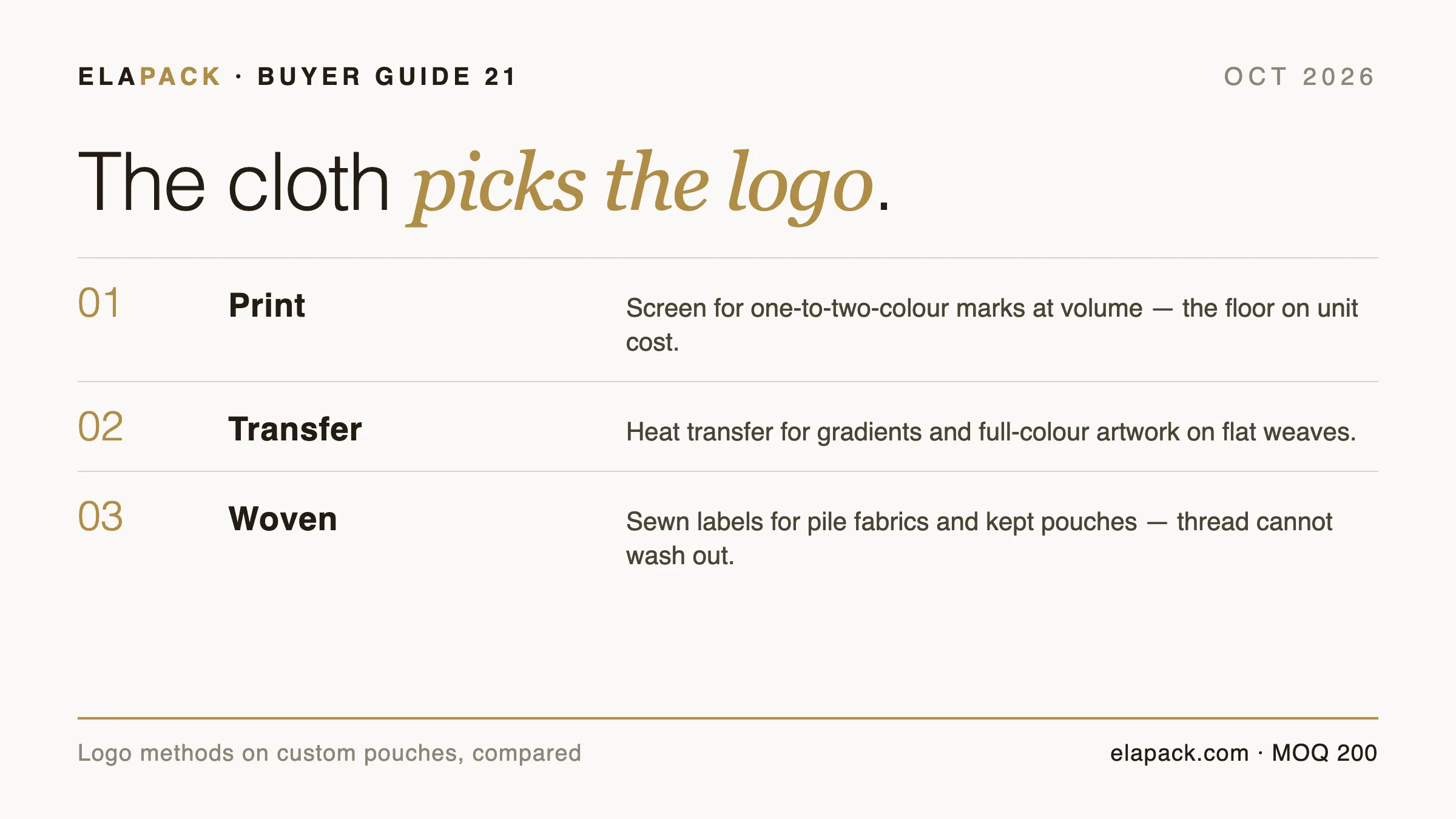
Choose the logo method after deciding which pouch fabric and construction you want to approve. A clean logo on one substrate does not establish the result on another. This guide compares the questions worth asking about direct printing, heat-applied graphics and sewn labels, without treating any method as permanently damage-proof.
Compare the proposed result, not a universal winner
Avery Dennison presents woven labels, printed fabric labels and heat-transfer branding as different options. Its range is a useful reminder that “fabric label” is not one construction and that a logo can be produced and attached in several ways. It does not establish that any option is suitable for every pouch. Avery Dennison branding options
Use this table to structure sample enquiries. These are purchasing checks, not measured performance rankings.
| Proposed method | Question to resolve | Sample detail worth recording |
|---|---|---|
| Direct screen print | Can the artwork reproduce on this fabric and color? | Small lettering, edges and appearance on the folded pouch |
| Heat-applied graphic | Is this transfer system appropriate for the actual substrate? | Surface change, adhesion and color behavior |
| Woven label | Does the woven interpretation preserve the necessary detail? | Legibility, label dimensions and placement |
| Printed fabric label | Does the proposed label and attachment suit the design? | Print clarity, edge treatment and stitching position |
The cheapest option cannot be identified from this list alone. For a useful comparison, hold the pouch specification and order scope constant, then ask what changes with each logo route. A price for one logo size and one fabric should not be compared as though it covers every alternative.
Browse custom jewelry pouches alongside drawstring bags before fixing the logo placement. If the intended product is a cotton pouch, request a sample on the proposed cotton specification, not simply a sample bearing the right logo on a different material. Our recommendation is to make substrate, artwork and method one approval decision. For adjacent formats, the custom cosmetic bags guide and the glasses cases and pouches guide apply the same logo questions to bag-style and eyewear products.
Ask what can change on the selected fabric
STAHLS' dye-migration handbook describes a problem in decorated polyester garments: color from the fabric can migrate into the applied graphic, and the result may not be immediately apparent. The source concerns garment decoration. It is relevant as a risk to discuss for a polyester pouch, not evidence that all pouches suffer the problem or that a particular transfer system has passed testing. STAHLS dye-migration handbook
If a heat-applied method is proposed, ask the supplier to assess the actual substrate and color. A sample on a different fabric may help discuss the design, but it leaves material-specific questions open. We do not prescribe a temperature, dwell time or wash test here because no exact transfer system and pouch fabric have been specified.
For a sewn label, inspect the label and its attachment as separate details. Check how the label sits when the pouch is filled or closed, where the stitching appears and whether the placement matches the approved drawing. A woven logo should not be described as impossible to damage merely because its design is woven rather than printed.
Keep comparisons relevant to the intended use. If the pouch will be washed, request an appropriate care specification and evidence for the proposed construction. If washing is not part of its intended use, do not invent a wash-resistance selling point. The same discipline applies to terms such as “permanent” and “fade-proof”: ask what conditions and evidence support them before using them in product copy.
Approve the complete logo specification
For the artwork brief, identify the logo version, intended finished size and position on the pouch. Supply the editable artwork you have and ask which file format the proposed method requires. Do not assume every process has identical artwork rules, or that a small raster preview is enough to approve production detail.
Our recommended approval record includes the fabric specification and color, pouch dimensions and construction, logo method, artwork revision, label or print position, and the sample reference. Record any substitute material used in an early sample so that a partial design check is not mistaken for complete approval.
For quotations, list quantities by version and identify changes in fabric, logo or dimensions. Ask how those changes affect the proposal rather than assuming that one total quantity makes all versions identical in production. If you are ordering a coordinated jewelry packaging set, include the other components as separate lines and clarify any assembly requested.
The final decision should be based on the sample and the agreed specification, not on a claim that one method is always the cheapest or most durable. Standard orders start at 200 pieces with a 15–20 day production window after sample approval. Send ELAPACK your pouch reference and logo artwork to request the applicable options and sample terms. Where evidence is still missing, leave the claim out of the product description until it has been resolved; a restrained, accurate description is more useful than a promise the order cannot substantiate.