
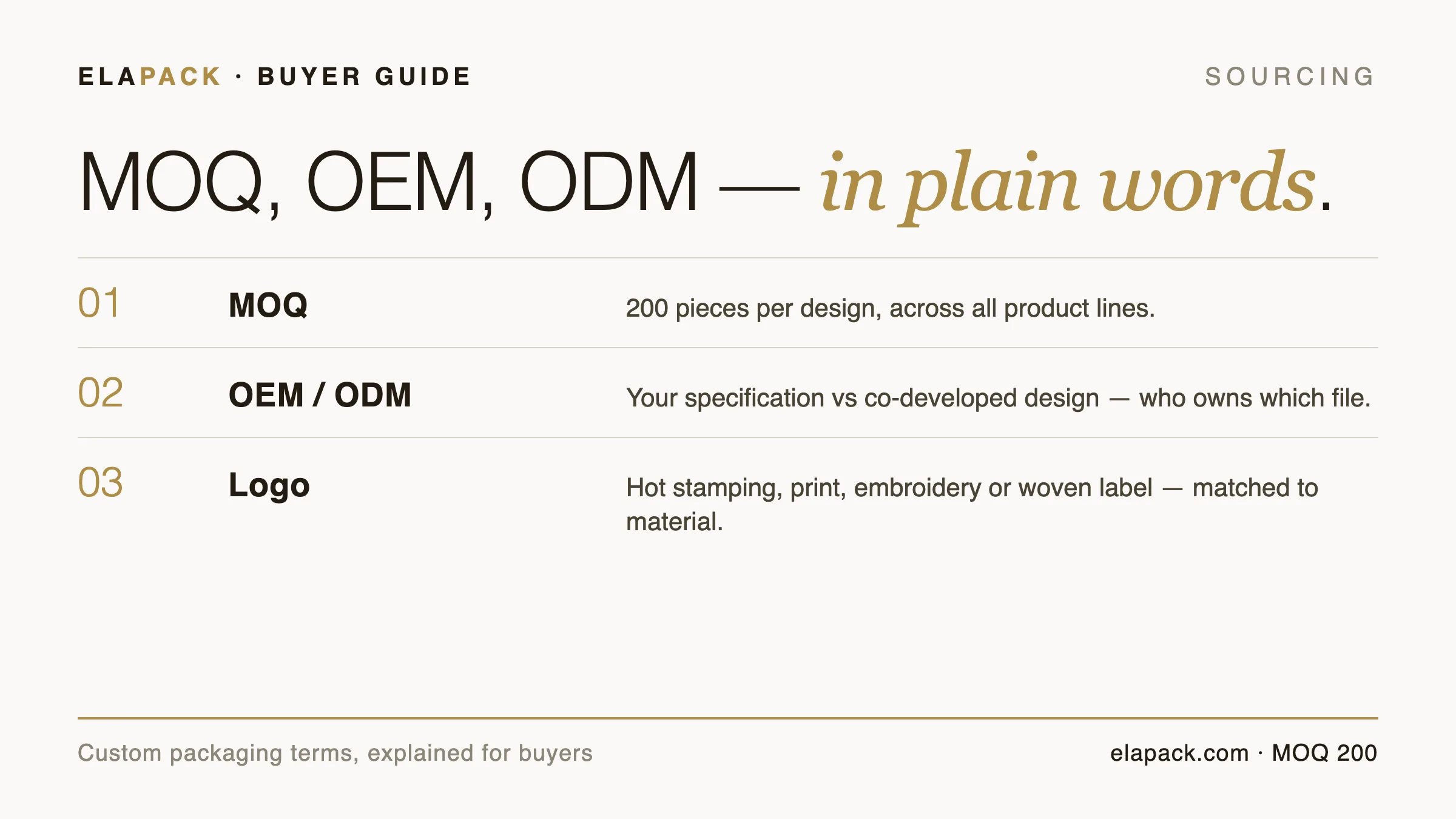
MOQ, OEM/ODM and logo-technique explanations in this guide are generic industry knowledge, except where ELAPACK's own confirmed trade terms are stated as such. Confirm every term with the supplier you are evaluating.
This guide is for packaging buyers and brand owners at small and mid-size brands who keep hitting the same three terms in every custom packaging conversation — the MOQ, the OEM/ODM choice, and the logo technique — and need to read all three before the first quote. If your question is which supplier to choose, what a quote costs, or how fast a factory ships, stop here: this page does not select a supplier, price a quote, or approve a production run. These three terms decide what you can order, who owns the design, and whether your logo survives the run. Read the three sections below and you will finish with a one-line answer to each, ready for the quote conversation.
What an MOQ is and why it exists
A minimum order quantity is the quantity at which a production run makes economic sense for the factory — not a negotiation anchor. Custom packaging carries setup work that happens once per design regardless of quantity: printing plates and press makeready for boxes, cutting dies for inserts, dyeing lots for fabric, sewing-line setup for pouches. The MOQ is where that fixed setup amortizes enough that the unit price works on both sides.
Three practical consequences follow:
- Unit price falls with quantity, and the first tier is the steepest. The gap between a 200-piece and a 500-piece price is proportionally larger than the gap between 2,000 and 5,000; the setup cost is being spread over fewer pieces.
- A low MOQ changes what packaging is for. When the minimum is high — 1,000 pieces and up is common on boxes — packaging is a stocking decision made once per season. When it is low, packaging becomes a testing decision: launch a line, read sell-through, reorder the winner and retool the loser. As a confirmed trade term of ours, ELAPACK runs MOQ from 200 pieces on bags and boxes alike, with 15–20 day production — the model this section describes.
- The number that matters is per what. Confirm whether the MOQ is per design, per SKU or per colour variant. One structure printed across three shades may share tooling and minimum, or may not; this single line changes what a multi-variant launch actually costs, more than the headline number does.
OEM vs ODM vs white label
The three cooperation models differ in who owns the design and what each side owes the other.
- OEM — you own the design. You bring the dieline, the structure, the artwork; the factory manufactures to it. You get exactly the package you specified and you keep the design; in exchange, you owe precise, complete specifications, and the sampling rounds are where your spec gets proven.
- ODM — the factory owns the design, you customize it. The factory's existing structure is adapted to your size, colour and logo placement. Setup is faster and cheaper because the design work exists; the trade-off is that the structure is not exclusively yours — check what exclusivity, if any, your volume buys, and what happens to your customizations if you leave.
- White label — no design at all. A stock product with your logo applied. The lowest barrier and the least differentiation; the brand lives only in the mark.
What to confirm regardless of model: who owns the dielines and artwork produced during the project, whether your customized version can be sold to anyone else, and what the re-order terms are once tooling exists. These questions are cheaper to ask before the first PO than after it.
Logo techniques by surface
The logo technique is chosen by the surface before the brand book. The same mark reads — and holds — differently on fabric and on board.
On fabric pouches and bags:
- Silkscreen print — crisp and economical; the default on cotton, muslin and satin, single to multi-colour against a colour reference.
- Heat transfer — full-colour coverage where the artwork needs gradients or photography.
- Woven label — the premium, durable option; reads as garment-grade branding stitched in.
- Embroidery — heritage and bespoke; sits especially well on textured weaves.
- Foil stamping — the metallic lift on velvet and suede that reads luxury at first touch.
On rigid and folding boxes:
- Foil stamping — gold or metallic logos on lid and base; the classic premium mark.
- Blind emboss and deboss — relief without colour; quiet and tactile.
- Spot UV — a gloss pattern over matte lamination that catches shop light.
- Inside-lid printing — the brand line that lands at the opening moment.
- Matte or gloss lamination — the base finish that sets how every technique above reads.
Two confirmations close the decision: the technique must hold across the run, so approve it on a printed sample of the actual material — a proof on screen or on a different substrate proves nothing — and the colour match should carry a reference (a Pantone number is the working standard) so close-enough has something to be measured against.
When the terms on paper are not enough
A quoted MOQ, model and technique still need one physical proof each. Three boundaries keep this page honest:
- An MOQ stated without its unit — per design, per SKU, per colour — is not yet a number you can plan a launch on. Ask until the unit is named.
- An OEM/ODM ownership term that lives in a conversation, not a document, does not exist. Get the design-ownership and exclusivity lines in writing with the quote.
- A logo technique approved off-spec is a colour risk. The swatch or printed sample on the actual material is the only approval that transfers to the run.
The three-line readiness check
Nothing on this page collects your data or sends anything. Copy the three lines below into your own note and fill them for your launch:
- The MOQ line: your quantity window, the minimum that applies, and its unit — per design, per SKU or per colour.
- The model line: OEM, ODM or white label — and who owns the design, in writing.
- The logo line: technique, surface and colour reference — approved on a sample of the actual material.
Keep the note local, and raise the open lines with your supplier through your existing approved contact process. With the three lines filled, your first quote conversation starts from decisions made rather than terms decoded — and the comparison between quotes becomes a real choice.