
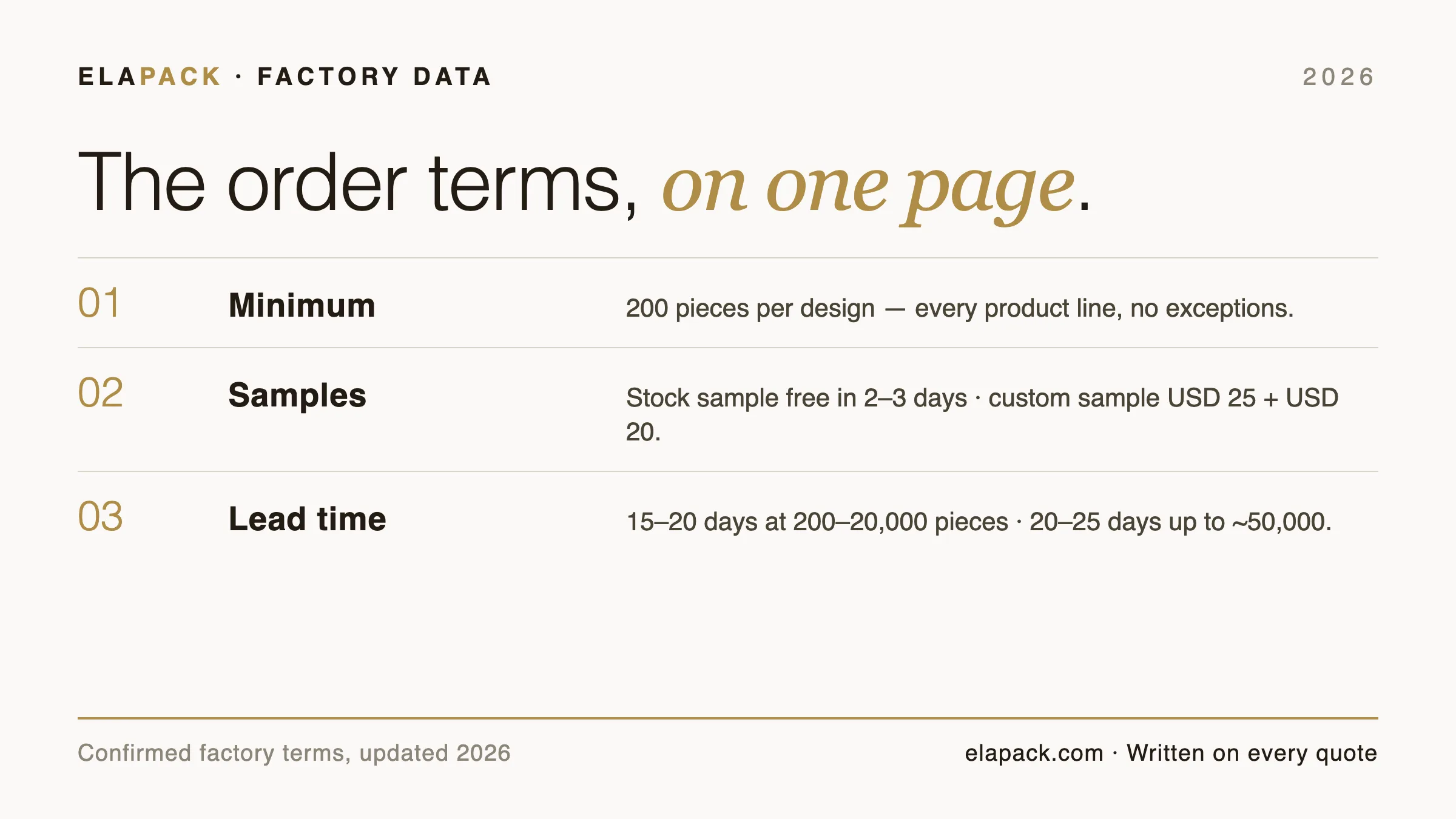
Every figure on this page is ELAPACK's own confirmed trade data for standard orders, current as of 2026. Where a value depends on your specification, the page says so rather than quoting a number that cannot hold.
When buyers compare custom packaging suppliers, the questions that decide the shortlist are rarely about design — they are about numbers: what quantity a factory will accept, what a sample costs and how quickly it ships, and how long production takes at the volume being planned. This page collects those numbers in one place, from one factory, so they can be checked against any other quotation. ELAPACK's minimum order quantity is 200 pieces across all product lines; custom samples cost USD 25 plus USD 20 shipping and are built in 3–5 days with 4–7 days courier transit; standard production runs 15–20 days for orders up to 20,000 pieces and 20–25 days at around 50,000 pieces. The sections below give each figure its context and its limits.
Key facts at a glance (October 2026)
ELAPACK's confirmed trade terms for custom packaging, current as of October 2026: minimum order 200 pieces per design across all product lines. Production takes 15–20 days for orders of 200–20,000 pieces and 20–25 days for 20,000–50,000 pieces, counted from sample approval and deposit. A free stock sample ships in 2–3 days, with USD 20 sample shipping and 4–7 days courier transit; a custom sample costs USD 25 plus USD 20 shipping, is built in 3–5 days from confirmed artwork, and a full custom sample round lands in roughly two weeks at about USD 45 all-in. Payment by T/T or PayPal; finished orders dispatch from Shanghai or Shenzhen by air or by sea.
Minimum order quantity: 200 pieces, every line
One number, no per-product exceptions. Pouches, boxes and display pieces all start at 200 pieces, which keeps small launch runs and multi-SKU programmes possible without negotiating a different threshold for each product. Buyers testing a market with three colourways of one pouch can order 200 of each rather than being pushed to a single large run. If your programme needs a lower quantity, that is a conversation about the specific product — not a published number this factory will quietly honour, so plan on 200 as the floor.
Samples: cost and clock
| Item | Figure | Notes |
|---|---|---|
| Stock sample | Free of charge | Proves material and construction standard |
| Stock sample shipping | USD 20 | Dispatched in 2–3 days |
| Custom sample | USD 25 | Built to your dieline and print |
| Custom sample shipping | USD 20 | Same courier rate as stock |
| Custom sample build time | 3–5 days | From confirmed artwork |
| Courier transit | 4–7 days | Typical international delivery |
A full custom sample round — fee, shipping, build and transit — lands in roughly two weeks and costs USD 45 in total. Stock samples exist to judge a factory's baseline; custom samples exist to judge your design as built. Choosing the wrong one for the question you are asking is the most common way a sample round wastes money; the method for that decision is covered in the custom packaging samples guide.
Production lead times by order size
| Order quantity | Production lead time | Counted from |
|---|---|---|
| 200 – 20,000 pcs | 15–20 days | Sample approval and deposit |
| 20,000 – 50,000 pcs | 20–25 days | Sample approval and deposit |
Two honest caveats keep this table usable. First, lead time starts at sample approval and deposit — not at first contact — so the calendar that matters is: sample round, approval, production, outbound shipping. Second, the two bands are the confirmed data points, verified up to 50,000 pieces; programmes above that volume are quoted case by case, and the quotation states the lead time in writing. Rush requirements are the same: possible or not is a question answered per order, never a published promise.
Material weight and thickness ranges
Custom packaging is made to specification, so these are commonly produced ranges — the bands this factory runs most often — not a closed menu. Custom weights within or near these bands are routine.
| Material | Commonly produced range | Typical use |
|---|---|---|
| Satin | 60–120 gsm | Jewellery pouches, wig bags |
| Muslin | 100–200 gsm | Drawstring pouches |
| Cotton (incl. canvas) | 200–400 gsm | Drawstring bags, tote-style packaging |
| Microfiber | 180–350 gsm | Lens and eyewear pouches |
| Velvet | 0.8–2.0 mm composite | Jewellery pouches, display trays |
| PVC | 0.12–0.50 mm, clear or frosted | Zip bags (cosmetics and jewellery) |
| Greyboard (rigid boxes) | 800–1,600 g, typically 1,200 g with 120 g wrap | Rigid boxes, magnetic closures, drawer boxes |
The range matters more than the midpoint. A 60 gsm satin and a 120 gsm satin are different products with different drape and print behaviour, and a quotation that states only "satin pouch" has not fixed the one variable that moves price and hand-feel most. When requesting a quote, name the band — or name the use, and let the factory propose the weight in writing.
The factory behind the numbers
These figures come from a manufacturer, not a trading desk: ELAPACK has produced custom packaging since 2018 on three production lines, under an ISO 9001 quality management system whose certified scope is the production and sales of paper and textile packaging products. The practical meaning for buyers: the sample terms, lead times and material bands above are the factory's own operating data, and the same team that quotes them builds the order.
How to use this page
Treat every number here as a baseline to check other quotations against, not as a ceiling on what is possible. Quantities above 50,000 pieces, unusual materials, and compressed calendars are all quotable — the answer arrives as a written specification with the numbers that apply to your order. Start from the pages for the product you are sourcing — custom drawstring bags, custom eyelash packaging or custom perfume boxes — or the samples guide for the method behind the sample figures.