
Scheduling, cost and checking guidance in this guide is generic industry knowledge, except where ELAPACK's own confirmed trade terms are stated as such. Confirm terms with the supplier you are evaluating.
This guide is for brand owners and packaging buyers planning a first custom packaging run — a pouch, a box, a set — who are about to ask a factory for a sample and want the round to prove something. It covers the five decisions that define a sample round: which kind of sample to ask for, what it should cost and how long it takes, what to check when it arrives, how the round fits the production calendar, and which terms to get in writing before paying. If your question is which supplier to choose, stop here: this page does not select a supplier, price a production quote, or approve a run. A sample tests three separate things — the material, the print and the supplier's process — and a round that has not decided which one it is testing wastes money either way. Work through the five decisions below and you will finish with a written sample request instead of a vague email.
Why sample rounds waste money
A sample is the cheapest mistake in packaging — when it is used as one. Ordered as a formality, it approves nothing:
- A buyer asks a factory for "a sample" without saying which kind or what it must prove.
- Either a stock sample arrives — the factory's standard, someone else's print — and gets judged for not showing the buyer's design, or a custom sample is paid for before the specs are settled and approves a design that changes a week later.
- Without deciding what the round is testing — material, print or process — the sample arrives to no checklist, and the production quotes stay incomparable.
- The run goes ahead on an unproven print or an untested structure, and the failure surfaces at production quantity instead of on one sample.
- The rework — a second sample round, a delayed launch — costs more than the first round saved.
- The task on this page is to decide the sample type, its checklist, its cost and its calendar before any fee is paid.
The fix is not more samples. It is one round, ordered on purpose, with the checks written before the parcel ships.
Five decisions that define the sample round
Decide type, cost, checklist, calendar and terms — before you pay the fee. Each decision ends with the question your round has to answer.
Decide stock or custom first
A stock sample is an existing product pulled from production. It proves the factory's material, construction standard and finish — not your design — and it is the right tool when you are qualifying a supplier's baseline. A custom sample is built to your brief: your dieline, your material, your print. It proves your design as built, and it is the right tool once the design is settled. Ordering the custom round before the specs are final, or judging a stock sample for not carrying your logo, are the two ways rounds get wasted. The question: what must this round prove — the factory's standard, or your design as built?
Know the cost and the clock before you pay
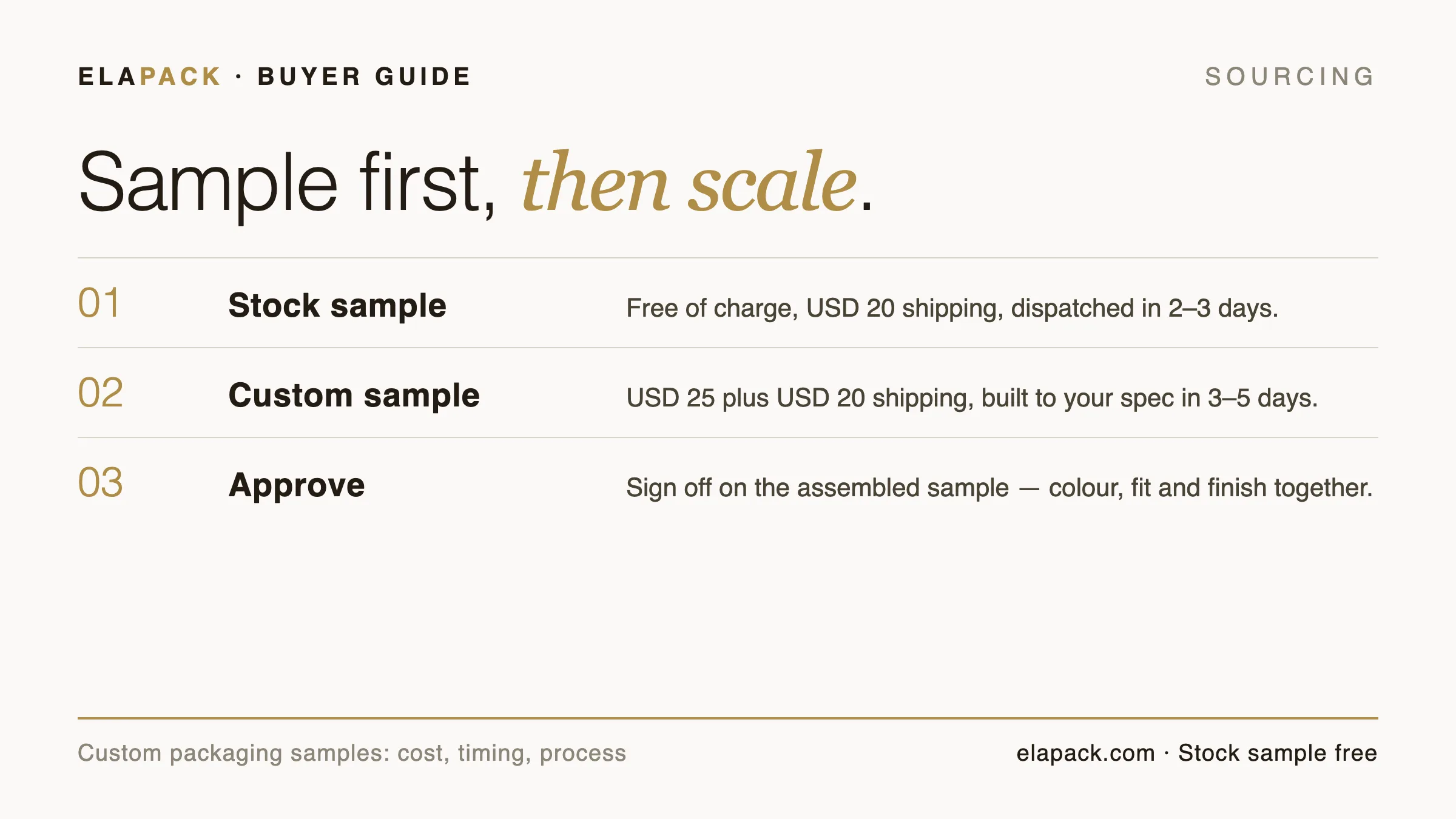
As a working reference, ELAPACK's own confirmed terms: stock samples are free with USD 20 shipping and are dispatched in 2–3 days, with courier transit of 4–7 days; custom samples are USD 25 plus USD 20 shipping and are built in 3–5 days. Across the wider industry, custom packaging samples commonly run USD 50–200 depending on structure and print, and dispatch times vary far more — which is why the fee, the shipping and the dispatch time belong in writing before the fee is paid. The question: what does this round cost in total and land on what date — counted as fee plus shipping, and build plus transit?
Check the sample against a written checklist
A sample that arrives to no checklist approves nothing. Write the checks before it ships: seams and construction, worked by hand; the closure — drawstring, magnet, drawer — actuated a dozen times; print adhesion and edge sharpness on the actual material, rubbed with a finger; colour against the Pantone reference in daylight, not under a desk lamp; and insert fit with the real product inside — a sample tested empty approves an empty box. The question: which five checks does this sample have to pass, and who signs them off?
Put the round in the production calendar
The sample round is not the pause before the timeline — it is the first item on it. In ELAPACK's confirmed terms, production runs 15–20 days after sample approval, so the honest launch count is: courier transit in, review and any revision round, 15–20 days of production, then outbound shipping — counted backwards from the launch date. A revision round planned as a maybe is a launch date that slips; planned as a line item, it is absorbed. The question: what is the real goods-in-hand date, counting one revision round?
Ask the crediting question before you pay
Many factories credit the custom sample fee against the first production order — but this is an industry pattern to ask about, not a term to assume, and policies differ everywhere. Ask the question in writing before paying the fee, and treat the answer as part of comparing suppliers: a factory's sample terms are an early, cheap signal of how it will handle production terms. The question: is the sample fee credited on the first order — and is that in the quotation, not in a chat reply?
When a sample that passes can still be wrong
A sample that passes on the desk can still fail at quantity. Three boundaries keep this page honest:
- A custom sample is often built with closer attention than a 200-piece run. Ask what changes between sample and production — tolerances, finish, print — and where the sample is more generous than the run will be.
- One sample proves one colourway and one print. Variations — a different satin colour, a second print position — may behave differently; confirm in writing which variations the sample covers.
- A sample approved from photos is not approved. Colour, hand-feel and closure action exist only in hand — schedule the review day before you need to sign off.
Prepare the sample request before you pay
Nothing on this page collects your data or sends anything. Fill the request from the run you are planning. Copy the lines below into your own note:
- The type: stock sample (material and standard) or custom sample (your dieline, material, print).
- The product: what it holds, its dimensions in cm, and the closure or structure.
- The branding: print method, placement and Pantone reference — and which colourways or variations the sample must cover.
- The terms in writing: sample fee, shipping fee, dispatch time for stock, build time for custom, and whether the fee is credited on the first order.
- The calendar: transit in, review day, one revision round, 15–20 days production, outbound shipping — counted back from launch.
Keep the note local, and send it to your supplier through your existing approved contact process. A round planned this way does what a sample is for: it finds the mistake at one piece, so the run that follows needs no excuse.