
Structure, insert and format guidance in this guide is generic industry knowledge, except where ELAPACK's own confirmed trade terms are stated as such. Confirm material and production specifics with the supplier you are evaluating.
This guide is for fragrance brand owners, boutique line builders and wholesalers who are planning custom perfume packaging — a flagship gift box, a discovery sampling program, or both — and need to brief a factory without wasting sampling rounds. It covers the five decisions that define a perfume packaging program: the bottle, the structure, the insert, the format split between box, sample card and pouch, and the branding and quantity plan. If your question is which supplier to choose, what a quote costs, or how fast a factory ships, stop here: this page does not select a supplier, price a quote, or approve a production run. Perfume packaging is built around the bottle, not bought off a template; the structure follows the glass. Work through the five decisions below and you will finish with a spec list ready to send for a quote.
Why template boxes fail fragrance
A perfume box does three jobs: it holds a glass bottle still, it survives the post and the retail counter, and it sets the tone of the scent before the cap comes off. When the box is ordered from a catalogue template instead of built from the bottle, one of those jobs fails.
- A fragrance brand orders a stock-size box because the template looked right, without sending the bottle dimensions.
- The boxes arrive and the bottle rattles in the insert, the lid presses on the cap, or the flacon sits off-centre under the window.
- Without the bottle's dimensions in the brief, the structure is guesswork and quotes are not comparable.
- A wrong box means re-cutting inserts, re-running wraps, or glass that arrives chipped and a launch that slips.
- Freight on re-sampling a fragrance program costs more than the sampling itself, because the first round set no dimensions.
- The task on this page is to map your bottle and your program to structure, insert and format, and prepare the spec list for a quote.
The fix is not a better template. It is a brief that starts from the bottle and works outward.
Five decisions that build the program
Start from the bottle — structure, insert, format, branding, quantity — before you compare quotes. Each decision ends with the question your line has to answer.
Start from the bottle
Measure the bottle, not the old box: length, width and height with the cap on, and the weight full. A travel spray, a flagship flacon and a multi-bottle gift set are three different briefs — a box that suits one will strangle or swamp another. The question: which bottles ship in this program, and how many per box?
Choose the structure
Three core structures cover fragrance. A two-piece lift-off lid — a full-height lid over a rigid base — is the gift moment for a flagship. A drawer format layers the bottle and the story card into a reveal that suits discovery sets. A magnetic flip-top gives a clean exterior and a slow, deliberate close for the retail counter. The question: what should the opening ritual feel like, and where does it happen — gifting, counter or unboxing?
Specify the insert
Glass decides the insert. EVA or molded inserts cut to the bottle profile hold the flacon firmly from the factory to the vanity; a generic cavity lets the glass shift, and glass that shifts arrives chipped. The question: how far does this box travel, and what happens if the bottle moves inside it?
Split the program: box, sample card, pouch
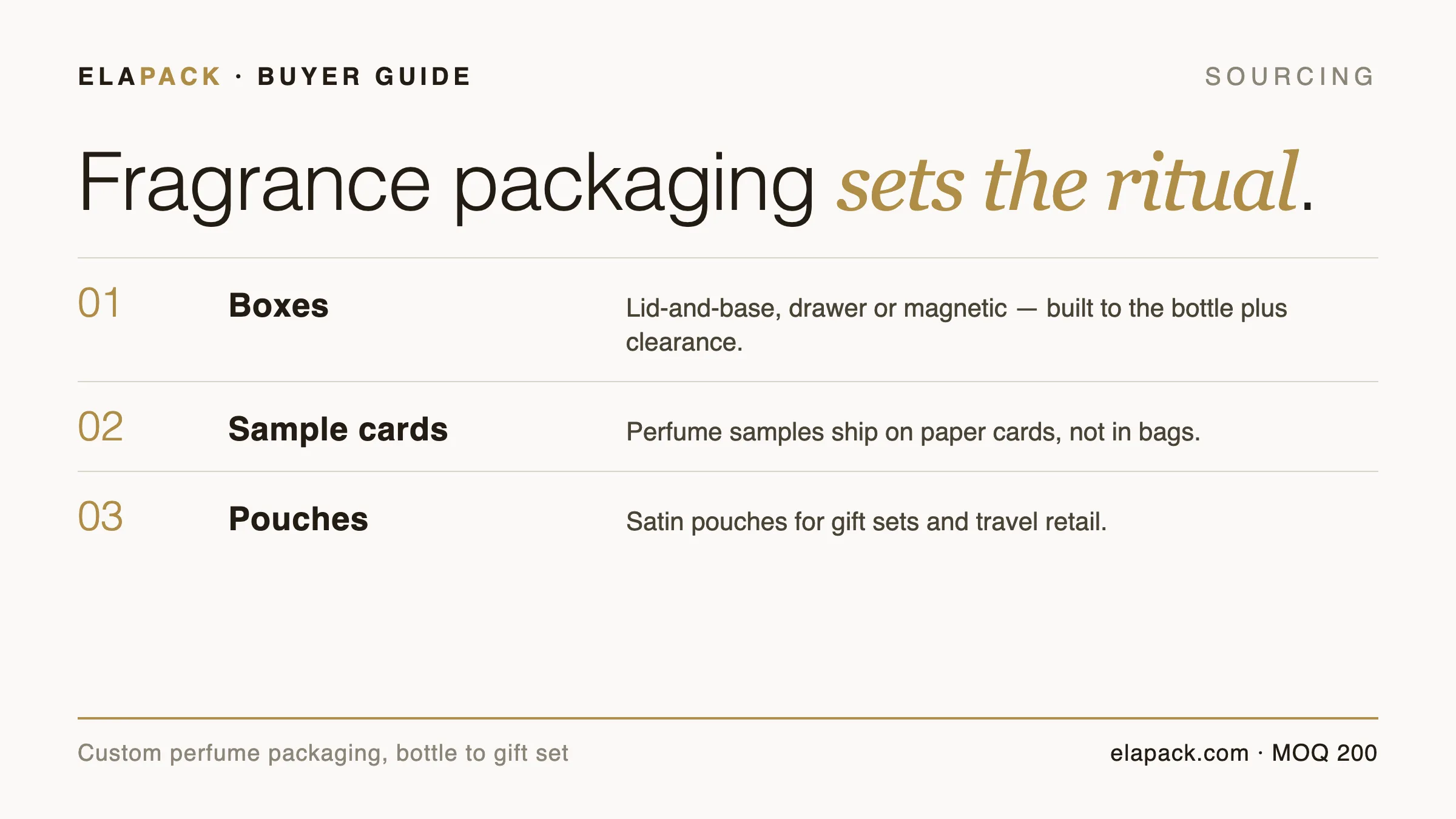
Fragrance rarely sells in one format, and the three formats do different work. The rigid box carries the purchase. The sample card carries the try-me moment: a fully printed paper card with vials or sachets mounted on it, sized to your sample count from a single vial through multi-scent discovery sets, and built mail-flat so it posts at standard letter weights — one card system for sampling campaigns, subscription inserts, boutique handouts and press mailers. A satin pouch carries the gift-wrap and refill moment around the bottle itself. Run as one matched program, the three reinforce each other; ordered separately, they drift apart in colour and finish. The question: which moments does your line actually sell — discovery, purchase or gifting — and does each have its format?
Set the branding and the quantity
The wrap carries the brand: offset print with foil stamping, embossing and spot UV, and inside-lid printing for the line the customer reads at the opening. As a working reference, ELAPACK's own confirmed terms: a 200-piece minimum across rigid perfume boxes and printed sample cards with custom sizes included, 15–20 day production, a free stock sample plus USD 20 shipping, and a USD 25 custom sample plus USD 20 shipping. Typical wholesale box programs elsewhere start at 500–1,000 pieces, so a 200-piece entry lets a fragrance line launch before it commits depth. The question: how many pieces does the launch need per format, and what should the sample round prove before you commit the run?
When a box that looks right is still wrong
A rendering cannot show glass fit, board grade or insert tolerances. Three boundaries keep this page honest:
- A rendering does not show whether the bottle actually seats. Ask for a physical sample built with your bottle dimensions applied.
- Print on a textured or curved wrap reads differently than on a flat proof. Approve finishes on the actual wrap material, not on screen.
- Mail-flat claims live inside postal size and weight bands. Confirm the packed sample card against the postal standard you will post it at, not by eye.
Prepare the perfume packaging spec list for your quote
Nothing on this page collects your data or sends anything. Fill the spec list from the bottle, the program and the quantity. Copy the lines below into your own note:
- The bottle: dimensions with the cap on (L×W×H in cm), weight full, and count per box.
- The structure: two-piece lift-off lid, drawer, or magnetic flip-top.
- The insert: EVA or molded, cut to the bottle profile.
- The format split: rigid gift boxes, printed sample cards (sample count and vial format), satin pouches — and which formats the launch actually needs.
- The branding: print program with Pantone reference, foil or emboss, spot UV, inside-lid printing.
- The quantity: launch quantity per format, and whether samples should be stock or custom.
Keep the note local, and send these specs to your supplier through your existing approved contact process. With the bottle dimensions in the brief, the quotes you collect compare like with like — and the first sample round proves the program instead of starting it over.