
Structure, fabric and sizing guidance in this guide is generic industry knowledge, except where ELAPACK's own confirmed trade terms are stated as such. Confirm material and production specifics with the supplier you are evaluating.
This guide is for wig brand owners, wig retailers and salon-line builders who are ordering custom wig packaging — a satin bag, a retail box, or a matched set — and need to brief a supplier without wasting sampling rounds. It covers the five decisions that define wig packaging: the bag that protects the fibre, the box that presents the hair, the set that pairs them, the sizing to the hair, and the branding on satin. If your question is which supplier to choose, what a quote costs, or how fast a factory ships, stop here: this page does not select a supplier, price a quote, or approve a production run. A wig has two packaging jobs — protect the fibre in transit and storage, present the hair at retail — and they are usually two products, not one. Work through the five decisions below and you will finish with a spec list ready to send for a quote.
Why one bag ordered for both jobs fails
A wig travels folded, hangs stored, and is first seen styled. One package asked to do all three jobs usually fails one of them.
- A wig brand orders a single bag for shipping, storage and display, chosen by unit price.
- The wigs arrive with fibres snagged at the closure, curl patterns crushed by tight packing, and nothing in the parcel that presents the hair to the customer.
- Without separating the protection job from the presentation job, the order is guesswork and quotes are not comparable.
- A wrong bag means tangling and snagged fibres — returns and reviews that mention condition before they mention the hair.
- The rework means re-sampling and a restock that slips for a line that sells on condition.
- The task on this page is to map the fibre, the channel and the set to bag, box and branding, and prepare the spec list for a quote.
The fix is not a better single bag. It is to buy the two jobs on purpose: a bag that protects, a box that presents.
Five decisions that build the program
Start from the fibre — bag, box, set, sizing, branding — before you compare quotes. Each decision ends with the question your line has to answer.
Choose the bag that protects the fibre
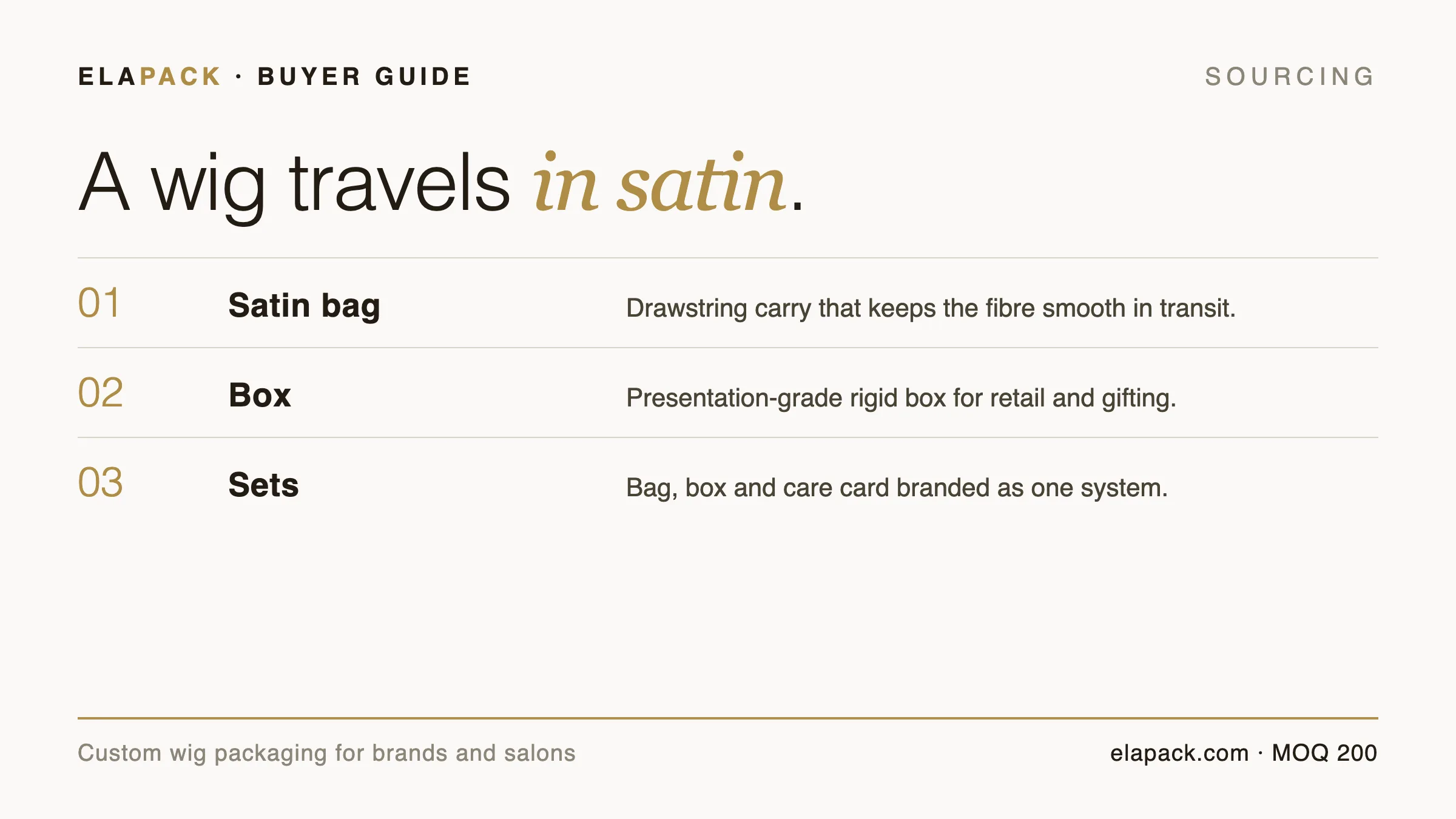
The bag is the wig's day-to-day home: the fibre meets its interior more than any other surface, in transit and between wears. Satin drawstring bags are the standard here for a reason — a smooth, low-friction interior lets the fibre glide instead of snagging, the drawstring closes without hardware that can catch, and the fabric reads premium against the hair. As a working reference, ELAPACK's own confirmed terms: a 30×40 cm satin drawstring wig bag as the standard size, a 200-piece minimum, and custom sizes at the same minimum. The question: which lengths and cap sizes does the bag carry, and does its interior protect the fibre or snag it?
Choose the box that presents the hair
Where the bag protects, the box presents — at the retail counter, in gift wrap, at the unboxing. A rigid upright box holds the wig in shape and photographs clean on a shelf; a magnetic flip-top gives a plain exterior and a slow, deliberate close; a sleeve-and-drawer format layers the wig with a care card or accessories into a reveal. The question: where does the customer first meet this wig — shelf, gift or parcel — and what should that opening feel like?
Pair them into a set
The strongest programs run both formats as one set: the satin sleeve folded inside the rigid box carries protection and presentation into a single unboxing, and the bag keeps working long after the box is discarded. Briefed as one matched set, the colours and finishes reinforce each other; ordered separately from two suppliers, they drift apart in shade and weight. The question: does your line sell protection, presentation or both — and if both, are they briefed to one supplier as one set?
Size to the hair, not to the photo
Sizing is where quiet failures start. A 30×40 cm bag suits most mid-length wigs; longer lengths and fuller volumes need more room, and a bag sized by eye from a photo is how curl patterns arrive crushed. Custom sizes sit at the same 200-piece minimum in ELAPACK's confirmed terms, so the size range does not have to be a compromise — but the finished size has to be stated in centimetres in the spec, not judged from a picture. The question: what is the longest wig in the line, folded the way it actually ships, and does every size in the range have a bag that fits it?
Brand the satin deliberately
Satin takes branding differently from paper or cotton, and the sheen changes how a mark reads. The standard methods are silkscreen print, a woven label sewn in, and heat-transfer print — in ELAPACK's confirmed terms, placeable inside or outside the bag, with the satin colour itself matched to a Pantone reference. The question: what should the customer see when the drawstring opens, and does the chosen method hold its edge on satin?
When a bag that looks right is still wrong
A photo cannot show interior friction, seam construction or how the fibre behaves against the fabric. Three boundaries keep this page honest:
- The interior does the protecting, and product photos show the outside. Ask for a sample and check the interior against your own hair fibre before the run.
- A drawstring channel that looks fine lying flat can snag where the cord gathers. Work the closure on the sample, not in the photo.
- Print on satin reads with the sheen — a logo that is crisp on cotton can shift or blur on satin. Approve the method on the actual satin, against your colour reference.
Prepare the wig packaging spec list for your quote
Nothing on this page collects your data or sends anything. Fill the spec list from the hair, the channel and the quantity. Copy the lines below into your own note:
- The hair: lengths, cap sizes and volumes in the line, and how each ships — folded, hung or boxed.
- The bag: satin drawstring, 30×40 cm standard or custom sizes, with the interior finish stated.
- The box: rigid upright, magnetic flip-top, or sleeve-and-drawer — and whether the satin bag sits inside it as a set.
- The branding: silkscreen, woven label or heat transfer, inside or outside, with a Pantone reference for the satin.
- The quantity: launch quantity per format — ELAPACK's confirmed minimum is 200 pieces, custom sizes included.
Keep the note local, and send these specs to your supplier through your existing approved contact process. With protection and presentation bought on purpose, the quotes you collect compare like with like — and the wig that arrives reads as new, not as shipped.