
Search volumes and keyword difficulty (KD) in this guide are Semrush US database figures exported on 2026-10-07. Supplier dieline practices are as published on the named companies' websites, checked October 2026. ELAPACK's own figures are its confirmed trade terms; where a practice varies across the market, this guide says so instead of quoting a single rule.
Every custom box begins as a flat drawing. Before a sheet of greyboard is cut, wrapped or printed, someone has decided where it cuts, where it folds and how the panels meet — and that decision, the dieline, is the one-time structural choice that every later artwork revision inherits. Get it right once and the box becomes a proven structure that artwork updates alone can refresh; get it wrong and every reorder repeats the correction. This guide covers what die cutting and the dieline are, what the search demand looks like, where dieline files come from and what to check before approving one.
Key facts at a glance
| Item | Figure or fact | Source |
|---|---|---|
| What a dieline is | A flat layout marking cut lines, crease lines and panels | Published industry definition (uprinting FAQ) |
| Cluster demand | 44 keywords, ~1,670 US searches/month; head terms KD 0–14 | Semrush US, 2026-10-07 |
| Free template libraries | Pacdora 3,000+ box templates; Packlane dielines on request | As published, October 2026 |
| ELAPACK custom sample | USD 25 plus USD 20 shipping, built to your dieline in 3–5 days | ELAPACK confirmed terms |
| Minimum order | 200 pieces, all product lines | ELAPACK confirmed terms |
| Production | 15–20 days at 200–20,000 pieces | ELAPACK confirmed terms |
| Rigid box board | Greyboard 800–1,600 g, typically 1,200 g | ELAPACK commonly produced ranges |
Die cutting and the dieline, in plain words
Die cutting is the process that turns a flat sheet into a box blank: a steel rule die presses through the sheet to cut the outline, and blunt rules crease the fold lines without cutting through. The dieline is the technical drawing that die is made from — as one printer's FAQ defines it, a file showing the flat layout of the box, marking where the design's elements sit on each panel. Cut lines and crease lines are different things and do different jobs: a cut separates material, a crease prepares a fold. Reading a dieline means knowing which is which, because artwork that crosses a cut line gets trimmed and artwork that sits on a crease cracks at the fold.
What the search data shows

The die-cutting cluster in the exported keyword pool runs to 44 keywords and roughly 1,670 US searches a month, with the head terms between 40 and 50 searches and keyword difficulty between 0 and 14. The demand splits cleanly in two: definitional searches — die cut examples, box die cuts, define die cutting — and application searches such as die cut carton box, die cut packaging boxes and die cut tray.
The cluster is low-volume but uniformly low-difficulty, and it splits between “what is this” and “how do I use it on my box” — exactly the two jobs a definitional guide that ends in a sourcing step performs.
Where dieline files come from
| Route | How it works | As published by |
|---|---|---|
| Request from the supplier | State the size you need; the dieline is emailed for design work | Packlane (free, within 24 hours) |
| Self-serve generator | Pick a box style, set dimensions, download a print-ready file | Pacdora (3,000+ templates; PDF, DXF, AI) |
| Factory-drawn to your product | The factory draws the dieline to the confirmed product dimensions | ELAPACK practice |
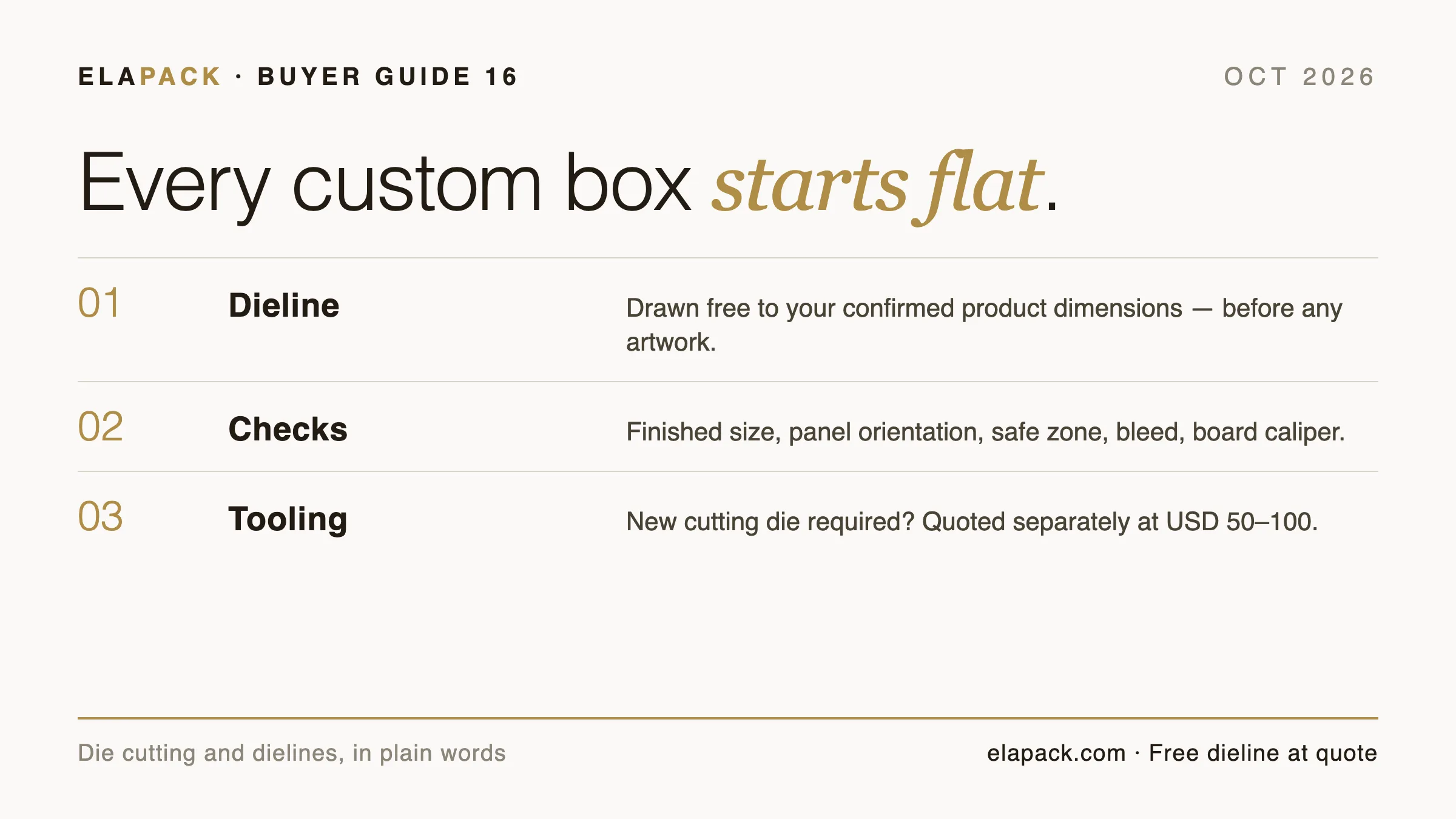
Which stage the file is released at — quotation, sampling or order — varies across the market: some suppliers bundle a custom dieline with a quote request, others issue templates freely and reserve custom drawings for production. ELAPACK's terms are confirmed: the dieline is drawn to your confirmed product dimensions free of charge at the quotation stage; the custom sample — USD 25 plus USD 20 shipping, built in 3–5 days — is made to that dieline; files are supplied as PDF, AI or DXF; customer-supplied vector dielines are accepted and verified with the die-making team before production; and cutting-die tooling, where a new die is required, is quoted at USD 50–100 depending on the product.
Secure the dieline before the artwork. Designing first and asking the box to fit later is the expensive order of operations, and artwork placed against a changing structure has to be redone.
What to check before approving a dieline
| Check | What you are verifying |
|---|---|
| Finished size | Internal dimensions against the product's outer size, with the board caliper accounted for |
| Panel orientation | Artwork sits upright on every panel once the box is folded |
| Safe zone | Design elements clear of crease and cut lines |
| Bleed | Print runs past the trim wherever colour reaches an edge |
| Board allowance | Dimensions carry the greyboard caliper (commonly produced 800–1,600 g) |
| Revision rounds | How many dieline revisions are included, stated in writing |
Work the checklist on the flat drawing and again on the made sample — a dieline can be correct as a drawing and still need a revision once the wrapped board and the real product meet. Each revision round is a question to settle before the production tooling is cut, not after.
Die-cut choices that shape the box
The dieline is also where the decorative structure is decided: a window cut in the lid, a shaped outer silhouette, or an internal tray cut to the product's footprint. These are ordinary die-cutting decisions, but they are one-time ones — a window moves with the tooling, not with the artwork, so the format should be confirmed at the sample stage alongside the size.
The bottom line
Approach the dieline in five lines: the product's outer dimensions; the box structure; the route the dieline will come by; the checklist above signed off on the drawing and the sample; and the order quantity against the 200-piece floor. Start from custom gift boxes or the magnetic closure gift box as structure references, and contact ELAPACK with the product dimensions to have the dieline drawn and the terms stated in writing.