
Fabric, print and sizing guidance in this guide is generic industry knowledge. Confirm material and production specifics with the supplier you are evaluating.
This guide is for packaging buyers and brand owners at jewelry labels who want custom pouches — for rings, necklaces, earrings, bracelets or small gift pieces — and need to choose them before they request samples or quotes. If your question is which supplier to choose, what a quote costs, or how fast a factory ships, stop here: this page does not select a supplier, price a quote, or approve a production run. A pouch chosen by look alone is a guess; the fabric, size, closure and branding have to fit the piece and the print. Work through the four decisions below and you will finish with a pouch shortlist and the spec list to send for a quote.
Why pouches picked by look alone go wrong
A custom pouch has four jobs: it has to hold the piece safely, survive the presentation, carry your branding well, and feel right in the hand. Each job maps to a decision — fabric, size, closure, branding — and when a pouch is picked by photo alone, one of those jobs usually fails.
- A packaging buyer or brand owner at a jewelry brand adds branded pouches to their line.
- They order pouches chosen by look, then find the fabric pills, the size does not fit the piece, or the logo prints poorly.
- Without mapping the piece and the brand bar to the pouch specs, the choice is guesswork and quotes are not comparable.
- A wrong pouch means re-sampling, re-ordering, or an unboxing that misses the brand bar.
- The rework can delay a launch or leave stock that does not match the brand.
- The task on this page is to map the piece and brand to fabric, size, closure and branding, and prepare the specs for a quote.
The fix is not to look harder at photos. It is to decide the four specs on purpose, so the quote you request is for the pouch you actually need.
Four decisions that choose your pouch
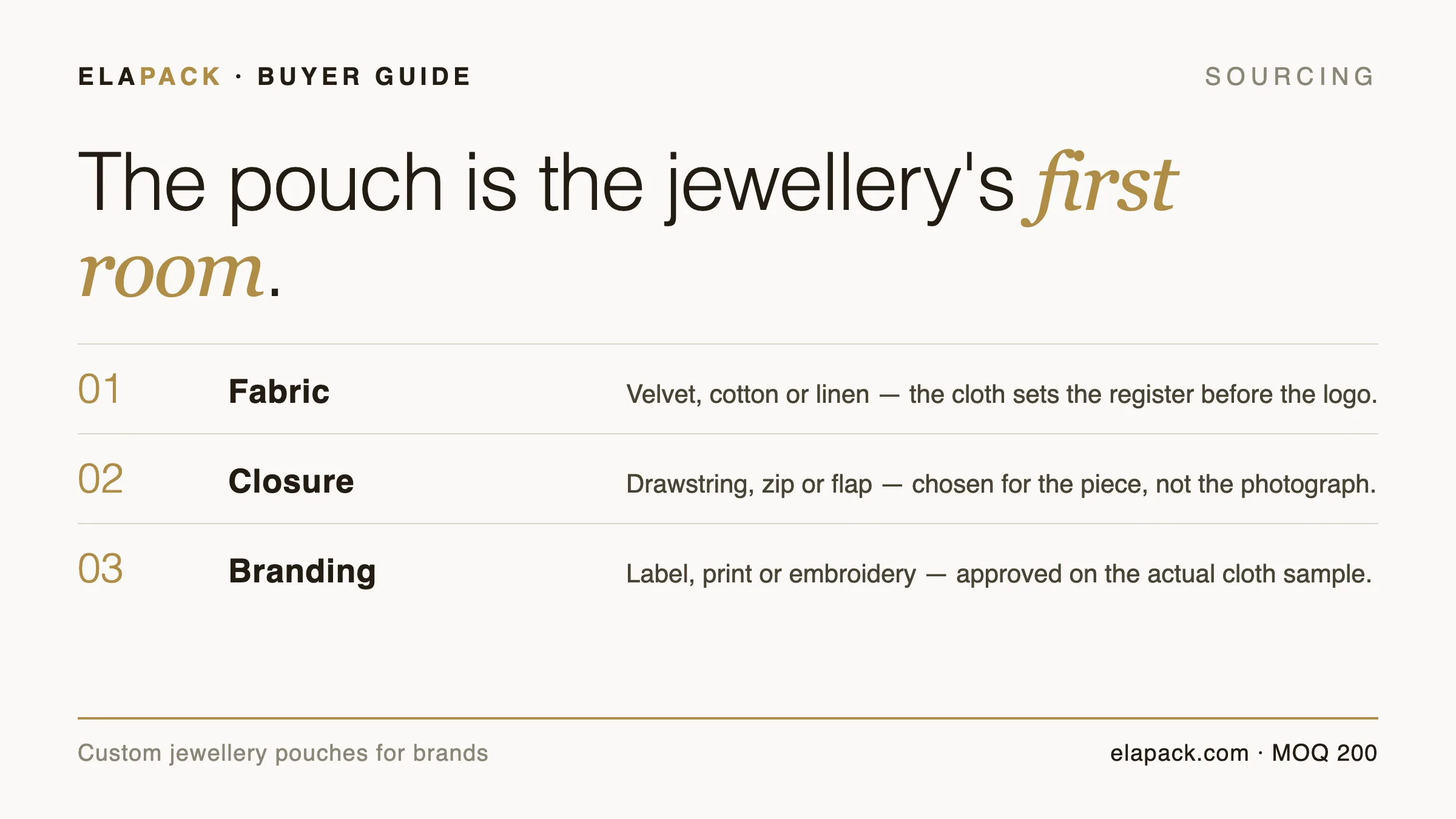
Map the piece and the brand bar to the fabric, size, closure and branding before you compare quotes. Each decision below ends with the question your piece has to answer.
Fabric
The first decision is the material. The main families are: velvet and suede, which read plush and premium and suit rings and pendants presented as gifts; cotton, muslin and linen, which read natural and understated and take print crisply; satin, which reads smooth and dressy against fine jewellery; and non-woven or microfiber, which read practical and economical for volume or retail use. The question from your side is which hand-feel and durability your brand needs, and how the fabric takes your print — a delicate logo needs a smooth, tight-weave surface, while a deep emboss or foil needs a fabric that holds the treatment. A supplier that works across this full range — velvet, suede, cotton, muslin, satin, linen, microfiber and non-woven, plus custom developments — lets you match the material to the piece instead of forcing the piece into one house fabric.
Size
The second decision is the fit. A pouch that is too small distorts the piece and the closure; one that is too large lets the piece rattle and looks sloppy at unboxing. Measure the piece and choose a pouch size with a little room — and remember the size also affects cost and the minimum order, so settle the size range before you ask for pricing. As a working reference, jewellery pouches commonly land in three bands: 7×9 and 8×10 cm for rings, stud earrings and slim pendants; 10×12 cm for larger pendants, bracelets and small gift pieces; and 12×15 cm upward when a piece ships with a box, a card or extra presentation. Sizes outside those bands are usually custom, so confirm the finished size in centimetres in the spec, not by eye from a product photo.
Closure
The third decision is how the pouch closes. A drawstring is classic and easy to open; a zipper is more secure and suits repeat use; a flap, tuck or button closure is minimal and clean for presentation. The question is what the piece needs and what you want the unboxing to feel like — a heavy piece that will be carried needs a secure closure, while a presentation piece may favour a clean drawstring. Most suppliers offer several closure options and can combine a closure with a specific fabric, so list the closure you want rather than leaving it to the supplier's default.
Branding
The fourth decision is how the brand appears. Options include a woven label sewn in, a printed logo, a deboss or foil stamp, embroidery, or a transfer print — and each suits different fabrics and order sizes. A woven label reads premium and durable; a printed logo is flexible for colour and placement; foil and deboss add a tactile, gift-like finish; embroidery reads heritage and bespoke. The question is what your brand bar requires — a logo that must be exact and consistent needs a method the fabric can hold across the run — so confirm the print method and the colour match (for example a Pantone reference) on the actual material before you commit.
Read the four together. A pouch can pass on fabric and size and still fail on closure or branding, so decide all four before you compare quotes.
When a pouch that looks right is still wrong
A fabric or print that looks right in a photo can still pill, shrink or print poorly in production. Three boundaries keep this page honest:
- A photo does not show hand-feel, weight or how the fabric behaves over time. Ask for a physical swatch or sample of the actual fabric before you commit to a large run.
- Print and branding behave differently on different fabrics. A logo that is crisp on a smooth cotton can blur on a textured velvet, so confirm the method on the actual material.
- Size in the product photo is hard to judge. Confirm the finished size in the spec, not by eye from a picture, and check it against your piece.
Prepare the pouch spec list for your quote
Nothing on this page collects your data or sends anything. Fill the pouch spec list for your quote request from the piece, the branding and the quantity. Copy the lines below into your own note:
- The piece: what it is, its size and weight, and how it will be presented or shipped.
- The fabric: velvet, suede, cotton, muslin, satin, linen, microfiber, non-woven or another material, with any colour reference.
- The size: the finished pouch size in centimetres that fits the piece with a little room — from 7×9 / 8×10 / 10×12 cm for most jewellery up to custom sizes.
- The closure: drawstring, zipper, flap, tuck, button or another option.
- The branding: the logo treatment (woven, printed, deboss, foil, embroidery or transfer), the colour match (for example a Pantone reference), and the placement.
Keep the note local, and send these specs to your supplier through your existing approved contact process — do not send it anywhere this page has not verified. With the list filled, you have finished the choosing task this page owns. Your next step is the comparison task — putting two pouches that both pass your four specs side by side on the same dimensions — which is a separate page for a separate decision.