
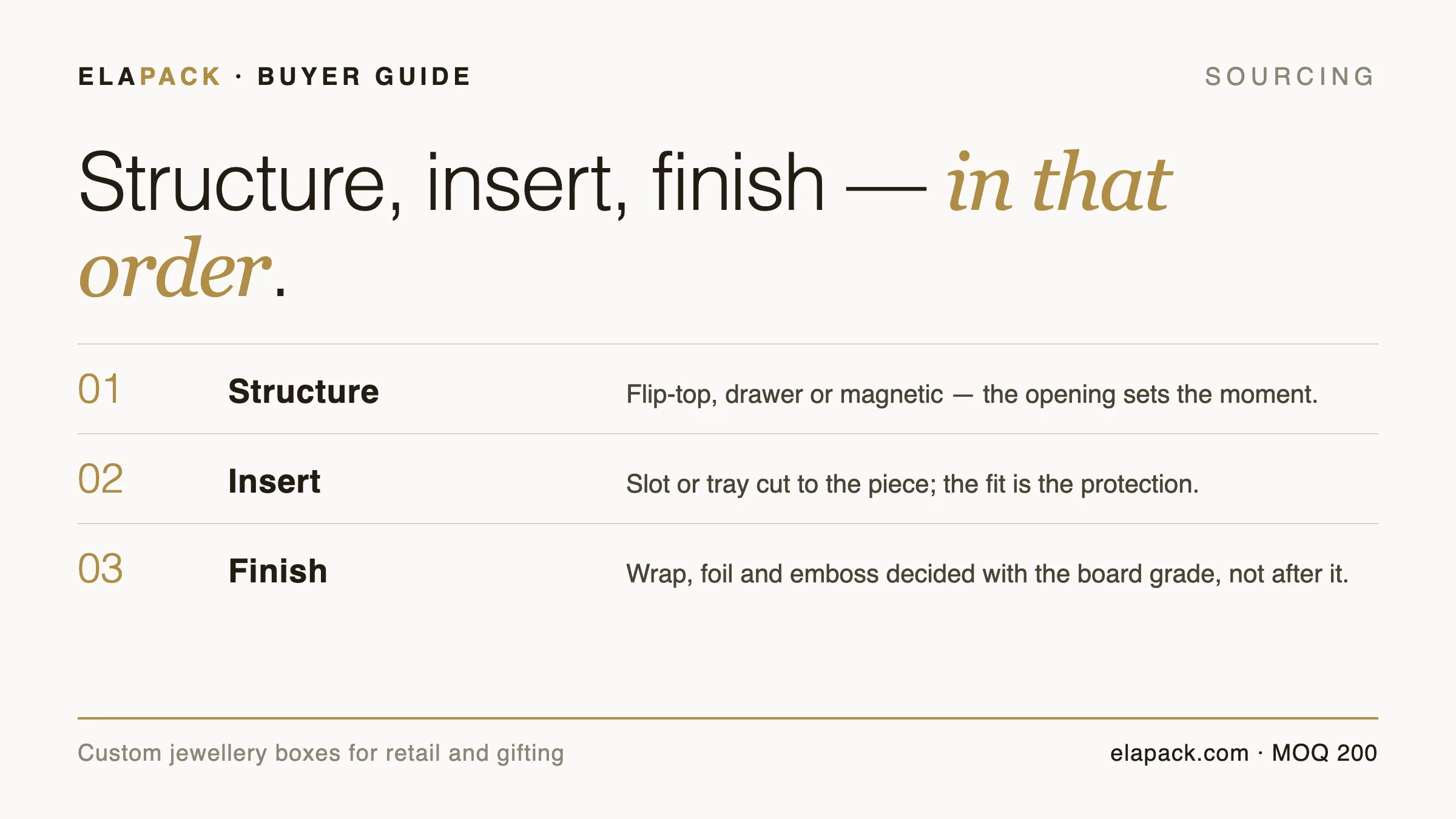
Structure, insert and finish guidance in this guide is generic industry knowledge, except where ELAPACK's own confirmed trade terms are stated as such. Confirm material and production specifics with the supplier you are evaluating.
This guide is for jewelry brand owners and packaging buyers at jewelry labels who are ordering custom jewelry boxes — ring, earring, pendant, bracelet or complete set programs — and need to brief a factory without burning sampling rounds. It covers the five decisions that define a custom jewelry box: the piece and its insert, the structure, the size, the wrap and finish, and the quantity and sampling plan. If your question is which supplier to choose, what a quote costs, or how fast a factory ships, stop here: this page does not select a supplier, price a quote, or approve a production run. A jewelry box chosen from a photo is a guess; the structure, insert and finish have to fit the piece and the brand before quotes mean anything. Work through the five decisions below and you will finish with a box spec list ready to send for samples and quotes.
Why boxes chosen from a photo disappoint
A custom jewelry box does three jobs at once: it holds the piece still in transit, it presents the piece at the counter or in the unboxing, and it carries the brand mark without apology. When the box is copied from a reference photo instead of built from the piece, one of those jobs usually fails.
- A brand owner or packaging buyer orders boxes customized to match a photo from another label or a marketplace listing.
- The boxes arrive and the ring slot swallows the ring, the pendant shifts inside the insert, or the foil logo sits off-centre on the textured wrap.
- Without mapping the piece and the brand bar to structure, insert and finish, the order is guesswork and quotes are not comparable.
- A wrong box means re-cutting inserts, re-wrapping lids, or retail stock that cannot go on the counter.
- The rework can delay a launch or leave stock that does not match the brand, which raises the cost of a wrong brief.
- The task on this page is to map your pieces and brand to the five decisions, and prepare the spec list for a quote.
The fix is not a better reference photo. It is a brief that starts from the piece and works outward.
Five decisions that choose your box
Start from the piece — insert, structure, size, finish, quantity — before you compare quotes. Each decision ends with the question your line has to answer.
Start from the piece and its insert
The piece decides the box, not the other way round. A ring needs single or double slots on a velvet or foam cushion; earrings and pendants need fitted inserts that hold pairs and chains without tangling; bracelets and small gifts run in compact footprints; a complete program pairs the box with a pouch and insert designed together. The insert families to know: EVA, contoured for a precise fit on each piece; sponge, soft cushioning under a velvet or satin covering; molded pulp, the economical structure with a natural look; flocked and velvet, the velvet-touch finish for premium lines. The question your line has to answer: what does each piece weigh, how does it move in transit, and which insert tier matches the price point of the line?
Choose the structure
The structure follows the selling moment. A rigid lift-off lid — full-height lid over a rigid base — is the premium, gift-ready structure for presentation pieces. A magnetic flip-top hides the closure in the base and gives a clean exterior with a slow, deliberate close. A ribbon tie makes the satin closure part of the unboxing ritual. A faux leather wrap gives a textured surface that takes embossed branding for jewelry and gift programs. The question: where does the box meet the customer — counter, unboxing, or both — and what should that moment feel like?
Set the size from the piece seated
Size is not a style choice; it is a fit measurement. Seat the piece in its insert, measure the length, width and seated height, and specify the internal dimensions of the box with clearance for the lid to close without pressing the piece. A box that is tight distorts the insert; one that is loose lets the piece shift. Custom sizes are a normal part of a box program, not an exception — confirm the finished internal dimensions in centimetres in the spec, not by eye from a photo.
Decide the wrap, finish and branding
The wrap colour and the finish carry the brand. A Pantone-matched wrap holds the colour system of the line across runs, with interior lid printing for the note the customer reads first. Foil stamping puts gold or metallic logos on lid and base; embossing and debossing give blind relief marks that read premium without colour; spot UV over matte or gloss lamination adds controlled contrast. The question your brand has to answer: which marks must stay exact across the run — and on which surface? A foil that is crisp on smooth wrap can soften on textured faux leather, so confirm the finish on the actual wrap material before the run.
Plan quantity and samples before you compare quotes
Quantity decides which factories can take the order at all. As a working reference, ELAPACK's own confirmed terms for custom jewelry boxes: a 200-piece minimum with custom sizes included, 15–20 day production, a free stock sample plus USD 20 shipping, and a USD 25 custom sample plus USD 20 shipping. Typical wholesale box programs elsewhere start at 500–1,000 pieces, so a 200-piece entry changes which lines can launch at all. The question: how many pieces does the launch actually need, and what will you learn from a sample before committing the run?
When a box that looks right is still wrong
A photo cannot show board grade, wrap hand-feel, insert tolerances or print registration. Three boundaries keep this page honest:
- A photo does not show the greyboard grade or the wrap weight. Ask for a physical sample of the actual box before a large run.
- Print and finishes behave differently on different wraps. Confirm foil, emboss and spot UV on the actual material, not on a proofing sheet.
- Insert fit lives inside tolerances the photo flattens. Seat the actual piece in the sample insert before the run.
Prepare the jewelry box spec list for your quote
Nothing on this page collects your data or sends anything. Fill the spec list from the piece, the brand and the quantity. Copy the lines below into your own note:
- The piece: what it is, its seated size and weight, and how it will be sold — counter, unboxing, shipping.
- The structure: rigid lift-off lid, magnetic flip-top, ribbon tie or faux leather wrap.
- The size: finished internal dimensions in centimetres, with lid clearance for the seated piece.
- The insert: EVA, sponge, molded pulp, or flocked and velvet — with the slot or well layout each piece needs.
- The wrap and finish: wrap colour with Pantone reference, and the branding set — foil, emboss or deboss, spot UV and lamination, interior lid printing.
- The quantity: launch quantity, and whether the sample should be stock or custom.
Keep the note local, and send these specs to your supplier through your existing approved contact process. With the list filled, the quotes you collect compare like with like, and the next decision — putting two samples side by side on the same dimensions — is a real choice instead of a guess.