
# How to Package Jewelry for Shipping: The Three-Layer Method Brands Use
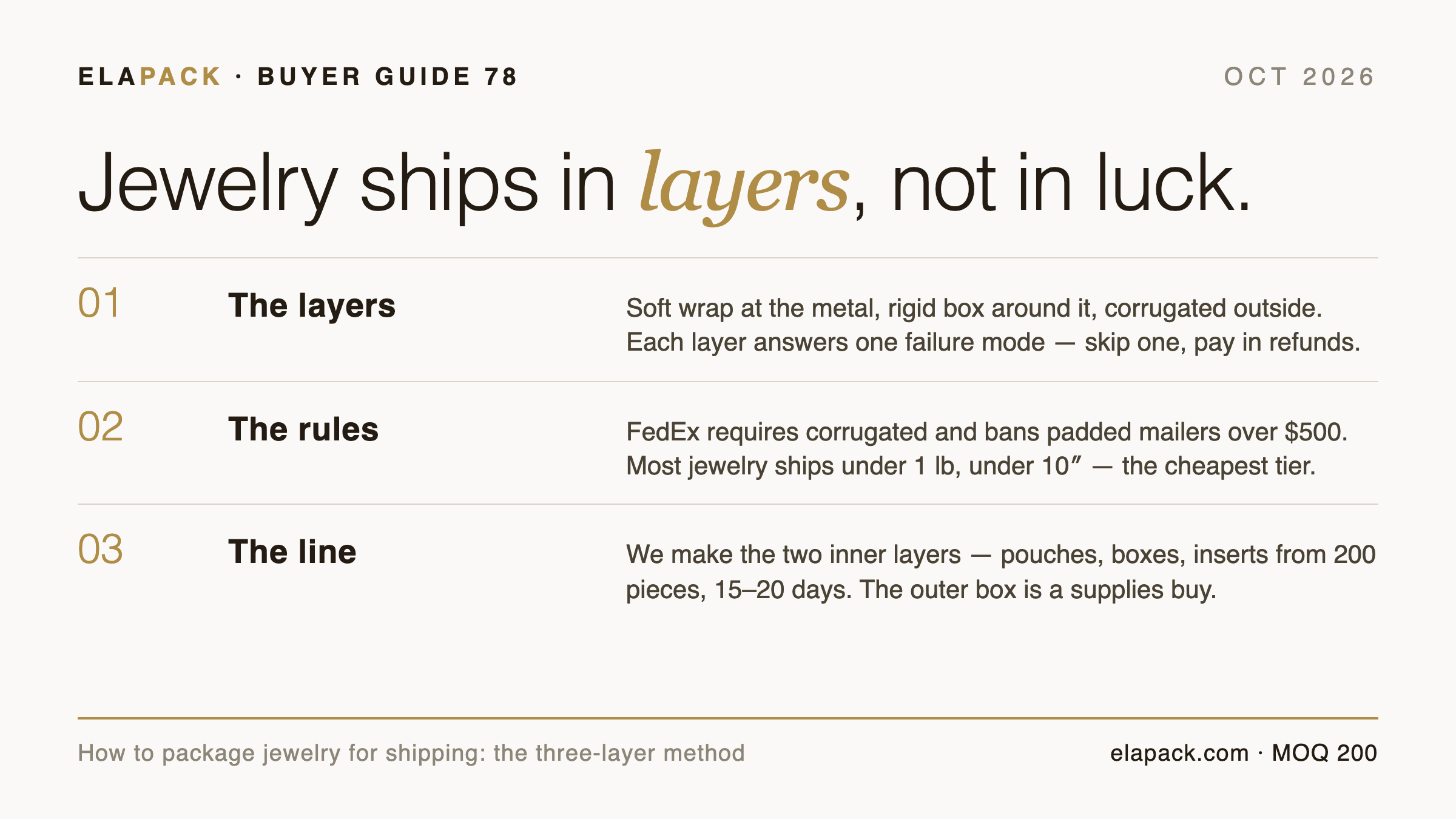
Jewelry survives shipping in layers, not in luck: something soft against the metal, something rigid around that, something corrugated around everything. This guide walks the three layers in the order a packing table actually uses them — and marks where our own product line fits, and where the honest answer is a shipping-supply purchase we do not sell.
Key takeaways
Package jewelry in three layers: a soft inner wrap, a rigid fitted box, a corrugated outer box — each layer answers a different failure mode.
- Carriers treat jewelry as a special class: FedEx requires corrugated packaging and bans padded mailers for declared values over $500.
- Molded foam and fitted inserts protect jewelry better than loose fill; a rattling inner box is a broken item in transit.
- Most jewelry ships under 1 lb and under 10 inches per side — the cheapest rate tier at every major carrier.
- Our factory makes the two inner layers — pouches, fitted boxes and inserts — from 200 pieces; the outer shipping box is a carrier-supplies purchase.
Last updated October 2026.
The three layers that protect jewelry in transit
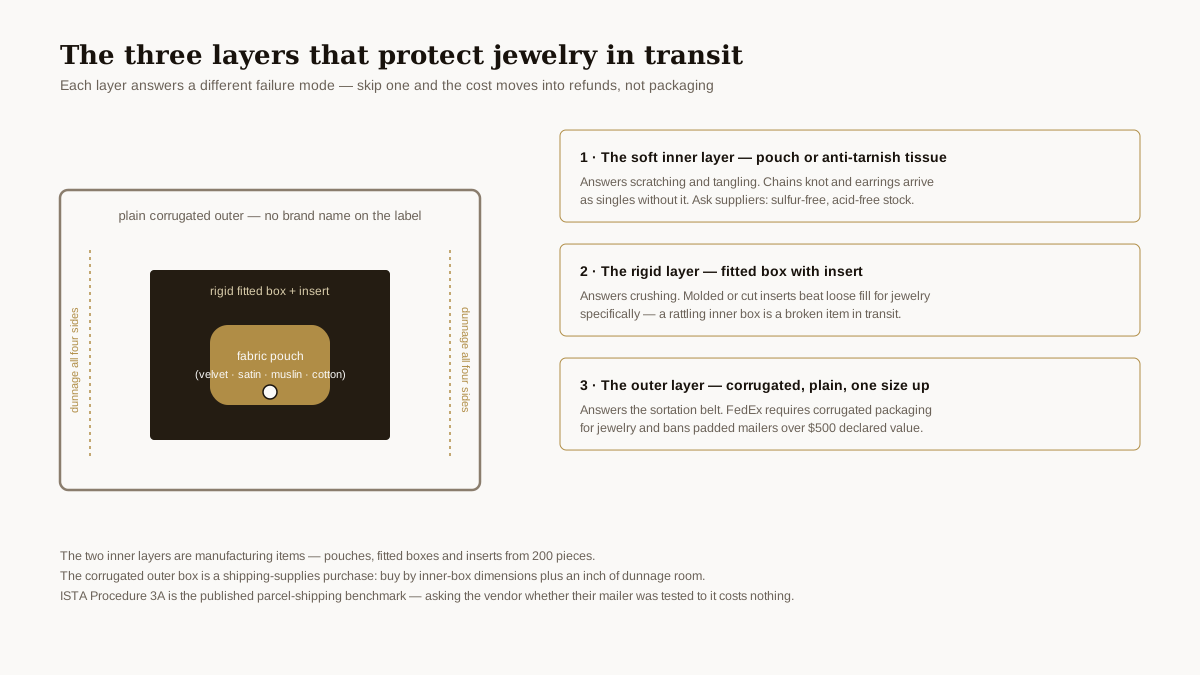
Shipping guides for jewelers converge on the same architecture, and it is worth treating as a specification rather than a suggestion. Shippo’s e-commerce guide states the sequence plainly: “wrap chains and delicate items in anti-tarnish tissue or soft jewelry pouches”, then secure each piece in “a small jewelry box, molded foam insert, or ring/earring holder”, then pack that inner box inside corrugated outer packaging with dunnage on all four sides so nothing shifts. Paper Mart’s version adds a practical first step for small pieces: a small plastic bag “helps keep items such as earrings together during shipment” before the decorative pouch or box goes on.
Each layer answers one failure mode. The inner wrap prevents scratching and tangling — chains knot around each other in transit, and earrings arrive as singles without something holding the pair. The rigid box prevents crushing: “items rattling loose inside a shipping box are items waiting to arrive broken”, in Shippo’s words. The outer box prevents the blunt trauma of the sortation belt. Skip a layer and you have not saved packaging; you have moved the cost into refunds.
What should jewelry be wrapped in before it goes in the box?
The layer touching the metal is a pouch or a tissue wrap. This is where material choice actually matters for the jewelry itself: silver and plated pieces tarnish in transit — weeks in a sealed box with the wrong air can dull a chain — which is why published guides recommend anti-tarnish tissue or soft pouches directly against the piece. The specification behind that advice is chemical, and it is worth asking suppliers for by name: ordinary tissue carries sulfur compounds and residual acids, and — as packaging suppliers state it plainly — “sulfur compounds tarnish metals — a sulfur-free sheet is anti-tarnish, which matters for jewellery and silverware”. Specialist anti-tarnish tissue is sold as “virtually sulfur-free (less than 0.0008%)” and moisture-controlled; the acid-free grades are pH-neutral and lignin-free, because “acids migrate — they transfer from an acidic wrapper into the item it touches, so the packaging itself becomes the source of damage”. The buyer’s move when a supplier quotes pouches or boxes for silver: ask whether the tissue and the board are sulfur-free and acid-free, and treat the answer as a line in the specification. Anti-tarnish treatment is a specialist supply; what we manufacture is the pouch layer around it, in velvet, satin, muslin and cotton, sized to the piece.
A practical order for a packing table: pair the jewelry (bag or tissue first for small pieces), pouch it, then box it. The pouch is also the customer-facing layer — the thing the recipient touches first — so brands tend to specify it in their fabric and color while the tissue does the protection. Our pouches run from 200 pieces with the same spec-confirmation step as every other product: dimensions and closure confirmed on the quotation before production.
Which box should hold the jewelry?
The middle layer is a rigid box fitted to the piece, and “fitted” is the operative word. A ring box is specified around the ring itself — for our ring boxes we ask for the band width, the setting height and the number of rings per box, then confirm dimensions, slot layout, materials and closure on the quotation. The same logic scales to pendants (chain channel or loop to stop the chain migrating) and earrings (slot pairs, card or foam). A generic gift box with a loose cotton pad is the cheap version of this layer; a slot-lined box is what photographs well and arrives intact.
Inside the box, molded or cut inserts beat loose fill for jewelry specifically — Shippo’s guide is blunt that foam inserts and molded infill “protect better than loose fill (packing peanuts, air pillows) for jewelry specifically”. This is also the layer where presentation and protection converge: a velvet or satin lined insert holds the piece still for the courier’s whole journey and frames it for the unboxing photograph at the end.
Can you ship jewelry in a padded envelope?
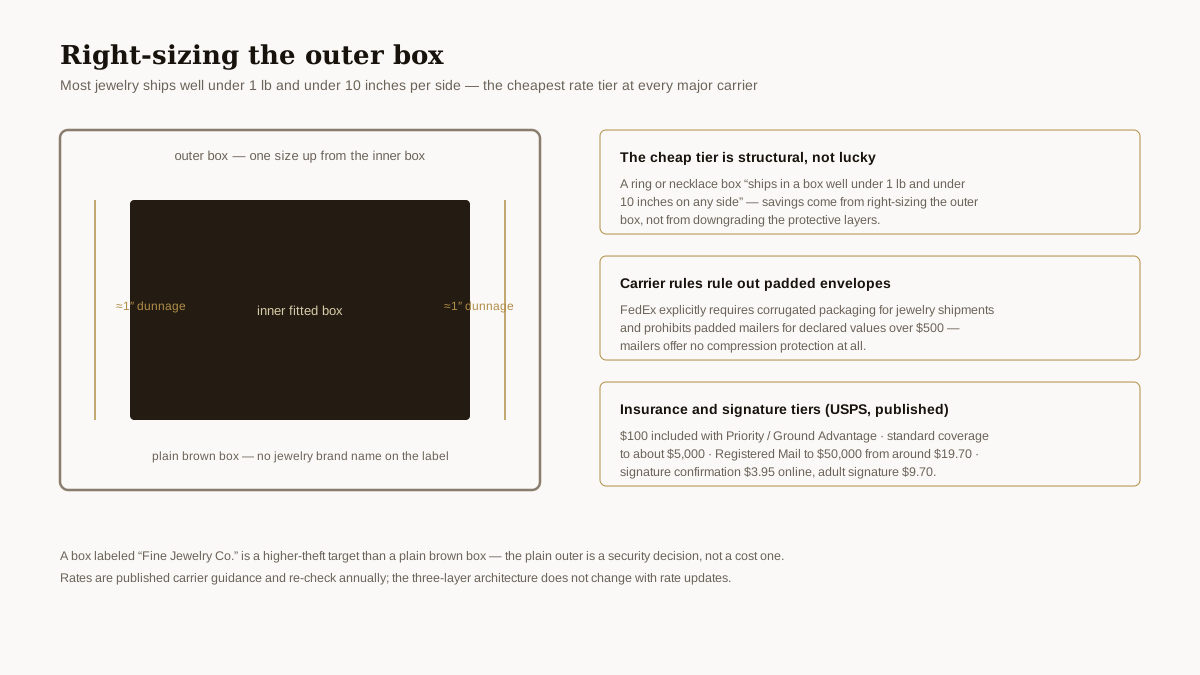
No — and the reason is carrier rules, not preference. Shippo’s carrier guidance records that FedEx “explicitly requires corrugated packaging for jewelry shipments” and “prohibits padded mailers for jewelry with a declared value over $500”; mailers and Tyvek offer no compression protection, which is the exact failure mode jewelry needs defense against. The outer box is corrugated, plain, and one size up from the inner box with dunnage on all four sides.
One honesty note from our side of the table: corrugated shipping boxes are a shipping-supplies purchase, not part of our custom line — our products are the pouch, the fitted box and the insert inside it. Buy the outer box by inner-box dimensions plus an inch of dunnage room, and if the shipment is valuable, keep the outer plain: a box labeled with a jewelry brand name is, as Shippo puts it, “a higher-theft target than a plain brown box”. For brands that want the outer-box choice validated rather than guessed, ISTA Procedure 3A is the published benchmark — “a general simulation test for individual packaged products shipped through a parcel delivery system”, up to 150 lb, covering the “vibration, shock and stresses encountered during handling”. Asking the shipping-supply vendor whether their mailer has been tested to it is a one-line qualification question that costs nothing to ask.
Insurance, signatures and the cheap tier
The shipping decisions around the package matter as much as the packaging. A ring or necklace “ships in a box well under 1 lb and under 10 inches on any side” — the cheapest dimensional tier at every carrier, which is why jewelry shipping costs surprise new sellers on the low side, not the high side. On insurance: USPS Priority Mail and Ground Advantage include $100 of coverage in the base price, standard coverage extends to about $5,000, and Registered Mail — sealed, locked and stored separately through the network — covers up to $50,000 from around $19.70. Signature confirmation runs $3.95 added online (against $4.95 at the counter), with adult signature at $9.70 for high-value orders.
For handmade sellers packaging their own orders, the same three layers scale down without changing shape: tissue or small bag, fitted box (a two-piece cotton-filled chipboard box is the entry version of the rigid layer), padded dunnage inside a plain corrugated outer. The mistake specific to handmade volume is skipping the rigid layer on bracelet and chain orders because the pouch “feels protected” — a padded envelope around a pouch is still a pouch taking the full weight of the sortation belt.
Sources
- Shippo — How to Ship Jewelry: Packaging, Insurance & Carrier Tips — https://goshippo.com/blog/how-to-ship-jewelry-for-your-e-commerce-store-tips-examples-for-shipping-jewelry
- Paper Mart — How to Package and Ship Jewelry — https://blog.papermart.com/small-business/how-to-package-and-ship-jewelry
- Jewelers Toy Store — Anti-Tarnish Paper Roll — https://www.jewelerstoystore.com/Anti-Tarnish-Paper-Roll-p/p10.htm
- Custom Printed Papers — Acid-Free Tissue Paper: Why It Matters for Packaging — https://customprintedpapers.com/acid-free-tissue-paper-why-it-matters-for-packaging
- ProPack Test Lab — ISTA Series 3A Test Information — https://propacktestlab.com/package-testing-forms-and-resources/ista-series-3a-test-request-form/ista-series-3-test-information
Frequently asked questions
How should I package jewelry for shipping?
Three layers: a soft inner wrap (anti-tarnish tissue or a fabric pouch) against the piece, a rigid box fitted to the item with an insert holding it still, and a plain corrugated outer box with dunnage on all four sides. Each layer answers a different failure mode — scratching, crushing, and transit shock respectively.
How do you package handmade jewelry for an order?
The same three layers, scaled down: pair the piece (small plastic bag or tissue keeps earring pairs together), pouch it in the brand fabric, box it in a fitted small box, and cushion it inside a plain outer box. For handmade volume, the rigid middle layer is the one sellers skip most and regret most.
What should jewelry be wrapped in to prevent tarnish?
Published shipping guides recommend anti-tarnish tissue or a soft pouch directly against the metal, particularly for silver and plated chains. Anti-tarnish treatment is a specialist supply; we manufacture the pouch layer in velvet, satin, muslin and cotton from 200 pieces.
Can I ship jewelry in a padded envelope?
Not safely, and not for meaningful values: FedEx requires corrugated packaging for jewelry shipments and prohibits padded mailers for declared values over $500, and mailers provide no compression protection in any case. Padded envelopes suit the non-jewelry items in the order, not the jewelry itself.
Does USPS insure jewelry shipments?
Yes, with tiers: Priority Mail and Ground Advantage include $100 of coverage in the base price, standard declared-value coverage extends to about $5,000, and Registered Mail covers up to $50,000 — at a premium starting around $19.70, with the package sealed and stored separately through the network.
What is the cheapest way to ship a ring?
A ring box plus small corrugated outer ships well under 1 lb and under 10 inches per side — the cheapest tier at every major carrier. The savings come from right-sizing the outer box to the inner one, not from downgrading the protective layers.
---
ELAPACK manufactures the two inner layers of jewelry shipping — fitted boxes, inserts and fabric pouches from 200 pieces, 15–20 days, custom samples in 3–5 days. [Send your piece dimensions for a quotation](https://elapack.com/contact/).