
Example figures and product scenarios in this guide are illustrative, not a promise about any supplier's capability. Confirm every specification against the current sheet from the supplier you are evaluating.
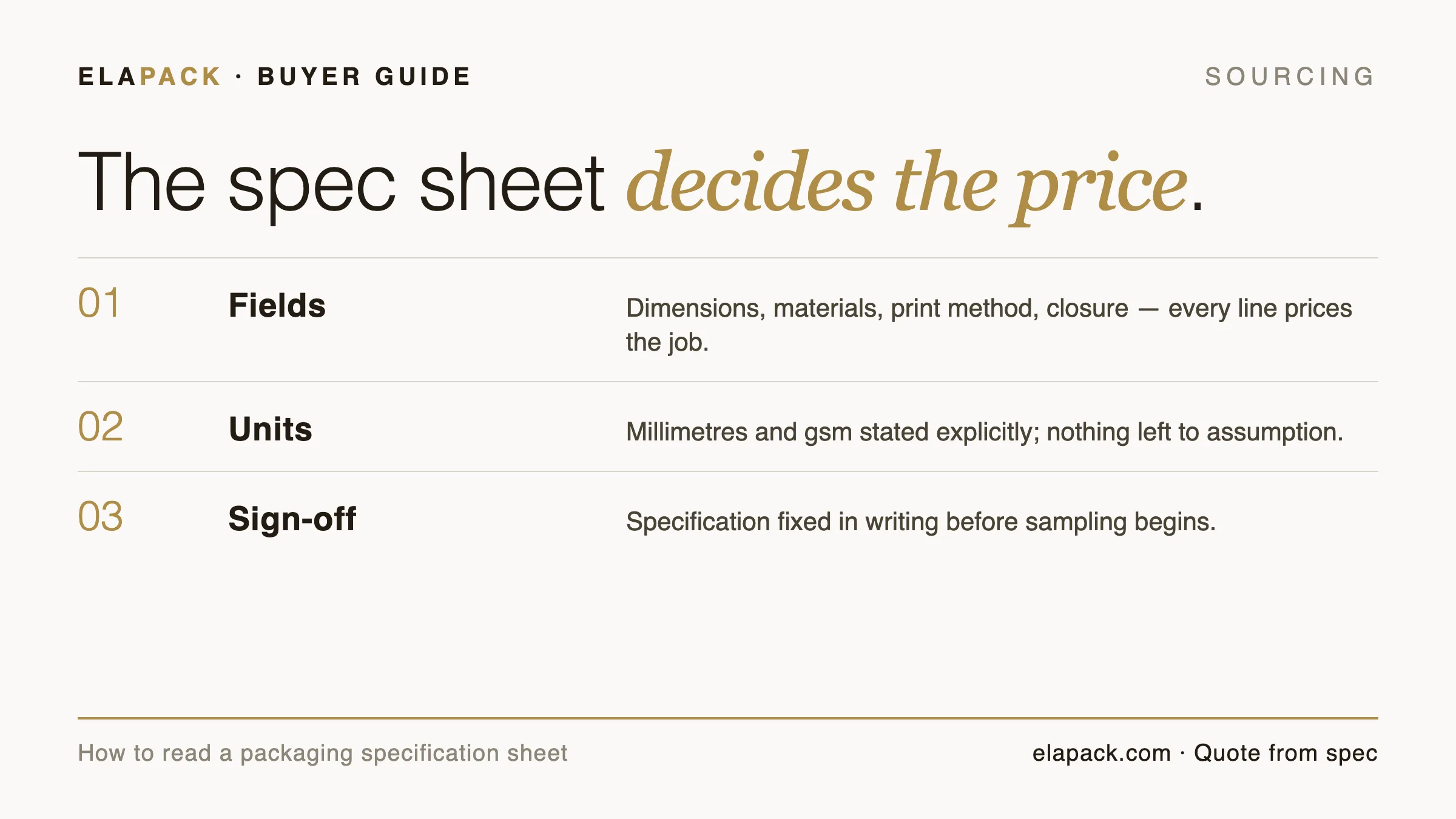
This guide shows packaging buyers and brand managers how to read a custom packaging specification sheet, so they can tell whether a construction fits their product and brand before they compare quotes. It is for premium jewelry, fragrance & gift, and hair (wig) brands selling in the US or Europe. If your question is which supplier to choose, what a quote costs, or how fast a factory ships, stop here: this page does not select a supplier, price a quote, or approve a production run. A spec on paper cannot prove the package will protect the product or meet the brand bar; it can only show you what to check and what still has to be confirmed. Finish the five-line check below and you will have a one-page fit boundary plus the open specifications to raise with your supplier.
Why the same specification can fit one launch and miss another
A packaging specification is a statement about the conditions a construction was built for, not a fixed fact that holds for every product. When the condition behind a number is missing from your reading, the spec stops telling you whether it fits your launch.
- A packaging buyer or brand manager receives a custom specification sheet for a new launch or a line extension.
- The sheet names the structure, board, finish and material, but it does not state the product weight, the brand-colour tolerance or the unboxing it was built for.
- Without those conditions, the buyer cannot tell whether the specification was built for a product and brand requirement like theirs.
- A choice made on the finished look alone can require extra sampling rounds, artwork or structural rework, or a production run that misses the brand bar.
- The rework can delay a seasonal or limited launch, which raises the cost of a wrong read.
- The task on this page is to map your product and brand requirements to the specification columns and stop at the first specification you cannot confirm.
The point is not to make the spec sheet look hostile. It is that the reading step, done in the right order, is what separates a quote you can compare from a paper comparison that says nothing about your launch.
Four specification groups to read in context before you compare quotes
Match the spec columns to your product and brand before you compare quotes. A construction can look right on paper and still sit outside your product weight, your colour tolerance or your compliance requirement. Work down these four groups in order; each one ends with the question your launch has to answer.
Structure and how the package opens
The group states the construction family — a rigid or set-up box, a folding carton, a shopping bag, a ribbon or textile closure — and how the package is meant to open and hold its content. The question from your side is whether the structure carries the product and delivers the unboxing your brand wants: a heavy flacon needs a different cavity and base than a light blister card, and a rigid lid that hinges changes the production line as much as the look.
Board, lining and the hand-feel bar
The group states the board type and weight (for example, grams per square metre), the lining and the paper sourcing. The question is whether the substrate holds the product's weight and takes the finish you want without losing the hand-feel your brand needs: a heavier board is not automatically better — it has to suit the size, the closure and the finishing process on the sheet.
Finish, decoration and colour
The group states the surface finish (matte, gloss, soft-touch lamination), the decoration (foil, embossing or debossing) and the colour reference the print is matched to. The question is whether the finish and the brand colour are specified with a tolerance the supplier commits to hold across the whole run, because a colour that drifts between batches can break a tightly art-directed launch even when the structure is right.
Materials and destination compliance
The group states the material content and any compliance claims the sheet carries — recycled content, certified paper, inks and coatings — and the destination rules they are meant to satisfy. The question is which claims your brand or your destination market requires to be verifiable with certificates or documentation, rather than stated on the sheet alone.
Read the four groups together. A construction can pass on structure and board and still fail on colour tolerance or compliance, and that is exactly where the sheet stops talking and your product and brand data has to start.
Where reading the specification is not enough
A spec on paper is not a proven package. Three boundaries keep this page honest:
- The sheet does not cover every production variable. Colour across a full run, the difference between a paper swatch and the produced material, and how the package survives transit can all drift from the page; each needs the supplier to confirm a condition, not a promise printed on the sheet.
- A construction can also be a genuine mismatch for the launch. If a required specification column is missing and the supplier cannot confirm it, treat that option as not yet evaluated for your product, not as a workable choice.
- Reading the sheet never replaces sampling. Material and colour approval and a pre-production sample still decide whether the construction holds the brand bar before the run — this page only narrows the field before those steps.
Run the five-line fit check before you brief a supplier
Nothing on this page collects your data or sends anything. Copy the five lines below into your own note and answer them for the launch you are planning:
- What is the product — its size, weight and fragility — and the launch or quantity window you are planning?
- Which structure and unboxing does the product need: a rigid box, a folding carton, a bag, a ribbon or textile closure?
- Which brand cues must stay consistent — the colour reference, the finish, the logo treatment — and what tolerance is acceptable?
- Which material or compliance requirements apply — recycled content, certified paper, coatings — and which must be verifiable, not just printed?
- Which specification is still open — the one the sheet does not state and you cannot confirm yourself?
When line 5 has an answer, you have finished the reading task this page owns: a completed fit boundary and one open specification to confirm. Keep the note local, and raise that open specification with your supplier through your existing approved contact process — do not send it anywhere this page has not verified.
Your next step, once the reading is done, is the comparison task: putting two constructions that both pass your fit check side by side on the same dimensions. That is a separate page for a separate decision, and it starts from the specification columns you have now filled in.