
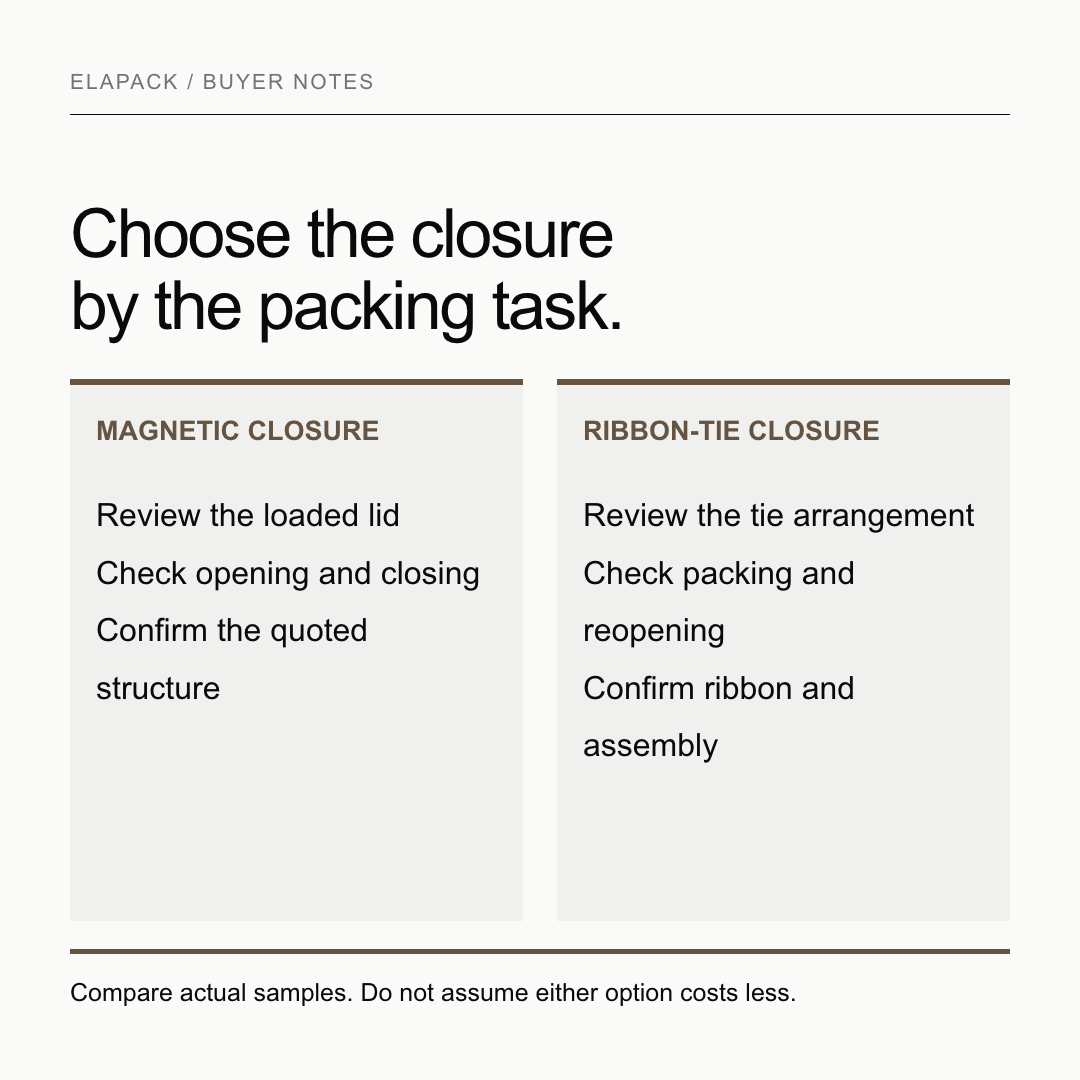
If you are deciding between a magnetic closure and a ribbon-tie gift box, review how the pack will be assembled, opened and closed. Ask for comparable samples before choosing by appearance alone. The comparison below is a buying checklist, not a claim that one closure is universally stronger or less expensive.
Define the two constructions you are comparing
ELAPACK lists a magnetic closure gift box and a ribbon gift box. Use those references to identify the proposed structure, then confirm whether the ribbon closes the box, decorates it or works alongside another closure. A visible ribbon does not answer that question by itself.
Keep the intended product, internal space and presentation requirements consistent where possible. If the proposed boxes differ in structure as well as closure, record both differences before attributing an observation to the magnet or ribbon.
A ribbon does not necessarily replace a magnetic closure
A public Cardboard Boxes NI product listing describes boxes combining magnetic closure with ribbon; it distinguishes an A6 shallow variant that has a small ribbon loop tab instead. That is a useful counterexample to treating “magnetic” and “ribbon” as mutually exclusive box types. The listing concerns that supplier's range, not ELAPACK stock.
| Construction described in the brief | What the buyer should establish |
|---|---|
| Magnetic box with a ribbon tie | Whether the ribbon is required for closure or presentation |
| Magnetic box with a pull tab | How the tab is used to open the lid |
| Ribbon-tie box without a magnet | How the tied ribbon retains the intended closing arrangement |
Only the cited supplier's combined construction and loop-tab variant are source observations. The third row is a comparison option to specify, not an assertion about that supplier's range. Ask for a demonstration of the proposed opening method before deciding which samples to compare.
Observe the actual packing sequence
Choose by the job the closure must perform
Separate retaining the lid, opening the lid and decorating the package in your brief. The cited combined box and loop-tab variant show why the presence of a ribbon alone does not identify its role.
| Your requirement | Candidate to request | Condition before selecting it |
|---|---|---|
| The recipient should not need to untie a bow | Magnetic sample without a required ribbon tie | Demonstrate opening and closing with the intended contents |
| A tied bow is part of the gift presentation | Ribbon-tie sample, with any other closure identified | Approve the tie arrangement and who will complete it |
| A ribbon is intended only to help open the lid | Sample with an opening tab | Confirm that the tab and the retaining closure are separate features |
| Both a magnetic close and a tied presentation are required | Combined construction | Include both features and any tying work in the quotation |
Editorial selection conditions derived from the functional distinctions above, not a strength, speed or durability test.
Ask the person who will pack the order to review each sample. For a ribbon-tie option, specify the desired tie arrangement and ask whether it will arrive tied or require work at the packing stage. For a magnetic option, review the actual lid movement after the product and insert are loaded.
| Decision point | Magnetic sample review | Ribbon-tie sample review |
|---|---|---|
| Opening | Check how the intended recipient opens the lid | Check how the recipient releases the tie |
| Closing | Review lid alignment with the contents loaded | Review tie position and the intended closing method |
| Packing work | Record the steps for the proposed construction | Record threading, tying or adjustment where required |
| Presentation | Inspect the closed box and its contact points | Inspect ribbon placement alongside the logo |
| Quotation | Confirm structure, insert and assembly scope | Confirm ribbon specification and assembly scope |
If packing time matters, observe your team using both samples and document the same task for each. Do not use an invented speed comparison or assume that one sample represents every version of that closure.
Review the package around the closure
Check the filled box, insert and any pouch together. If this is a complete packaging set, include all intended components in the review. Ask separately about the outer shipping pack and any validation required for your delivery conditions; a presentation sample alone should not be treated as shipping-test evidence.
For additional options, compare the custom box category and ribbons and accessories. Request a written specification for the particular combination rather than mixing features from different catalog images.
Keep the price comparison like for like
Request the same quantity and delivery scope for each proposal. Ask suppliers to separate changes in the box construction, insert, finish, ribbon and packing work. If one option is quoted flat and another assembled, have that difference explained before comparing totals.
Choose the version that meets the project’s agreed requirements. If the ribbon arrangement is important to the design, approve it on the assembled sample. If repeated opening matters, agree on the review method for the actual sample rather than making an unsupported durability claim.
Prepare the comparison request
For a gift packaging application, send the product dimensions, desired presentation, order quantity and packing arrangements. Contact ELAPACK with the two constructions you want to compare and identify any requirement that needs sample or test evidence.