
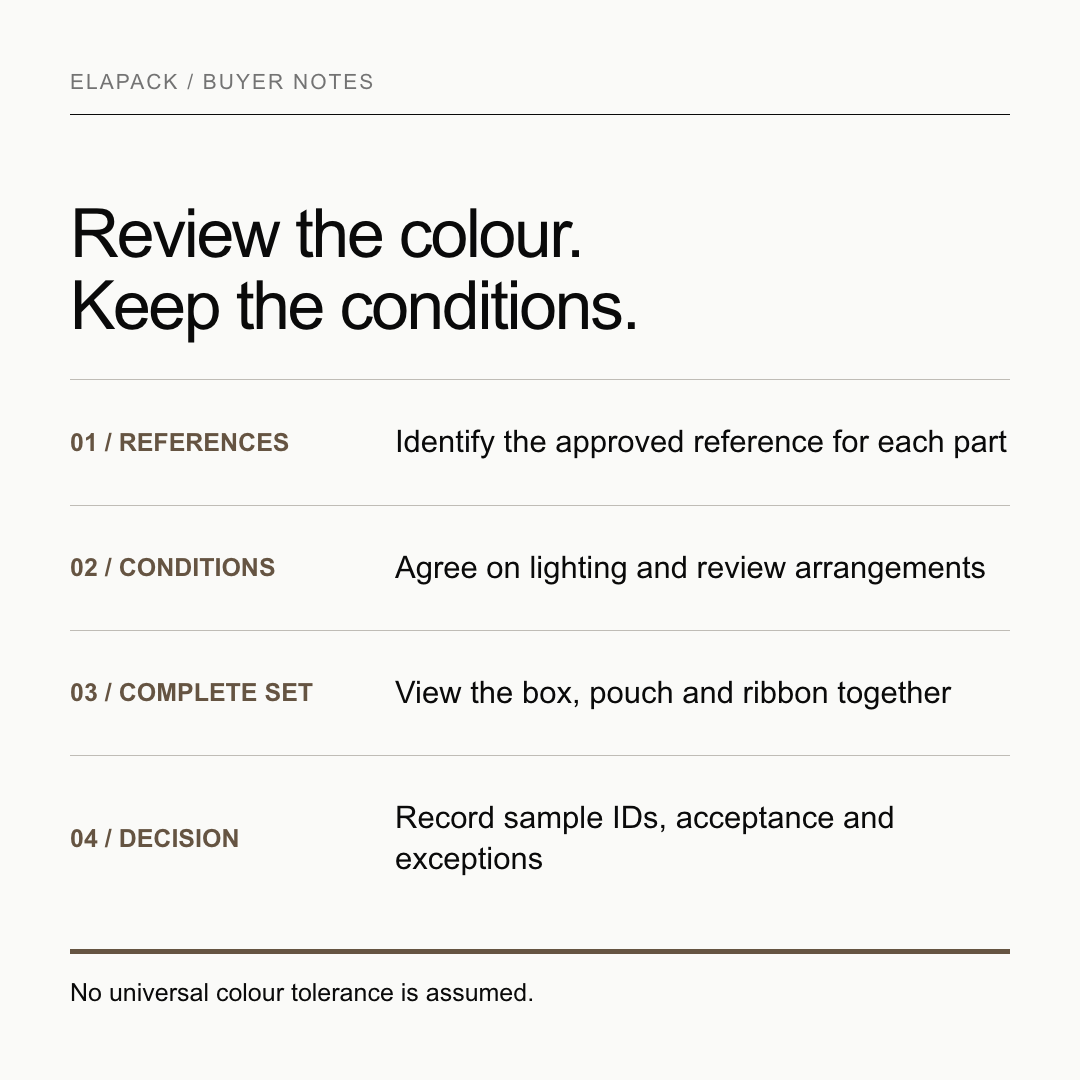
If a box, pouch and ribbon are meant to work as one packaging set, agree on the colour relationship before approving the components. Decide whether they should closely match, form a tonal group or deliberately contrast. Then record the references and review conditions for that decision.
Give each component an identifiable reference
Prepare a short colour brief for the box, pouch and ribbon or accessory. Name the proposed material and finish, attach the design reference and identify the physical sample to be reviewed when available.
If your brief begins with a colour code or digital artwork, ask what sample will represent the finished component for approval. Keep the reference, supplier sample and final decision linked by an identifier; avoid approving an unnamed photograph that cannot later be tied to a specific sample.
Agree on lighting before judging a mismatch
Datacolor explains that two samples may match under one light source and differ under another. This is called metamerism. Its guidance also distinguishes controlled visual assessment from instrument measurement; both have a role in a colour workflow. See Datacolor’s guide to light sources and colour evaluation.
For your project, agree on the principal viewing conditions and any additional environment that matters to the intended presentation. Ask the supplier to describe how it will carry out the comparison. If the proposed review conditions cannot be reproduced by both sides, resolve that limitation before using the review as an acceptance requirement.
Separate a lighting change from a sample mismatch
Datacolor distinguishes two observations: flare is a single material's appearance changing under different lights; metamerism is two samples matching under one light but not another. The distinction makes feedback more specific.
| Observation | What to record |
|---|---|
| One material changes appearance between lights | Its reference and both defined light sources |
| Two materials match in one light but not another | Both sample IDs and the two light sources |
| Samples differ under the agreed primary light | The reference, material and observed difference before diagnosing a cause |
The last row is a suggested review step, not a diagnosis. Do not label every visible difference “metamerism,” and do not invent a numerical tolerance from a photograph.
Compare the finished components as a set
Once individual samples are ready, place the proposed box, pouch and ribbon together in their intended arrangement. Compare each component to its own reference, then review the overall relationship. Record whether you are accepting a close match, a tonal difference or an intentional contrast.
A ribbon gift box can serve as a format reference when discussing where the ribbon sits against the box. It is not evidence that every proposed material combination will match. Ask to review the actual materials selected for your order.
Write down what “acceptable” means
Do not insert a universal numerical colour tolerance into the order without agreement. If instrumental measurements are part of acceptance, ask a qualified supplier or colour specialist to specify the method, settings, reference and limits suitable for the proposed components. Do not compare figures without knowing how they were obtained.
| Approval record | What to keep |
|---|---|
| Component | Part name, proposed material and finish |
| Reference | Identifiable physical standard or agreed reference |
| Viewing conditions | Lighting and review arrangements agreed by both sides |
| Measurement, if required | Method, settings and acceptance limits agreed for the project |
| Visual decision | Match, tonal relationship or contrast accepted |
| Exceptions | The specific difference accepted, or the revision required |
| Version | Sample identifier, decision date and approver |
Treat an approved exception as applying to that recorded version. If the material, finish or component supplier changes, ask whether the colour review needs to be repeated instead of carrying the previous approval forward without checking.
Make feedback actionable
Reopen approval when the reference conditions change
Datacolor's guidance on digital colour communication explains why a clear standard and reliable measurement conditions matter when colour data moves between suppliers. A numerical result needs its reference and method; an isolated value is not an approval record.
For your project, use the following change log to decide what to review again. These are proposed approval steps, not a claim about ELAPACK equipment or a mandatory industry tolerance.
| Proposed change | Approval item to revisit |
|---|---|
| Paper, fabric or ribbon reference changes | The finished component against its agreed reference |
| Coating or finish changes | The component's appearance under the agreed lighting |
| Measurement method or settings change | Whether the new result can be compared with the recorded result |
| One component changes after set approval | Its relationship with the other approved components |
If a sample is unsuitable, identify the component, reference and viewing conditions in the feedback. Describe the difference you observed and request a revised sample. Avoid a vague instruction such as “make it more premium,” which does not state the intended colour change.
To discuss coordinated packaging, contact ELAPACK with the component list, colour references and intended gift presentation. Indicate which samples or review conditions still need to be agreed before production approval.