
Structure, insert and sizing guidance in this guide is generic industry knowledge, except where ELAPACK's own confirmed trade terms are stated as such. Confirm material and production specifics with the supplier you are evaluating.
This guide is for nail brand owners selling press-on sets direct, at retail or both, who are ordering custom press-on nail packaging — a first run, a rebrand or a wholesale pack — and need to brief a supplier without wasting sampling rounds. It covers the five decisions that define a press-on nail box: the set format, the tray and insert, the shade-forward branding, the channel structure, and the quantity and sampling plan. If your question is which supplier to choose, what a quote costs, or how fast a factory ships, stop here: this page does not select a supplier, price a quote, or approve a production run. A press-on box is sold by the shade and size system it shows; the packaging has to present the set, not just contain it. Work through the five decisions below and you will finish with a brief ready to send for samples and quotes.
Why press-on boxes fail in the customer's hand
A press-on set is a system: shades, sizes, an applicator, sometimes glue. The box does three jobs: it holds every tray in its place, it shows the shade and size system at first sight, and it survives both a mailer and a retail shelf. When the box is ordered by unit price alone, one of those jobs fails.
- A nail brand orders the cheapest box that fits the tray, without planning the set layout.
- The boxes arrive and the trays slide, sizes mix, decorations catch on the insert, and the shade the customer ordered reads differently under retail light.
- Without mapping the set — trays, sizes, accessories — to the box layout, the order is guesswork and quotes are not comparable.
- A wrong box means scratched finishes, mixed sizes at unboxing, and returns that cost more than the packaging saved.
- The rework delays the restock the line was counting on.
- The task on this page is to map your set and channel to format, insert, branding and quantity, and prepare the brief for a quote.
The fix is not a cheaper box. It is a brief that starts from the set and works outward.
Five decisions that build the box
Start from the set — format, insert, branding, channel, quantity — before you compare quotes. Each decision ends with the question your line has to answer.
Start from the set format
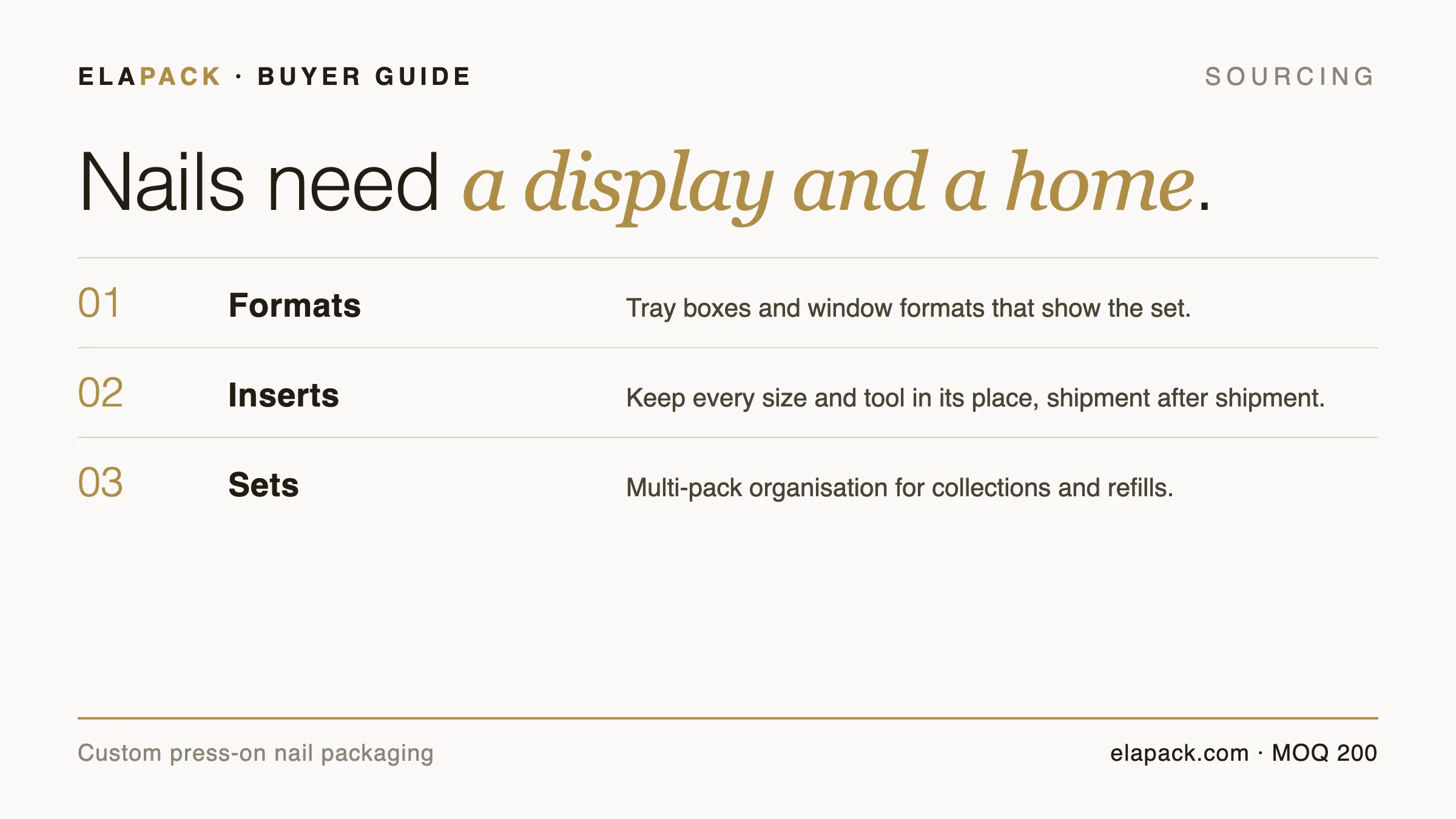
The set decides the box. Single-set sleeves run slim for direct-to-customer mailers. Multi-size kits hold a full size range plus accessories, and need a layout that keeps every size visible and in order. Wholesale display packs carry multiple sets for the counter. The question: what exactly is in one sellable set — trays, size range, glue, file, applicator — and how many sets per box?
Specify the tray insert
Press-on contents are light but fragile: finishes scratch, and sizes mix the moment a tray can move. Fitted inserts cut to the tray profile hold trays, tips and accessories each in their own well, in transit and on the shelf. Nails that present in size order sell; nails that arrive mixed get returned. The question: which contents must never move, and what cushioning does a decorated finish need?
Plan shade-forward branding
The customer buys a shade. Full-colour print on the wrap should show the shade system accurately — under retail light, not just on a screen — with foil or emboss carrying the brand mark above it. Because the shade is the product, colour accuracy on the box is not a cosmetic detail; it is the claim. Approve print against a colour reference on the actual wrap material before the run. The question: which shades anchor the line, and does the box show them true?
Match the structure to the channel
A box that goes into an e-commerce mailer needs different things from one that sits on a shelf: the mailer box protects through the post and presents at unboxing; the retail box faces the customer under shop light, stacked and handled. Many lines need both behaviours from one structure — so confirm which channel leads before the dieline is cut. The question: where does this box live — mailer, shelf, or both — and which one leads?
Plan quantity and samples before you compare quotes
As a working reference, ELAPACK's own confirmed terms for custom press-on nail boxes: a 200-piece minimum with custom sizes included, 15–20 day production, a free stock sample plus USD 20 shipping, and a USD 25 custom sample plus USD 20 shipping. A 200-piece entry lets a line test shades and set formats before committing depth. The question: how many pieces does the launch need, and what should a sample prove before the run?
When a box that looks right is still wrong
A mockup cannot show tray fit, shade accuracy or mailer survival. Three boundaries keep this page honest:
- A mockup does not show whether the tray actually seats. Ask for a physical sample built with your tray dimensions applied.
- Shade accuracy lives on the printed wrap, not on the screen. Approve colour on the actual material against a reference.
- A structure that looks sturdy can still rattle in a mailer. Test the packed box, not the empty one.
Prepare the press-on nail packaging brief for your quote
Nothing on this page collects your data or sends anything. Fill the brief from the set, the channel and the quantity. Copy the lines below into your own note:
- The set: tray count and dimensions, size range, accessories (glue, file, applicator) and their wells.
- The format: single-set sleeve, multi-size kit, or wholesale display pack — and sets per box.
- The insert: fitted insert cut to the tray profile, with a well per accessory.
- The branding: full-colour print with the anchor shades, foil or emboss for the mark, approved on the actual wrap.
- The channel: mailer, retail shelf, or both — and which leads.
- The quantity: launch quantity, and whether the sample should be stock or custom.
Keep the note local, and send these specs to your supplier through your existing approved contact process. With the brief filled, the quotes compare like with like — and the box that arrives shows the shade system the way the customer bought it.