
Structural and sourcing guidance in this guide is generic industry knowledge. Terms marked as ELAPACK figures are the factory's confirmed 2026 trade terms; everything else should be confirmed with the supplier you are evaluating.
This guide is for founders and packaging buyers planning or running a subscription box programme — beauty, candle, jewellery, snack or gift clubs — who need to buy subscription box packaging that works in month ten as well as month one. Companion pages cover what a box costs and when to order it; this page covers the decisions that come first. If your question is theme design or vendor selection, stop here: this page does not design editions or pick a supplier. A subscription box bought like a one-off box is a monthly mistake; the box has to be specified for the programme — the repeat, the variation and the transit — not for one edition. Work through the five decisions below and you will finish with a programme spec you can hand to any supplier.
Why subscription boxes get bought wrong
A subscription box looks like a box, so it gets specified like one: one structure, one quote, one order. Then the programme starts, and the box meets the three things a one-off never has to survive — repetition, variation and a monthly calendar.
- A founder specifies a beautiful box for launch month and orders it like any custom box.
- Month two needs a new theme; month three needs a taller product; month five needs 3,000 units, not 500.
- Each month re-opens decisions the spec never fixed — because the box was specified for an edition, not for the programme.
- The programme pays for it as repeated sampling, re-tooling and air freight, or as a box that quietly stops changing with the theme.
- By winter the unboxing looks like everyone else's, because variation was never designed in.
- The task on this page is to make the five programme-level decisions up front, so monthly editions become print changes on a settled structure.
The fix is not a better launch box. It is a specification that assumes the box will repeat and change at the same time.
Five decisions that specify a subscription box programme
Decide the programme before the edition: structure, insides, variation, transit, terms. Each decision ends with the question your programme has to answer.
Decision 1 — The box structure, chosen for repeat opening
A subscription box is opened every month, often kept, sometimes shown on camera. The main structures: a folding carton that ships flat and reads economical; a tuck-end mailer with a printed interior — the workhorse of high-volume programmes; a magnetic flip-top in greyboard (commonly produced at 800–1,600 g) that reads keepsake and gets reused by subscribers; a rigid lift-off lid for the gift-tier programme. The recurring question changes the choice: a box that must survive twelve openings a year and still look good on unboxing needs a different hinge and board than a box opened once. The question: will subscribers keep this box, and does the structure deserve that?
Decision 2 — What goes inside: pouch, insert, card
The inside items carry the edition. A pouch holds the small piece — jewellery, a votive, a mini — and the fabric band sets the hand-feel: satin 60–120 gsm, muslin 100–200 gsm, cotton 200–400 gsm, velvet as a 0.8–2.0 mm composite. An insert — EVA, paper card or moulded pulp — holds the product so it does not shift on camera. The theme card prints the month. The question: does each inside item carry a job — protect, present, brand — and would a subscriber notice if one went missing?
Decision 3 — Variation mechanics: what changes monthly
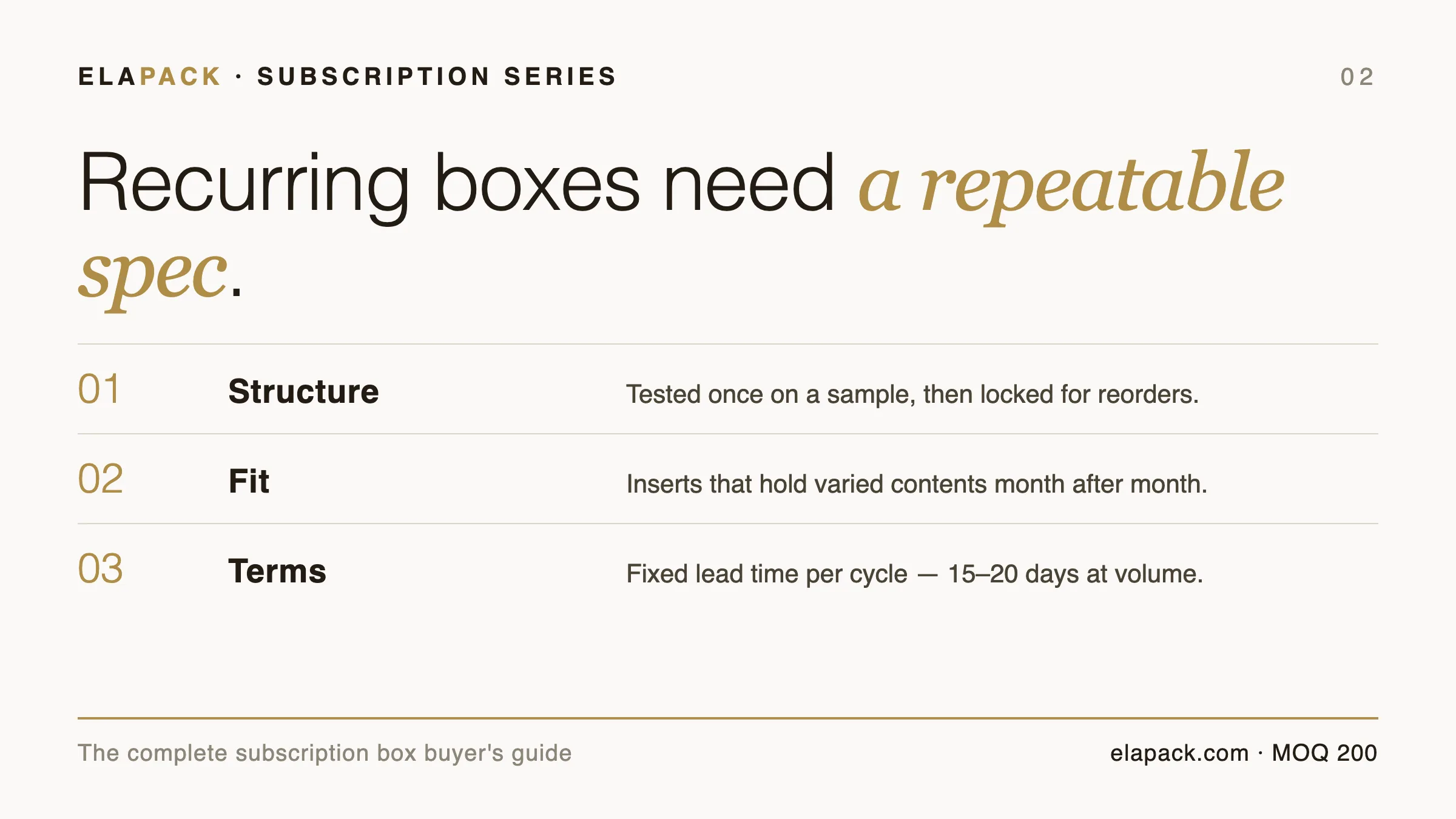
This is the decision a one-off buyer never makes. Decide, in the spec, what changes every month and what does not: the dieline stays, the artwork changes; the box stays, the sleeve or belly band changes; the structure stays, the ribbon colour changes. Sleeve-and-box systems exist precisely for this — the box is confirmed once, and each month is a printed wrap. Ask any supplier which tooling and plate charges recur when only the artwork changes, and hold the answer in writing. The question: has the programme made variation cheap, or does every theme re-buy the box?
Decision 4 — Transit survival, every month
A subscription box ships to consumers, monthly, in single parcels — so the packaging has to survive parcel handling without a secondary carton, and the product has to survive inside the box. Glass, wax and soft goods each fail differently: a candle glass needs an insert that locks it; wax softens in summer transit lanes; fabric creases. The question: what does this month's product do to the box in transit, and has that been tested — not assumed?
Decision 5 — Supplier terms that fit a recurring calendar
The programme terms matter more than the launch quote. ELAPACK's confirmed terms as a reference point: a 200-piece minimum across all product lines, so a theme variant can be tested at 200 instead of forcing one oversized run; production of 15–20 days at 200–20,000 pieces and 20–25 days at 20,000–50,000, counted from sample approval and deposit; custom samples at USD 25 plus USD 20 shipping, built in 3–5 days. A recurring programme consumes these terms monthly, so ask every supplier the recurring questions: does the tooling recur, does the sample round shorten once the dieline is confirmed, and does the lead time hold in the programme's busy quarter? The question: were these terms quoted for one order, or for twelve?
Read the five together. A box that passes structure and fails variation, or passes price and fails transit, is still wrong for a programme.
When a good-looking box is still a wrong programme buy
The box that photographs best in month one is rarely the box that runs best in month ten. Three boundaries keep this page honest:
- A launch sample proves the edition, not the programme. Only a second month on the same dieline proves the variation mechanics.
- A quotation that does not separate one-time tooling from recurring artwork charges hides the programme's real monthly cost.
- Transit failures surface in peak season, when replacements are slow. Test the packed box in a parcel before the busy quarter, not during it.
The programme spec list
Nothing on this page collects your data or sends anything. Fill the programme spec before you brief a supplier, so the programme is bought once. Copy the lines below into your own note:
- Programme: what ships monthly, typical unit count per edition, and how many variants per theme.
- Box: structure (folding carton, tuck mailer, magnetic flip-top, rigid lid), finished size in cm, and whether subscribers keep it.
- Insides: pouch fabric and band, insert material, card format — each with its job named.
- Variation: what changes monthly (artwork only? sleeve? ribbon colour?) and which charges are one-time.
- Transit: the product's failure mode in a parcel, and the test that proves the box handles it.
- Terms: MOQ, lead time bands, sample terms — confirmed in writing for a recurring calendar.
- Calendar: the monthly order date that keeps 15–20 day production ahead of each pack week.
Keep the note local, and send it to your supplier through your existing approved contact process — do not send it anywhere this page has not verified. With the programme spec filled, the companion pages take over: the cost breakdown builds the budget layer by layer, and the timeline guide turns the calendar into dates. A subscription programme that specifies once and varies cheaply is the whole game — the box is just where it shows.