
Industry price references in this guide are published third-party benchmarks and vary by market and volume. ELAPACK's own figures are its confirmed trade terms — MOQ, sample fees, lead times — stated as such; unit prices are quoted per specification, never announced.
This guide is for founders and packaging buyers at subscription box programmes budgeting the monthly box, its pouches and insert cards, who need a cost structure they can defend before quotes arrive. If your question is design or supplier selection, stop here: this page does not pick a vendor or price your exact specification. A budget built from a single "per box" benchmark is a guess; subscription packaging cost is assembled in layers, and the levers live in the specification, not in the benchmark. Work through the four layers below and you will finish with a budget frame and the seven-line spec that makes quotes comparable.
Why packaging budgets miss
A monthly box looks like one purchase, so it gets budgeted as one number. Then the quote arrives at two or three times the benchmark — not because anyone cheated, but because the benchmark described a different specification in every layer.
- A founder budgets "about a dollar a box" from a blog benchmark.
- Quotes come back for a magnetic-closure rigid box with foil, a velvet pouch and a printed card — a different product in every layer.
- The benchmark was never wrong; it was attached to the wrong specification, so every comparison built on it is meaningless.
- The edition ships cheap and looks it, or ships right and eats a margin nobody modelled.
- Next month the same argument repeats, because the budget was a number, not a structure.
- The task on this page is to replace the single number with a layered frame — and the spec list that makes two quotes comparable line by line.
Four layers that build the cost
Read the cost as layers — box, contents, one-time items, volume — and budget each on purpose. Each layer ends with the question your specification has to answer.
Layer 1 — The box itself
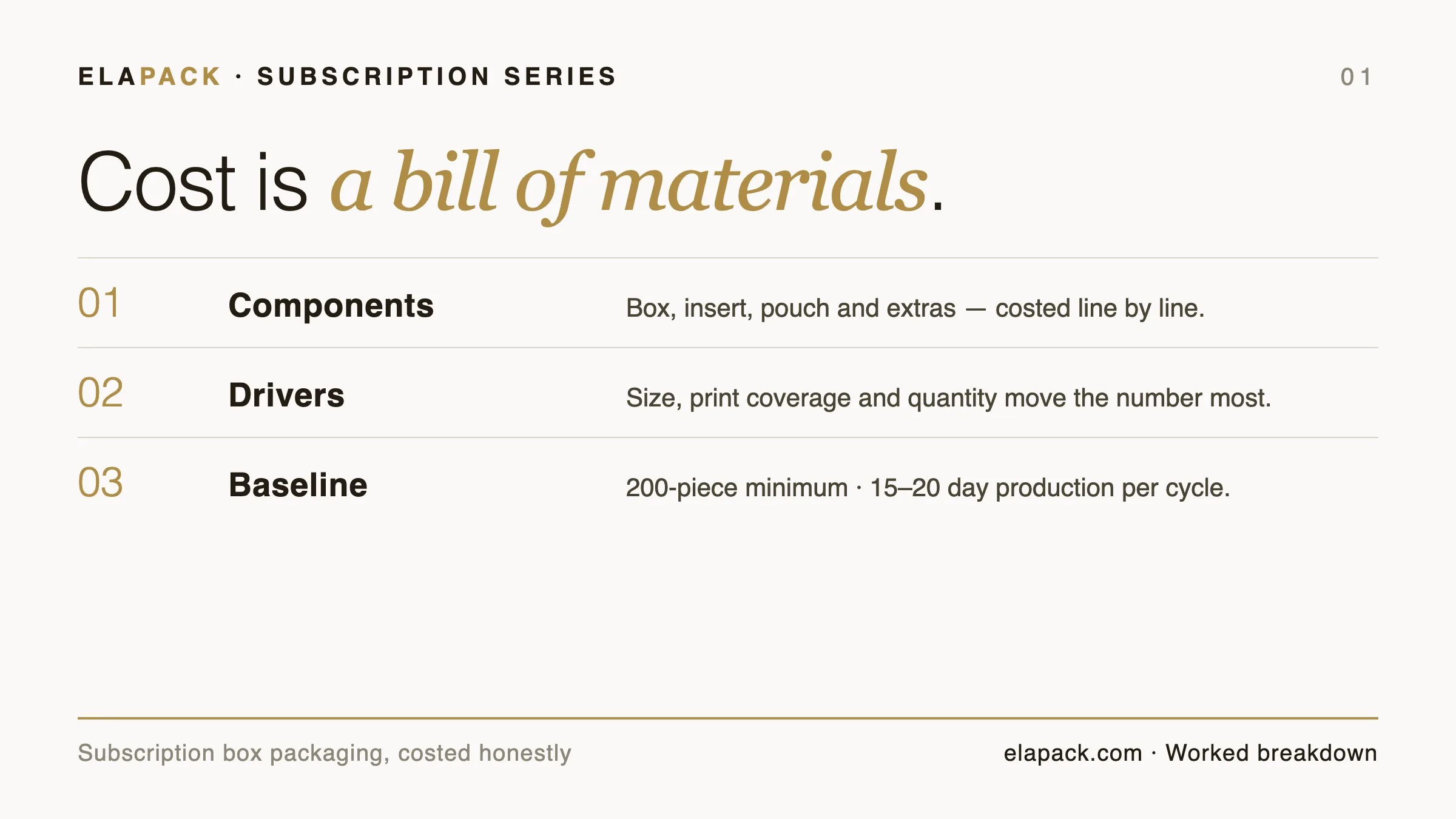
Published benchmarks put box manufacturing at roughly USD 0.60–2.50 per unit depending on structure and quality, and a filled box — box, filler, inserts — at USD 2–4 at typical customisation. Structure moves the number most: a folding carton that ships flat sits toward the low end; a rigid lift-off lid in greyboard (commonly produced at 800–1,600 g) sits at the top; a magnetic flip-top lands between. Size is the quiet multiplier — a box grown two centimetres in every dimension grows board, print area and freight at once. The question: which structure does the unboxing actually require, and is every centimetre earning its freight?
Layer 2 — What goes inside
The pouch that holds the jewellery, votive or mini carries a fabric cost driven by material band — satin 60–120 gsm, muslin 100–200 gsm, cotton 200–400 gsm, velvet as a 0.8–2.0 mm composite — with print or label added per piece. Insert cards print to the monthly theme; EVA, sponge and pulp inserts are usually the smallest lines on the sheet. The question: does each inside item carry a job — protect, present, brand — or is it there because last month's box had one?
Layer 3 — One-time versus every month
This layer decides whether a programme is expensive or cheap. One-time: the dieline and structural decisions, confirmed at the first sample round (ELAPACK custom sample: USD 25 plus USD 20 shipping, built in 3–5 days). Recurring: artwork and theme print. The core economy of a subscription programme: confirm the dieline once, and monthly themes become print changes on a proven structure — the expensive decisions stop recurring. Ask any supplier which tooling, plate or setup charges recur when only the artwork changes, and put the answer in the budget in writing. The question: has your structure been confirmed once, or is your programme re-deciding it every month?
Layer 4 — Volume and the MOQ floor
Quantity is the biggest lever on unit cost across every layer — published references run from about USD 0.45 per box for materials at high volume to several dollars for bespoke rigid work. ELAPACK's floor is 200 pieces across all product lines, so a theme can be tested at 200 per variant instead of one oversized run; production runs 15–20 days at 200–20,000 pieces and 20–25 days toward 50,000. The question: is this month's quantity sized to what the theme proved, or to a volume discount you cannot yet use?
When a cheap quote is expensive
The lowest unit price is not the lowest cost; the spec you cannot see is where budgets die. Three boundaries keep this page honest:
- A quotation without material bands — "satin pouch" with no gsm — has not fixed the variable that moves price and hand-feel most. Ask for the weight in writing.
- Tooling and plate charges that recur with every theme turn a cheap monthly unit price expensive by winter. Ask which charges are one-time.
- Ex-works versus landed: confirm what a quoted price includes — freight terms from Shanghai or Shenzhen, and who pays each leg — before comparing two numbers as if they were the same kind of number.
The seven-line budget spec
Nothing on this page collects your data or sends anything. Fill the spec frame before you request quotes, so quotations arrive comparable. Copy the lines below into your own note:
- Box: structure (folding carton, magnetic flip-top, rigid lift-off lid), finished size in cm, board weight if rigid.
- Pouch: fabric and band (for example cotton 200–400 gsm), finished size, closure.
- Cards: format, printed sides, finish.
- Inserts: material (EVA, sponge, pulp) or none.
- Quantity: per variant and total, against the 200-piece floor.
- One-time items: dieline, tooling, plates — each marked one-time or recurring.
- Theme changes: what changes monthly (artwork only?) and what that change costs.
Keep the note local, and send it to your supplier through your existing approved contact process. With the frame filled, the cost of subscription box packaging stops being a benchmark argument and becomes a line-by-line comparison — the only kind a recurring budget survives.