
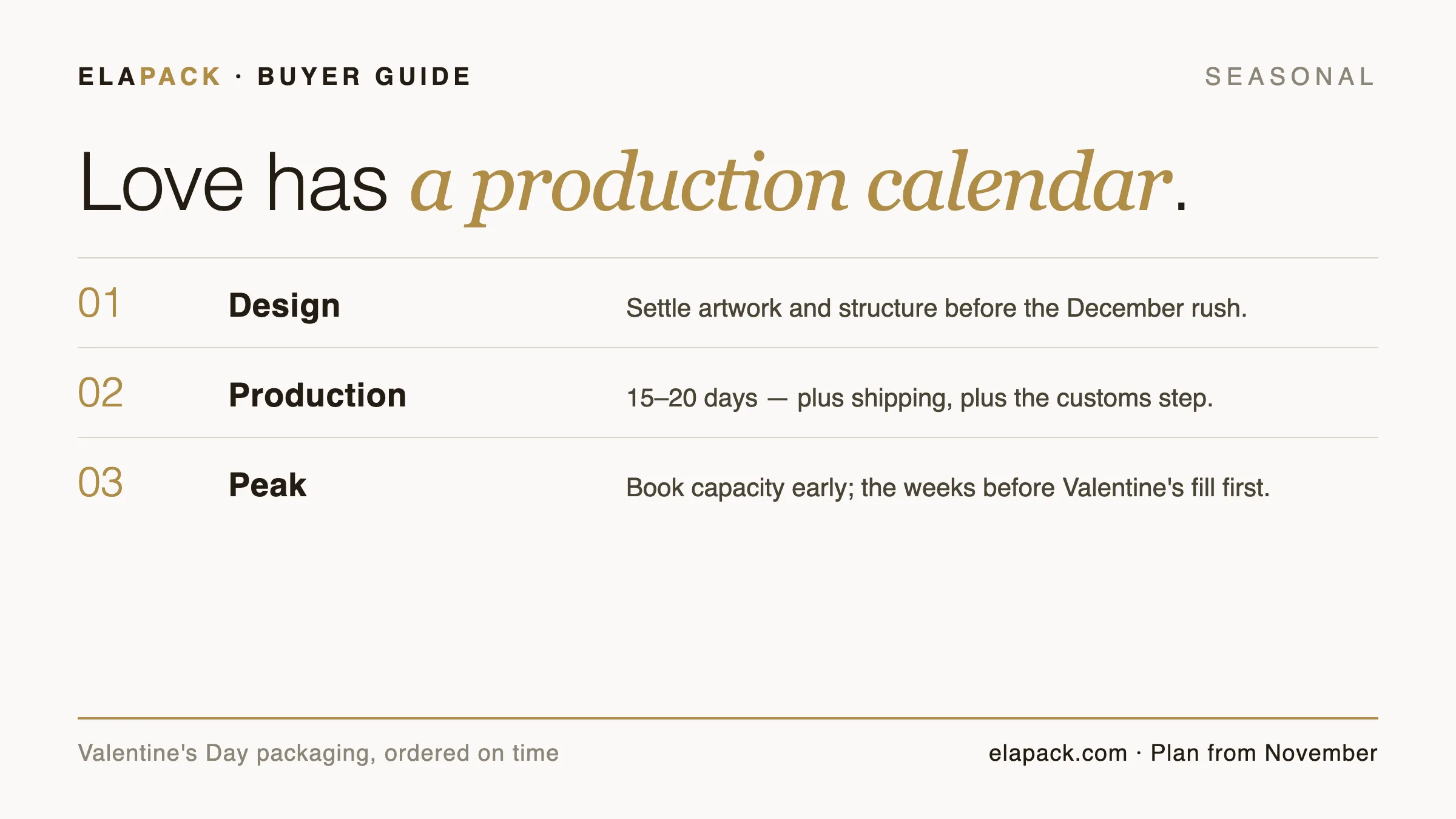
The planning method in this guide is generic sourcing practice. Clocks stated as ELAPACK figures are the factory's confirmed 2026 trade terms; subscriber-side dates describe common market patterns, not promises about any fulfilment partner.
This guide is for founders and packaging buyers at subscription box programmes — candle, beauty, jewellery or gift clubs — planning a February 14 drop and needing to know when the packaging has to be ordered. If your question is theme design, supplier selection or pricing, stop here: this page does not design your box or choose a vendor. A Valentine's box is a calendar problem before it is a design problem: artwork can be fixed overnight, a missed production slot cannot. Work backwards from February 14 with the clocks below and you will finish with a dated order plan you can hold a supplier to.
Why Valentine's boxes miss the date
A February drop has one constraint the rest of the year does not: every subscriber expects delivery before February 14, and the market's shipping patterns compress everything upstream of it.
- A subscription founder plans a Valentine's edition and briefs the theme in January.
- The quote comes back fine, but the 15–20 day production has not started — and the sample round has not happened.
- The box that misses its production slot arrives as plain stock, as an air-freight premium, or as a February 20 "Valentine's" box — and subscribers notice all three.
- The edition still ships, but the margin pays for air freight or the brand pays in look.
- Next season the same calendar repeats, because the lesson was filed as bad luck.
- The task on this page is to replace luck with arithmetic: count back from February 14 through packing, freight, production, sampling and artwork.
The fix is not urgency. It is arithmetic done early, while every option is still open.
Count back from February 14
Build the calendar backwards; every upstream date is forced by the one after it. Each step ends with the question that date has to answer. Figures marked as ELAPACK's are confirmed factory terms: production 15–20 days for runs of 200–20,000 pieces; custom samples built in 3–5 days with 4–7 days courier transit; dispatch from Shanghai or Shenzhen by air or by sea.
Step 1 — Subscriber delivery: the week of February 8
Common market pattern: programmes set order cutoffs in late January and pack the February box in the first days of the month, so boxes reach subscribers roughly February 7–13. The question your fulfilment calendar answers: which day must the packed box leave your pack site?
Step 2 — Packing week: packaging on site by late January
Packing a themed box — box, pouch, insert card, ribbon — takes days at volume, and finished packaging must be at the pack site in the last week of January. The question: how many domestic transit days from port or airport to your pack site does your forwarder quote?
Step 3 — Freight from China: air in days, sea in weeks
Boxes leave Shanghai or Shenzhen by air or by sea. Air freight is counted in days and priced at a premium; sea freight is counted in weeks and priced for volume. Get both quotes in writing with transit days — this one choice moves your production deadline by weeks. The question: does this edition's volume justify air, or does the calendar only work if production finishes earlier and the boxes sail?
Step 4 — Production: 15–20 days, starting early January
For subscription box packaging to be ready for a late-January dispatch with air freight, ELAPACK's confirmed 15–20 day production window has to start in the first ten days of January — counted from sample approval and deposit, not from first contact. The question: does your quantity, theme change or material sit inside standard terms, or does the quote need to state its own clock?
Step 5 — Sample approval: the two weeks before production
A custom sample round at ELAPACK — USD 25 for the sample plus USD 20 shipping, built in 3–5 days from confirmed artwork, 4–7 days in transit — lands in roughly two weeks including a revision look. For approval before an early-January production start, the sample round runs in mid-December. The question: is your artwork confirmed enough that the sample is an approval, not a discovery?
Step 6 — Artwork and dieline: locked in early December
Theme artwork and dieline — box structure, pouch size, card format — must be final before the sample is built, which is what makes the mid-December sample real. The question your team answers: who signs off artwork, and by which date?
Read the chain together and the honest headline is: the Valentine's calendar starts in early December, not January. Reading this in October means you are early — spend the margin on theme design and dieline confirmation. Reading it in January means air freight and simplified structures are the honest paths, and the plan should say so out loud.
When a timeline that looks right still slips
A calendar with no buffer is a plan to miss by exactly one delay. Three boundaries keep this page honest:
- Every ELAPACK clock above starts from confirmed artwork or sample approval. A late approval moves every date after it, silently.
- Cutoffs and pack weeks above describe common market patterns; your fulfilment partner's calendar is the one that counts. Confirm it in writing.
- Sea-versus-air decided late is air at premium rates. Decide it while both options still exist.
The dated order plan
Nothing on this page collects your data or sends anything. Fill the dated plan for your edition from your own fulfilment calendar. Copy the lines below into your own note:
- Subscriber delivery deadline: the date boxes must be in subscribers' hands, before February 14.
- Dispatch from pack site: your pack-and-ship day, from your fulfilment calendar.
- Packaging on site: dispatch date minus pack days and domestic transit.
- Freight choice: air or sea from Shanghai or Shenzhen, with written transit days.
- Production start: on-site date minus 15–20 days (ELAPACK standard, to 20,000 pieces; larger runs quoted).
- Sample approval date: production start minus a two-week custom sample round (USD 45 all-in).
- Artwork and dieline lock: the date theme files and dieline are final — the date the whole chain really starts.
Keep the note local, and send it to your supplier through your existing approved contact process. With the dates filled, ordering a Valentine's edition stops being a bet on goodwill and becomes a schedule both sides signed — which is what a recurring programme runs on.