
Search volumes and keyword difficulty (KD) are Semrush US database figures, mirror-looked-up 2026-10-08. Material descriptions are industry references as published by packaging suppliers and textile encyclopaedias (sources named inline). Order terms — MOQ 200 pieces, 15–20 day production, custom sample at USD 25 plus USD 20 shipping — are ELAPACK's confirmed trade terms. Fibre compositions and fabric weights are supplier-specific: ELAPACK's confirmed ranges are quoted where stated, everything else is a decision framework, not a specification.
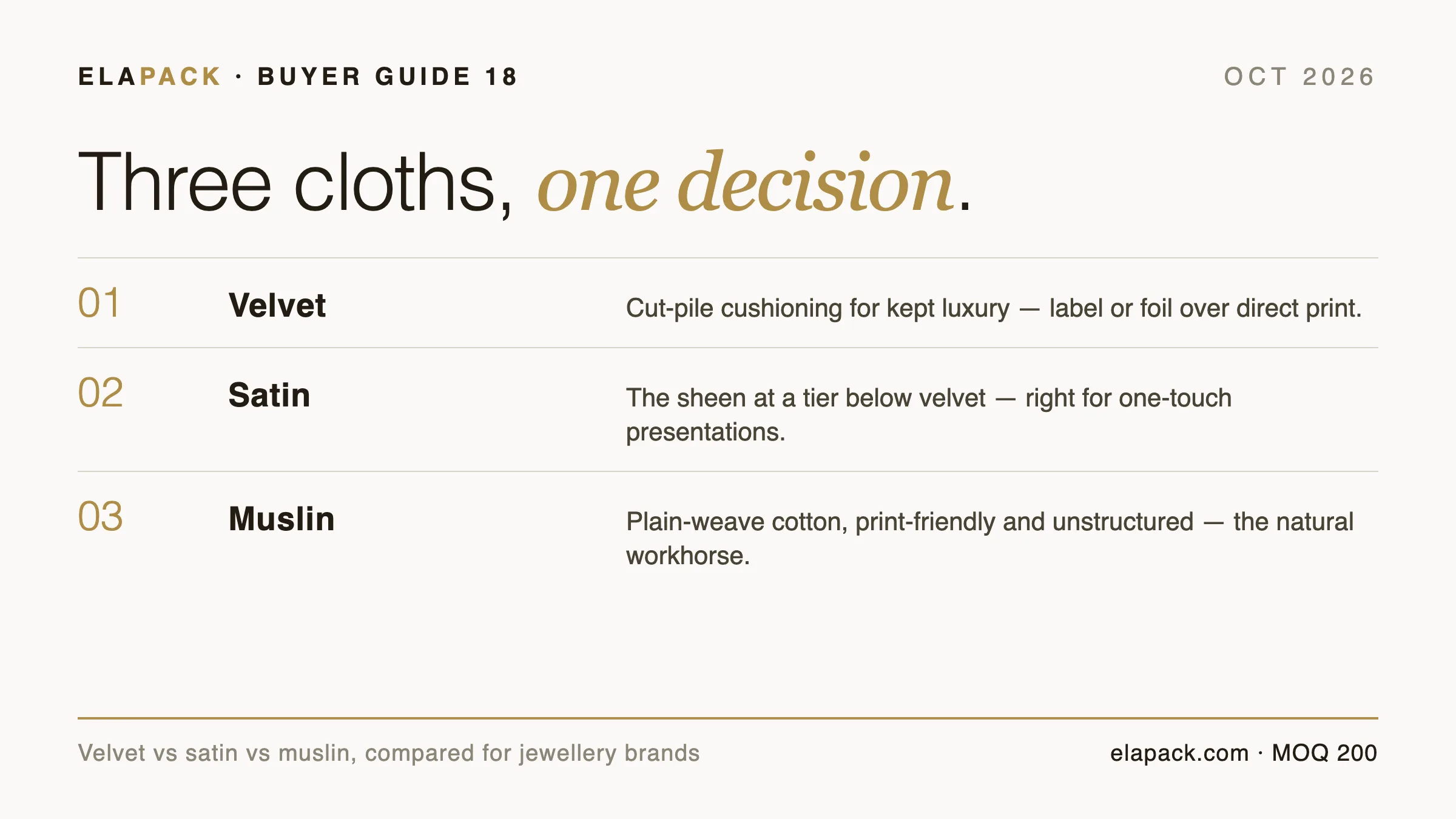
Quick answer: velvet when the pouch is part of the luxury presentation and pieces need cushioning; satin for a sleek, lightweight sheen at lower cost; muslin for a soft, matte, natural-cotton look at the accessible end. None of the three names specifies fibre content or weight — request the fabric reference and composition for each before comparing quotes.
Key facts at a glance
| Item | Figure | Source |
|---|---|---|
| Minimum order | 200 pieces per design, all pouch lines | ELAPACK confirmed terms |
| Production lead time | 15–20 days at 200–20,000 pieces | ELAPACK confirmed terms |
| Custom sample | USD 25 plus USD 20 shipping, built in 3–5 days | ELAPACK confirmed terms |
| Comparison-term demand | muslin vs linen 260/month (KD 7); cotton vs muslin 170 (KD 3) | Semrush US, 2026-10-08 |
| Product-term demand | velvet jewelry pouches 70 (KD 4); microfiber jewelry pouch 50 (KD 0) | Semrush US, 2026-10-08 |
| Sizing demand | drawstring bag dimensions 90/month (KD 2) | Semrush US, 2026-10-08 |
What the search demand looks like

Buyers do not search one head term — they search the comparison itself. "Muslin vs linen" (260/month) and "cotton vs muslin" (170/month) outrank every single-material product term in this band, and difficulty sits at KD 0–7 across the comparison cluster. A factory-written comparison that answers the question and lands the buyer on a pouch page serves that intent directly.
Comparison queries are the demand — the supplier who answers the versus question owns the cluster.
What the three names actually specify — and what they don't
A material name is a construction or finish description, not a specification. As packaging references point out, pouches sold as "velvet" may be woven from polyester, rayon, cotton or blends, and "satin" may be silk or polyester — the trade name does not guarantee the fibre (as published on packgenio.com, checked October 2026). Muslin is a plain-weave cotton cloth: the weave is the definition, the yarn and weight still vary. That is why the first line of any pouch brief is the fabric reference and composition, not the trade name.
Treat velvet, satin and muslin as starting positions — approve the fabric reference, not the word.
Velvet: the presentation and protection choice
Velvet's cut pile is what reads as luxury: a deep, light-absorbing surface that cushions metal and keeps pieces from sliding. Industry guides recommend it where the pouch itself is part of the gift presentation and where hard pieces would otherwise knock against each other in transit or storage (as published on bagwalas.com and gemsondisplay.com). The same pile is its constraint — direct printing on velvet holds less detail than on flat weaves, which pushes premium programmes towards sewn labels or foil rather than screen ink (as published on drawstringpouchbag.com). ELAPACK lists a velvet jewellery pouch in its standard range.
Choose velvet when the pouch will be kept, touched and photographed — and plan the logo method around the pile.
Satin: the sheen at a lower cost tier
Satin is the sleek option: a smooth, reflective face, lighter hand and a drape that suits ribbon-tied presentations. Published supplier comparisons place satin meaningfully below velvet on cost — one specialist supplier states satin runs 15–25% less than velvet while retaining most of the visual appeal (as published on richpkg.com) — with the trade-off that the smooth weave snags and frays more readily under repeated opening and closing (as published on drawstringpouchbag.com). For gift programmes where the pouch is opened once and presented, that durability gap rarely decides the purchase; for pouches handled daily it should. ELAPACK's range includes a satin pouch.
Satin buys the shine at a tier below velvet — accept it for one-touch presentations, question it for daily handling.
Muslin: the natural-cotton workhorse
Muslin is plain-woven cotton: matte, soft, unstructured and the most accessible of the three on cost. It takes screen printing well (flat weave, cotton fibre), which is why branded muslin drawstring bags are a standard entry product for retail and event programmes — ELAPACK lists a custom muslin drawstring pouch and covers weights and sizes in a dedicated muslin guide. What muslin does not offer is structure or cushioning: it protects against dust and scratching, not against impact. Fabric weights in the trade run roughly 100–145 gsm and above (as published on bagsgeek-type retail references; ELAPACK's confirmed weight options are quoted per project).
Muslin is the right answer for breathable, print-friendly, everyday branding — not for impact protection.
The three-way comparison
| Decision axis | Velvet | Satin | Muslin |
|---|---|---|---|
| Surface | Cut pile, deep matte lustre | Smooth, reflective sheen | Plain weave, soft matte |
| Cushioning | Highest of the three | Light | Light, unstructured |
| Typical positioning | Kept luxury packaging | Gift presentation, one-touch | Everyday branded storage |
| Logo fit | Sewn label or foil preferred over direct print | Print and label both viable | Screen print friendly |
| Cost tier | Highest of the three (satin cited 15–25% below it) | Mid | Most accessible |
| Specification to request | Pile fibre and composition, lining | Weave fibre, face vs reverse | Yarn, weight (gsm), wash finish |
Editorial comparison of published material behaviour, not a test ranking. Column entries are positioning statements — the specification rows are what make quotes comparable.
Compare samples, not names
Run the review the same way for all three: same jewellery piece, same handling routine, logo at actual size. Record where cords, seams and closures touch the piece, and check the loaded pouch inside the intended box and insert — a complete packaging set is approved as an assembly, not as separate empty parts. If appearance decides, compare both finalists under your presentation lighting before signing off. The cotton pouch and microfiber pouch pages cover the adjacent flat-weave options if neither pile nor satin fits the brief.
What to put in your enquiry
For each material under consideration: the fabric reference and fibre composition; the weight or construction unit the supplier quotes (gsm for muslin and cotton, pile description for velvet, weave for satin); usable internal dimensions with the closure drawn — the sizing question is real demand, at 90 US searches a month for drawstring bag dimensions alone; the logo method and its artwork requirements; quantity against the 200-piece minimum; and the sample route (custom sample USD 25 plus USD 20 shipping, 3–5 days). Browse the full pouches and bags collection or the jewellery pouch line to anchor the styles before you brief.
The bottom line
Velvet for kept luxury and cushioning, satin for sheen at the tier below, muslin for print-friendly natural cotton — and in every case, the fabric reference beats the trade name. Contact ELAPACK with the material shortlist, sizes, logo artwork and quantity, and the quotation will state the fabric, logo method and terms that apply to your jewellery packaging programme.