
This guide covers textile storage covers for handbags and shoes. Fabric availability, dimensions and contact performance require project confirmation. It does not claim a universal GSM range, breathability ranking, moisture barrier or mould-prevention result.
Quick answer: measure the item in its stored shape, identify the surfaces and hardware that will contact the fabric, then approve a loaded sample. A dust bag is a soft cover; it is not a rigid transit case or a substitute for suitable storage conditions.
Define the storage task
A handbag dust bag and a shoe dust bag may share a drawstring concept, but they need different dimensions and contact checks. State whether the cover is for presentation, routine storage or use inside another pack. This page does not concern vacuum-cleaner filter bags.
For leather goods, follow the product maker's care instructions. Leatherology's care guide is an external leather-care reference, not a test of ELAPACK fabric. Suitability for a particular finish, colour or storage environment must be checked for that product.
Measure the stored object
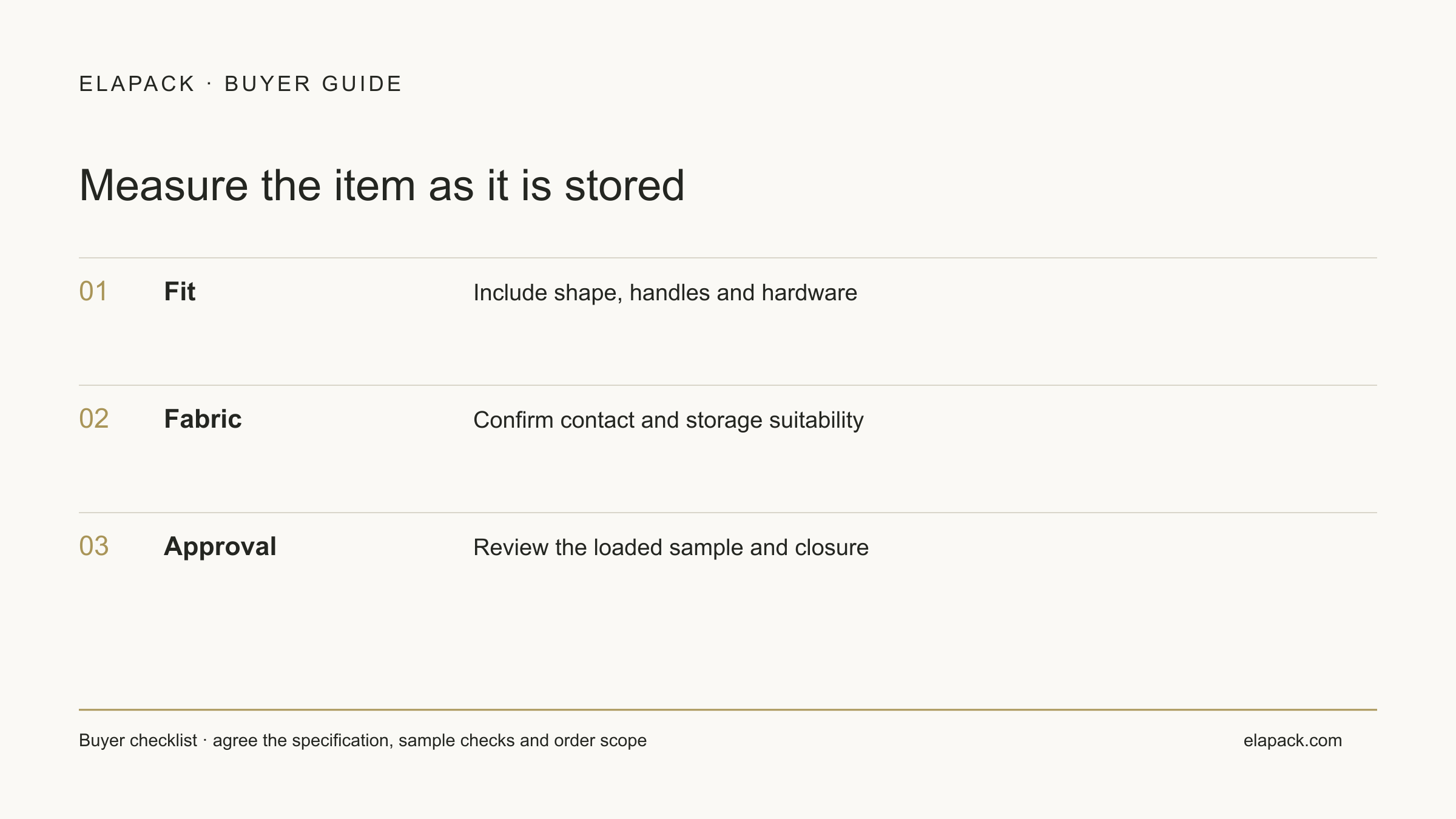
For a handbag, record the stored width, depth and height, including how handles and hardware will sit. For shoes, state whether the design is one cover per shoe or one for the pair. Give the supplier a drawing or an actual sample where the shape is difficult to describe.
Distinguish usable internal dimensions, finished external dimensions and fabric cut dimensions. They are not interchangeable: seam, gusset and closure construction affect the usable space. Ask for a proposed pattern and allowance rather than calculating cut size by adding one universal margin to the item.
On the sample, check that the product enters without forcing seams, the closure gathers clear of sensitive surfaces, and the hardware is positioned as intended. A pair cover does not by itself keep the shoes from contacting each other; request separation if that is part of the brief.
Material selection needs contact evidence
| Candidate to discuss | Specification to request | Check for the actual item |
|---|---|---|
| Cotton or muslin | Fibre composition, construction, weight and finish | Surface contact, colour transfer and fit |
| Satin-type fabric | Fibre composition, weave and finish | Contact with coated or polished surfaces |
| Velvet-type fabric | Fibre composition, pile and backing | Lint, contact and hardware interaction |
| Microfiber or another textile | Actual fabric reference and construction | Intended use and any required care checks |
The table is a selection framework, not a stock list or a ranking of airflow and protection. Fabric names do not establish moisture handling or long-term storage suitability. Request project-specific material evidence if those properties matter.
Related base constructions appear in the cotton pouch and muslin pouch pages. Compare the drawstring bag options for a handbag or shoe dust-bag brief; confirm the proposed storage-cover pattern, material and fit separately.
Closure and branding
Agree the opening size, closure position, cord and any end fittings on the drawing. Do not use a fixed channel depth as a standard for all sizes. Check whether the gathered fabric or trim presses against the item; a storage cover should not be assumed to carry the product by its drawstring.
Propose the mark, position and branding process with the chosen fabric. Printing, a sewn label and embroidery are alternatives to evaluate for feasibility and contact, not a universal price hierarchy. Review a physical sample and agree any relevant transfer or handling tests.
What to record at approval
Keep the product reference, loaded arrangement, fabric reference, finished dimensions, drawing revision, artwork and acceptance checks together. Include any inner separation and outer packing. Recheck the sample when the stored item, finish or hardware changes.
A soft cover does not establish crush protection, prevent mould or guarantee a specific storage life. Follow the goods maker's storage guidance and evaluate any separate protective container or route test needed.
ELAPACK's MOQ is 200 pieces. Confirm size, colour and artwork allocation in the quotation; this does not mean every variant can be split freely. For a complete set, each component has a 200-piece minimum. Custom samples are USD 30 plus USD 25 shipping, with a 3–5 day sample-making timeframe. Stock samples are free with USD 25 shipping and a stated delivery timeframe of 4–7 days. Production is typically 15–20 days after sample approval and payment receipt; confirm by order.
Contact ELAPACK with the stored dimensions, surface details and intended use. The pouch material comparison covers related presentation choices.