
Style, dimension and minimum-order references are as published by US print suppliers (Company Folders, BD Print, Packaging Xpert, Oh My Print Solutions, VistaPrint, E-Card Systems — read 17 October 2026); they describe those suppliers' ranges and are quoted for comparison only. Ordering terms in this guide are this factory's confirmed trade terms.
A gift card is the most-sold gift in retail, and also the flattest object a brand ever has to present. The card itself is a standard rectangle — the same size as a bank card — so everything a brand adds around it is a choice about occasion and channel, not about fit. Yet the market answers that choice with three different words that few buyers can separate: the sleeve, the envelope and the holder. US print suppliers list all three side by side; community threads confirm the instinct — a sleeve reads casual, an envelope reads formal, a folder or holder adds protection and perceived value.
Quick answer: pick the carrier by occasion and channel, not by looks. Sleeves for counters, events and volume programmes; envelopes for formal and seasonal gifting; folders and box-style holders when the card is the whole gift and has to stand alone. All three are printed card-stock carriers built around the standard card size, and all three are custom-printed from 200 pieces per design at this factory.
Three carriers, three jobs
| Carrier | What it is | Where it wins | Where it is wrong |
|---|---|---|---|
| Sleeve | open-ended slip, card slides in | counters, events, volume mailers | no closure; card can slide out |
| Envelope | folded card stock with a flap | formal and seasonal gifting | slower to assemble by hand at volume |
| Folder | scored sheet that folds around the card | corporate programmes, the card as the gift | more board per unit than a sleeve |
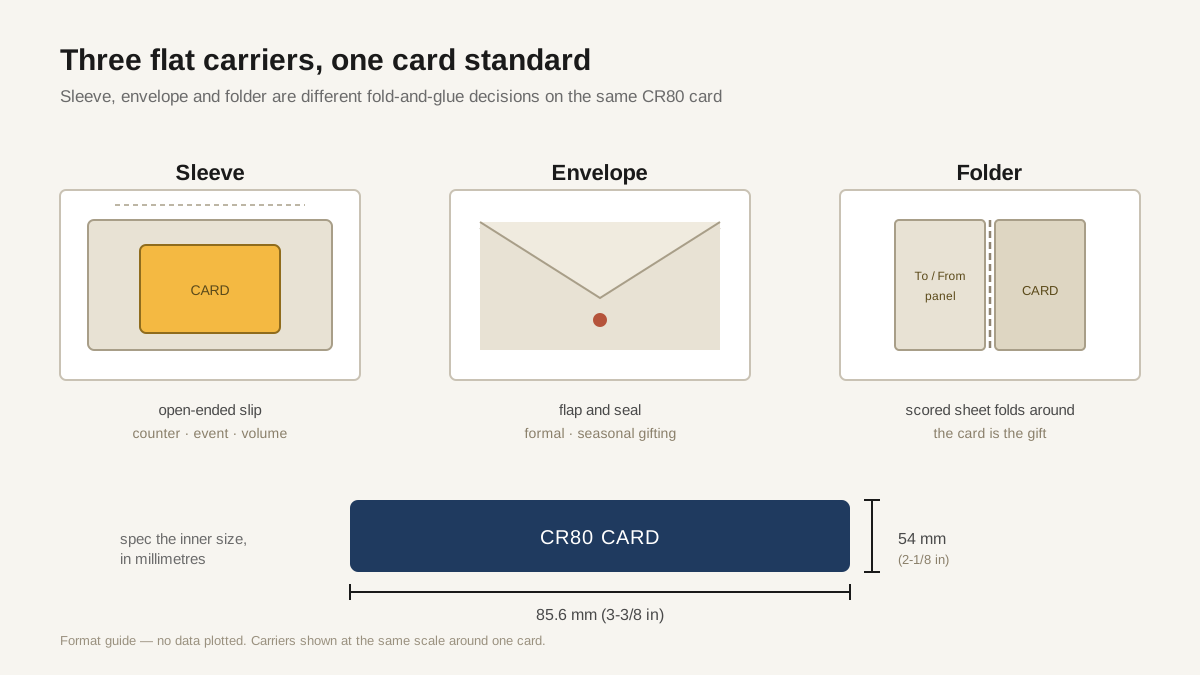
The sleeve is the workhorse. It is one piece of card stock, cut and glued into an open-ended slip, and it is the cheapest carrier to print and the fastest to pack — which is why promotional programmes and retail counters run on it. The envelope trades a little assembly speed for formality: a flap, a seal, sometimes a coloured lining, and the card becomes something that can be handed over at a dinner or slid into an invitation. The folder is the presentation tier of the flat carriers — a scored sheet that folds around the card, sometimes with a die-cut window or a printed To/From panel — and it is the right answer when the card is the entire gift and must carry the brand alone. The gift card boxes guide covers the tier above these: pop-up and slider structures for when the card needs a box, not a fold.
Choose by where the card changes hands, not by which sample photo looks best.
One standard size, every carrier
Every carrier in this family is built around one number: the CR80 bank-card format, 3-3/8 × 2-1/8 inches (85.6 × 54 mm). US suppliers publish their stock carriers at a fraction over it — VistaPrint lists sleeves at 3.5 × 2.25 inches, which is the card plus print bleed and a working slip tolerance (as published, read 17 October 2026). Two practical consequences follow. First, the inner dimension is the spec that matters: too tight and the card catches, too loose and it slides out of an open-ended sleeve. Second, one dieline family covers the whole programme — sleeve, envelope and folder are different fold-and-glue decisions on the same cut, which is why a brand can run mixed carriers from one supplier without three tooling conversations. Confirm the finished inner size in the spec, in millimetres, against the actual card you will load — including any magnetic stripe or embossed area that adds thickness.
Print methods and what they signal
Card stock is a small surface, so the print method does outsized brand work. One or two Pantone spot colours on a coloured paper is the classic formal-envelope look — one US gift-card printer publishes exactly that construction: one or two spot colours, twelve paper colours, at a listed USD 0.39 per sleeve with about two to three weeks of production (as published, read 17 October 2026). Full digital print is the volume default for sleeves, where the artwork is a logo and a colour field. Foil and deboss lift a folder into gift territory on the same board. The method also prices the programme: spot colour means plates and a cleaner unit cost at volume; digital means no plates and a flat cost curve that favours first runs. State the method, the paper colour and the Pantone references in the enquiry, and ask for a printed proof on the actual stock — card-stock colour shifts are small in absolute terms and very visible on a 3.5-inch canvas.
When not to use a flat carrier at all
Two situations push past this family. When the card is mailed on its own, a flat carrier still needs an outer mailing envelope — a bare sleeve in a postal stream arrives scuffed, and the community's recurring complaint about over-packaging cuts the other way too: restraint is only honest when the carrier survives the trip. And when the card anchors a physical gift set — a bottle, a candle, a piece of jewellery — it belongs inside the box with the product, as an insert or a card slot, not in a standalone carrier. The custom gift card boxes guide covers the box-tier structures, and the packaging inserts guide covers holding a card inside a larger set.
Ordering: the ladder you actually face
| Rung | Typical published terms | Fit |
|---|---|---|
| Online printer | from 25 pieces (one lists 25–5,000, 100# coated stock) | first tests, domestic speed |
| US print trade | folders and sleeves from USD 0.21 each at 50–150 piece minimums (one publishes a per-type price table); spot-colour sleeves at a listed USD 0.39 each, ~2–3 weeks | formal programmes, mid volume |
| US offset / volume tier | offset from 500 pieces; a listed curve that falls from USD 1.96 at 100 to 15.8 cents at 10,000 | large domestic runs |
| This factory | 200 pieces per design · 15–20 working days · custom sample USD 25 + USD 20 shipping, 3–5 days | branded runs, mixed carrier programmes |
A first branded carrier programme usually mixes rungs: a domestic print run to prove the artwork, then a factory run once the design is stable and the quantities repeat. Bring the card (or its exact dimensions), the carrier split — how many sleeves, how many envelopes, how many folders — and the print method and paper colour. T/T or PayPal, air or sea freight from Shanghai or Shenzhen, and the sea-freight arithmetic is why the calendar in the gift card boxes guide, worked backwards from a Q4 shelf date, applies to flat carriers exactly as it does to boxes.
The bottom line
One card standard, three flat carriers, and a ladder from 25-piece online tests to 200-piece factory runs: pick the carrier by where the card changes hands, spec the inner dimension in millimetres against the real card, and move to a factory run when the design is stable and the quantities repeat. Start the enquiry with the card dimensions, the carrier split and the print method; the quotation comes back with the dieline family that covers all three.