
Material classifications and trade-offs are industry references as published by packaging suppliers (sources named inline); the three insert systems and the layered-board cost figure are ELAPACK's published production references. Order terms — MOQ 200 pieces, 15–20 day production — are ELAPACK's confirmed trade terms.
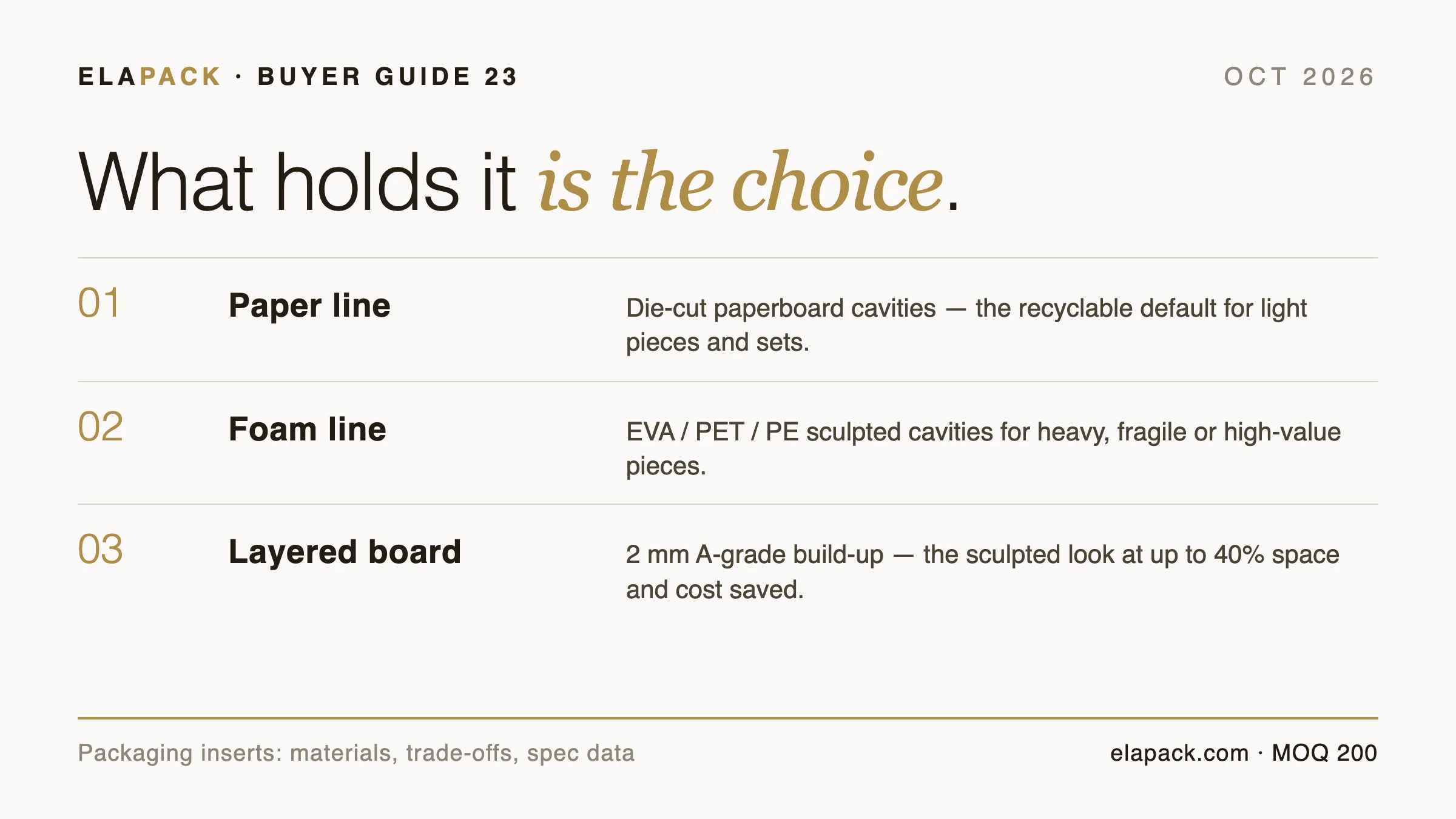
Quick answer: inserts trade protection against presentation and cost. Paper systems are the recyclable default for light pieces, EVA/PET/PE foams hold heavy or fragile items in sculpted cavities, and layered A-grade board saves up to 40% of space and cost where a sculpted look is wanted without foam. Specify by product weight, fragility and how the piece is lifted out.
Key facts at a glance
| Item | Figure | Source |
|---|---|---|
| Minimum order | 200 pieces per design | ELAPACK confirmed terms |
| Production lead time | 15–20 days at 200–20,000 pieces | ELAPACK confirmed terms |
| Insert systems (ELAPACK) | Recyclable paper line; EVA/PET/PE foam line; layered 2 mm A-grade board | ELAPACK published references |
| Layered-board saving | Up to 40% of space and cost vs sculpted alternatives | ELAPACK published figure |
Fitments and insert cards: one enquiry, two line items
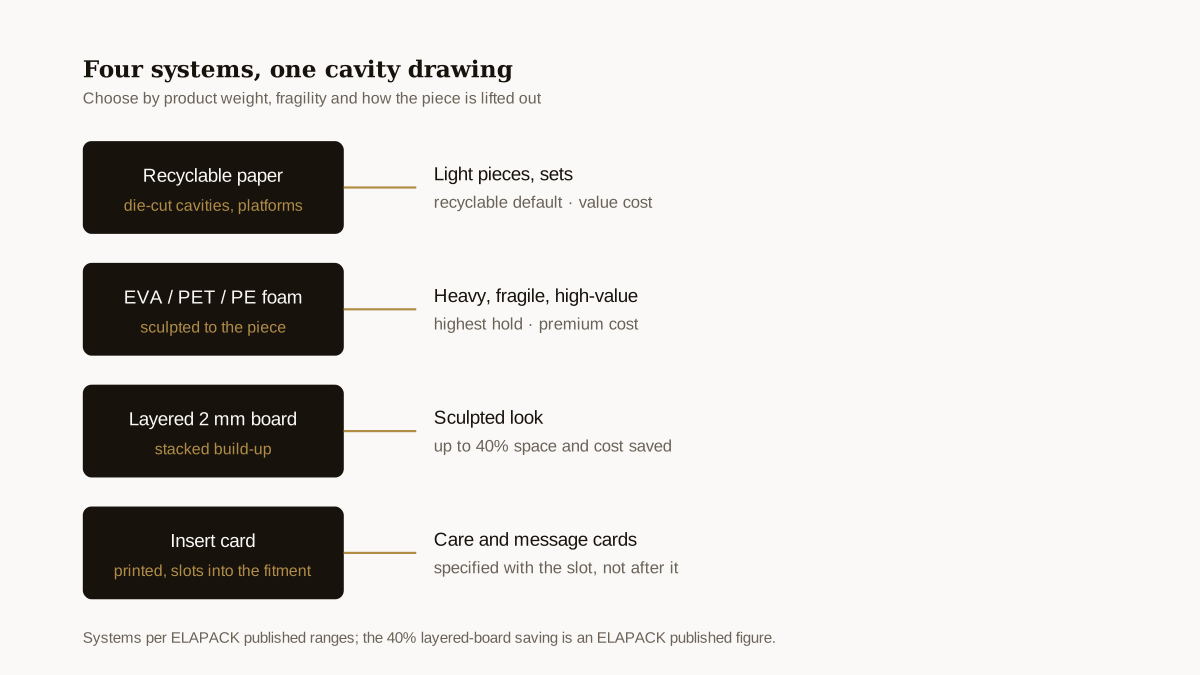
Buyers arrive with two different needs that share one keyword family: structural fitments that hold the product, and printed insert cards (care cards, message cards) that ride along. Specifying them together keeps the unboxing one coherent object — the fitment carries the product, the card carries the words, and both are cut to the same cavity drawing. The box they sit in has its own guide in custom rigid boxes.
Spec the fitment and the card against one cavity drawing — they share the box interior whether ordered together or not.
The material systems side by side
Industry references converge on five fitment families: paperboard, corrugated or fluted, moulded pulp, thermoformed, and foam (classification as published on wynalda.com), with foam subdivided into EVA, PU, EPE and PE grades (as published on dauxin.com and customboxmakers.com). ELAPACK's published range organises the same landscape into three systems.
| System | What it is | Best at | Watch-out |
|---|---|---|---|
| Recyclable paper line | Die-cut paperboard cavities and platforms | Light pieces, sets, recyclable programmes | Needs design for heavy items |
| EVA / PET / PE foam line | Sculpted cavities, custom-cut to the piece | Heavy, fragile or high-value pieces | Higher cost; sculpt per product |
| Layered 2 mm A-grade board | Stacked board build-up in place of sculpted foam | Sculpted look at up to 40% space/cost saving | Confirm fit on sample, as with any cavity |
| Moulded pulp (as published) | Pressed fibre forms | Jar-shaped goods at volume | Tooling needs quantity |
| Thermoformed (as published) | Formed plastic trays | Clarity, sealed hygiene formats | Presentation mismatch in luxury sets |
Systems one to three are ELAPACK published ranges; pulp and thermoformed rows are published industry options included for completeness.
Three systems cover luxury work — pulp and thermoform belong to other industries' toolkits.
The rule that decides: weight, fragility, lift
A published comparison gives the cleanest dividing line in the category: cardboard fitments run lower-cost and suit products under roughly two pounds with basic separation needs; foam runs higher-cost and protects fragile, heavy or high-value items (as published on printonpapers.com). Add the third axis luxury packaging adds: how the piece is lifted out. A cavity that protects in transit but fights the customer at the counter has the wrong draft angle, not the wrong material — which is why the sample review loads the actual product and lifts it, in the sample process. Format examples across the range: a watch box with a sculpted pillow, an eyelash box with a die-cut platform, a magnetic gift box with a layered-board fitment.
Choose by weight, fragility and lift — in that order — and prove the lift on the loaded sample.
Insert cards: the quiet second intent
"Packaging insert cards" names its own line item: care cards, warranty cards, gift messages. They are specified like any printed component — board weight, size against the fitment's slot, artwork, Pantones — and they fail in one predictable way: ordered at a size that does not slot into the final fitment. Specify the card with the fitment, not after it. For colour approvals across card and fitment, the four-step control chain in the colour tolerance guide applies to both.
Worked examples in the range
The candle programme in the candle boxes guide maps all five published fitment types to jar, pillar and votive formats. Complete presentations — box, fitment, pouch, card — sit in the sets collection, and the softest layer of the stack, wrapping tissue, has its own guide in custom tissue paper.
What to put in your enquiry
An insert enquiry a factory can quote first time carries: the product's dimensions and weight; fragility notes (glass, plating, scratch-sensitive faces); the box it goes into; the lift requirement — how the piece is removed and by whom; the material system or a request for proposals across two; card slot requirements if insert cards ride along; and quantity against the 200-piece minimum. Sculpted foam cavities are cut to the confirmed product drawing, so product drawings come before insert quotations.
The bottom line
Paper for light and recyclable, foam for heavy and fragile, layered board for the sculpted look at lower cost — and specify the card with the cavity. Contact ELAPACK with the product drawing, weight and box format, and the quotation will state the insert system, cavity layout and terms that apply.