
Candle-box sizing, insert and structure descriptions are industry references as published by packaging suppliers (sources named inline). Order terms — MOQ 200 pieces, 15–20 day production, custom sample at USD 25 plus USD 20 shipping, cutting-die tooling at USD 50–100 where required — are ELAPACK's confirmed trade terms.
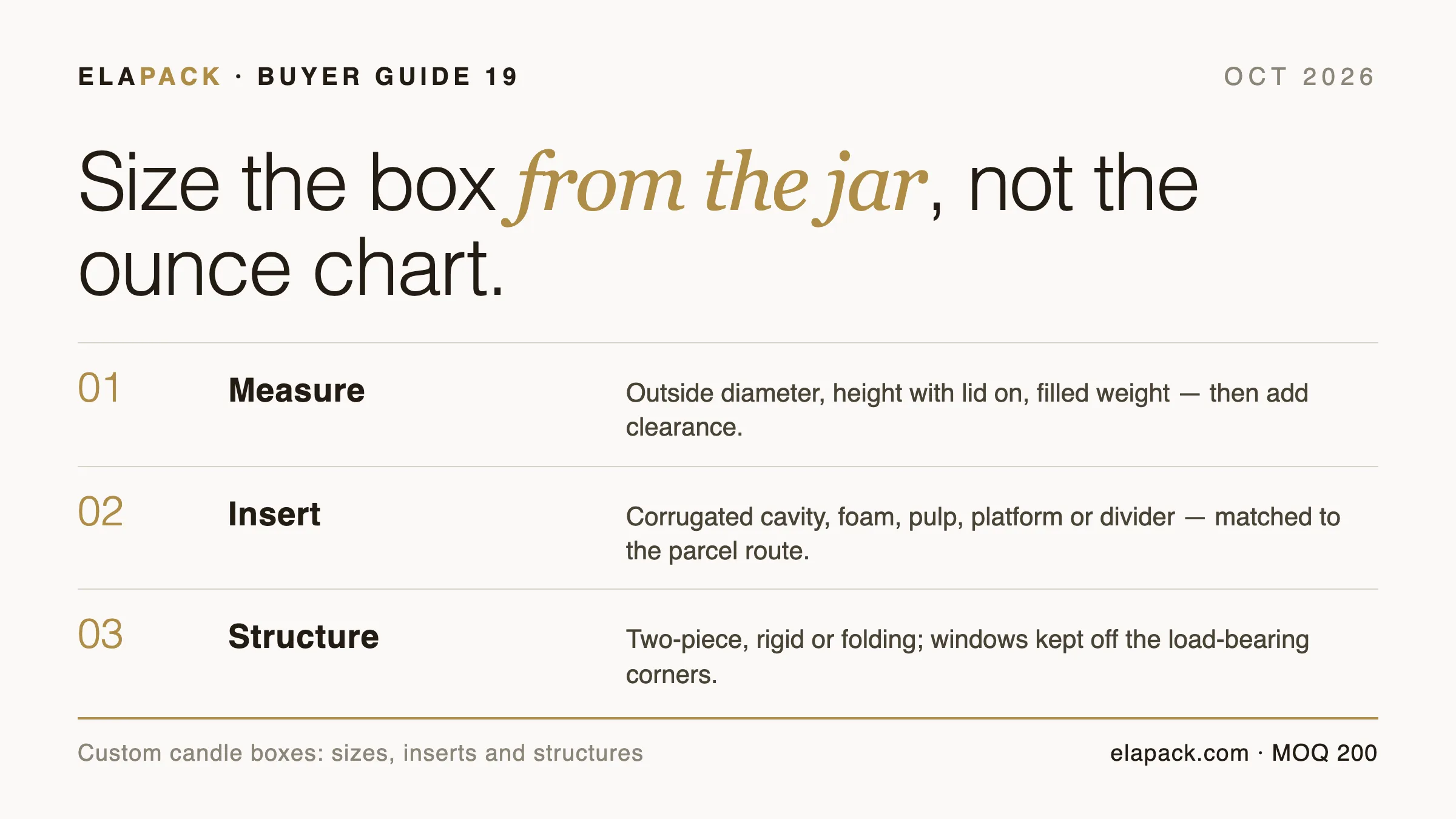
Quick answer: size the box from the measured candle, not from an ounce chart — outside diameter, height with the lid on, filled weight — then add clearance and choose the insert for the shipping route. Glass jars moving through parcel networks need an insert; the box alone is not the protection.
Key facts at a glance
| Item | Figure | Source |
|---|---|---|
| Minimum order | 200 pieces per design, all box lines | ELAPACK confirmed terms |
| Production lead time | 15–20 days at 200–20,000 pieces | ELAPACK confirmed terms |
| Custom sample | USD 25 plus USD 20 shipping, built in 3–5 days | ELAPACK confirmed terms |
| Cutting-die tooling | USD 50–100 where a new die is required | ELAPACK confirmed terms |
How candle buyers specify boxes
Candle-box enquiries arrive in three spec flavours: the retail box sized to the vessel, the insert that holds the jar, and the wholesale pack that ships multiples. Buyers who name all three in one brief get one dieline set; buyers who split them across suppliers get a carton that fits a box that almost fits the jar. This guide covers the one-off and retail candle box programme; if you pack a recurring monthly programme, see the candle subscription box guide for the repeat-order structure.
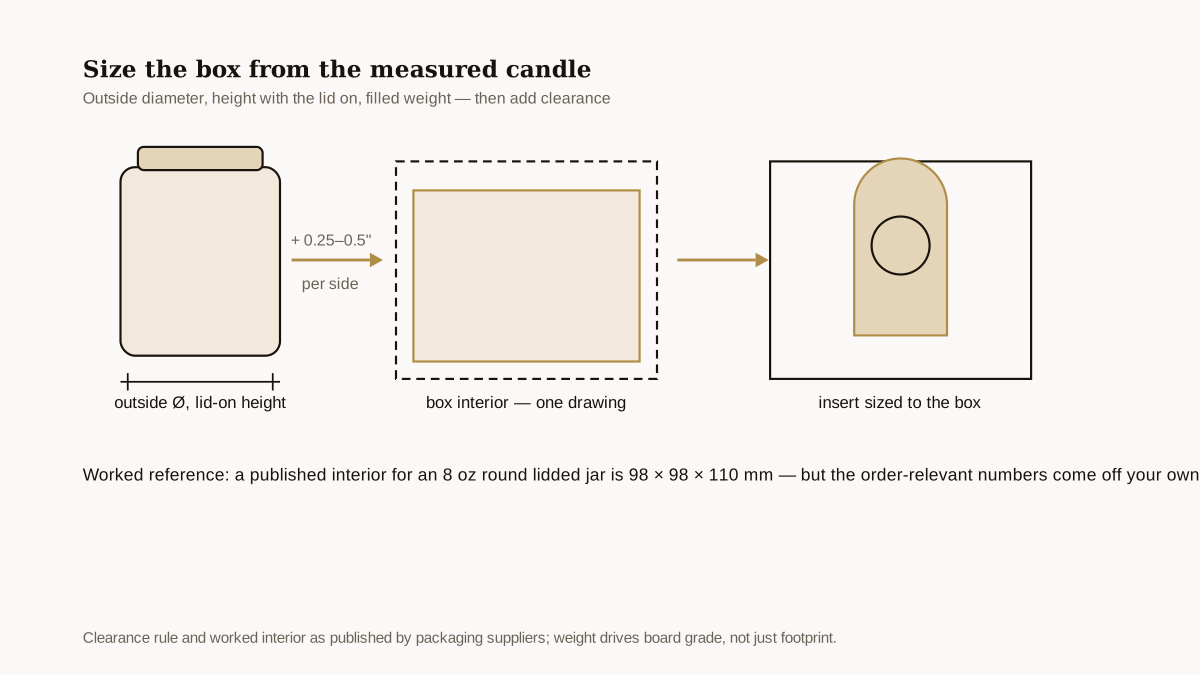
Size the box to the jar, the insert to the box and the carton to the box — in that order, on one drawing.
Measure the candle before anything else
Published sizing guides converge on the same rule: measure the actual filled candle, then add clearance. The measurements that matter are the outside diameter (or width and depth), the total height with the lid on, and the filled weight — weight because it drives board grade, not just footprint (as published on briskpackaging.com, August 2026). For clearance, supplier guides recommend adding roughly 0.25–0.5 inches per side between vessel and box wall (as published on thecustomizeboxes.com). As a worked reference, one supplier's published interior for an 8 oz round lidded jar is 3-7/8 × 3-7/8 × 4-3/8 inches (98 × 98 × 110 mm), with 4, 8 and 12 oz jars the most common volumes (as published on personalizedcandlebox.com and customboxdepot.com).
| Jar volume | Box planning basis | Source basis |
|---|---|---|
| 4 oz | Measure jar, add 0.25–0.5" per side | Published clearance rule |
| 8 oz | e.g. 98 × 98 × 110 mm interior for a round lidded jar | As published, personalizedcandlebox.com |
| 12 oz | Measure jar, add clearance; check weight for board grade | Published rule, customboxdepot.com |
| Pillar / taper | Diameter and burn-line height; platform insert | briskpackaging.com |
| Votive / tealight sets | Unit count × cavity size; divider insert | briskpackaging.com |
An ounce chart is a starting point — the order-relevant dimensions come off your own filled vessel.
Choose the insert for the shipping route
The insert is what stops a glass jar becoming a claim. Published comparisons break the options into five systems: a corrugated cavity insert, cost-effective and recyclable, holding heavy vessels well for direct-to-parcel shipping; a foam insert, highest protection for fragile or irregular vessels at a higher unit cost; moulded pulp for eco-positioned brands, which needs volume to amortise tooling; a paperboard platform for pillars and tapers, keeping wax off the box walls; and multi-cavity dividers for votive and tealight multipacks, preventing unit-to-unit contact (as published on briskpackaging.com). The same source states the principle bluntly: a candle that cannot move cannot build momentum against the box wall.
| Insert system | Best for | Cost position |
|---|---|---|
| Corrugated cavity | Heavy jars, direct parcel shipping | Cost-effective, recyclable |
| Foam | Fragile or irregular vessels | Highest protection, higher unit cost |
| Moulded pulp | Eco-positioned jar programmes | Needs volume for tooling |
| Paperboard platform | Pillars and tapers | Light, simple |
| Multi-cavity divider | Votive and tealight sets | Scales by cavity count |
Decide the insert by what happens after the tape gun — the parcel network, not the shelf, breaks candles.
Structure: two-piece, rigid or folding
Three structures cover the range. A two-piece lid-and-base lets the candle lift straight out without tipping, which protects glass rims, at a higher unit cost than cartons. A rigid box — chipboard core wrapped in printed paper — is the presentation choice and does not fold flat, with higher tooling and unit cost. Folding cartons ship and store flat and run efficiently at volume, but on their own they are not enough for heavy glass through parcel networks (structures compared as published on briskpackaging.com). Window cutouts show wax colour and vessel shape, at the cost of panel strength and an extra film step — published guidance keeps windows away from load-bearing corners and stacking faces. For presentation-grade candle gift sets, the magnetic closure gift box and the ribbon gift box are the two most-used formats; box structures across the range are on the boxes collection and gift boxes page.
Board, finish and the brief
Board options follow the contents: SBS white paperboard as the full-colour default, kraft for muted one-to-two-colour looks, E-flute corrugated where crush resistance matters, and rigid greyboard for keepsake boxes — with greyboard tiers from 1.5 to 3.0 mm carrying rising cost and presence (ELAPACK published reference ranges; grades at 2.5 mm suit medium-to-large gift boxes). Finishes run the same set as the rest of the luxury range — lamination, foil, emboss, spot UV — compared in the surface finishes guide. A quotable brief carries: measured vessel dimensions and weight, box structure, insert system, board and finish, artwork with Pantone references, quantity against the 200-piece minimum, and the destination shipping route so the insert choice can be checked against it.
The bottom line
Measure the filled candle, size the box with real clearance, match the insert to the parcel route, and let structure and finish follow the brand position. Contact ELAPACK with the jar dimensions, order quantity and delivery route, and the quotation will state structure, insert, board grade and tooling that apply.