
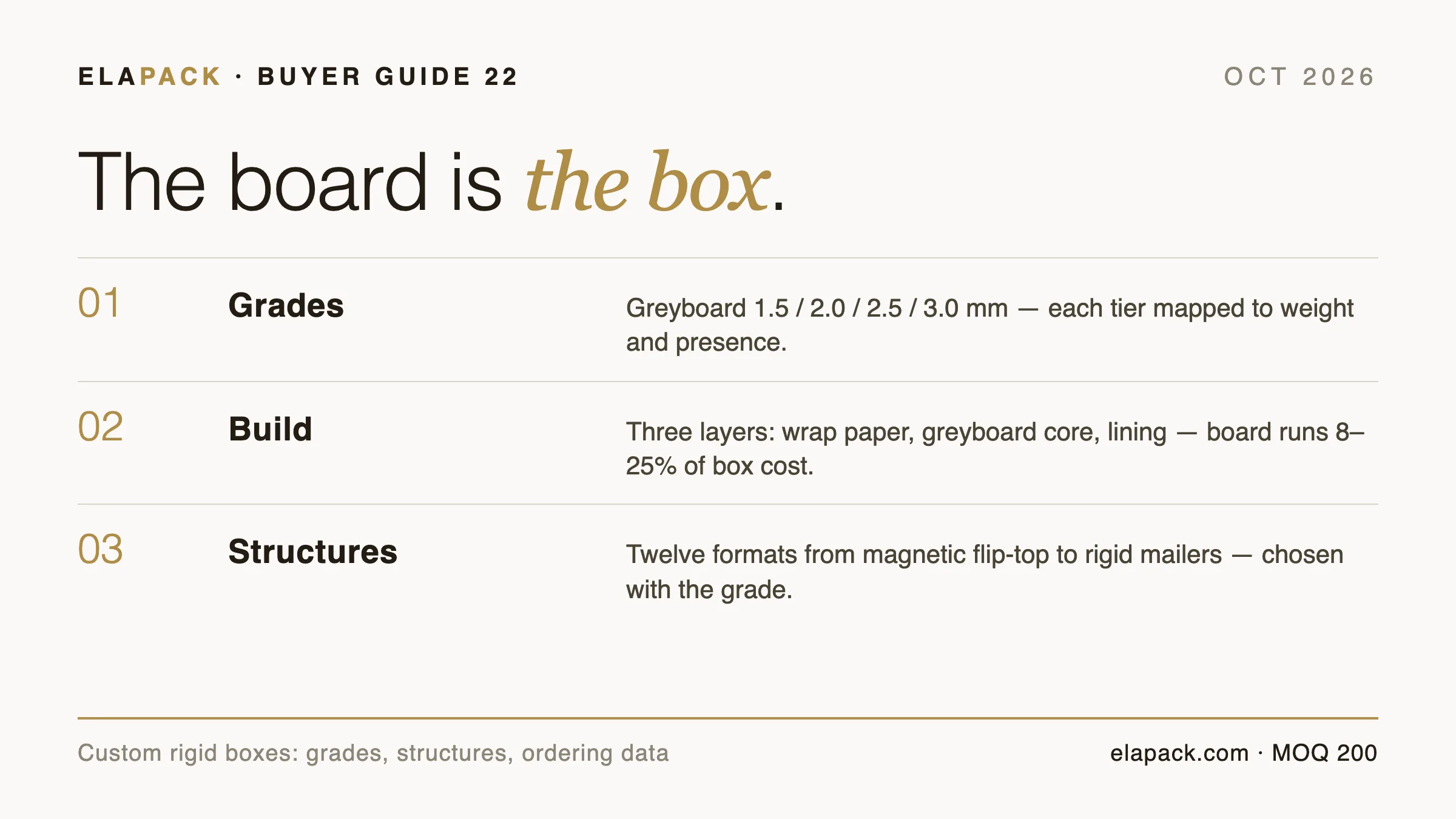
Construction descriptions are industry references as published by packaging suppliers (sources named inline); greyboard grades, cost shares and the twelve-structure list are ELAPACK's published production references. Order terms — MOQ 200 pieces, 15–20 day production, custom sample USD 25 plus USD 20 shipping, cutting-die tooling USD 50–100 — are ELAPACK's confirmed trade terms.
Quick answer: a rigid box is a three-layer build — wrap paper, greyboard core, lining paper — and the greyboard grade is the decision that carries everything else: 1.5 mm for small light boxes, 2.0 mm as the standard premium grade, 2.5–3.0 mm for large and heavy formats. Fix the grade with the structure, not after it.
Key facts at a glance
| Item | Figure | Source |
|---|---|---|
| Minimum order | 200 pieces per design | ELAPACK confirmed terms |
| Production lead time | 15–20 days at 200–20,000 pieces | ELAPACK confirmed terms |
| Custom sample | USD 25 plus USD 20 shipping, 3–5 days | ELAPACK confirmed terms |
| Cutting-die tooling | USD 50–100 where a new die is required | ELAPACK confirmed terms |
| Greyboard grades | 1.5 / 2.0 / 2.5 / 3.0 mm tiers | ELAPACK published references |
| Board share of box cost | ≈ 8–14% at 1.5 mm rising to 16–25% at 3.0 mm | ELAPACK published figures, reference basis |
How buyers name rigid boxes
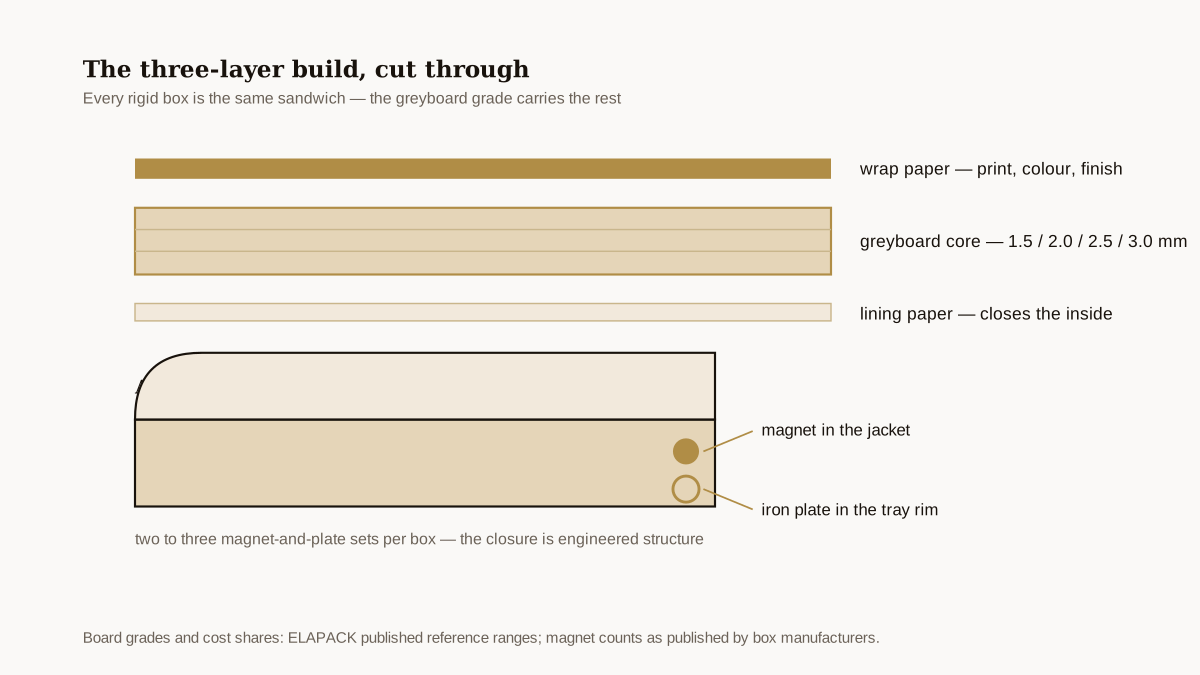
Enquiries that use the trade names — rigid box manufacturers, rigid box packaging supplier, rigid mailers — get quoted faster, because the words already specify the construction: a greyboard base, a wrapped cover and a glued cavity, built in one piece rather than folded from sheet. This guide uses those names throughout; the cross-section above shows the build they refer to. The structure decision this guide covers is the layer beneath the finishes compared in the surface finishes guide — finishes sit on this build.
Rigid boxes are ordered by construction, not by occasion — name the build in the enquiry, not the gift.
The three-layer build
Every rigid box is a sandwich. The greyboard core — also called chipboard, a dense layered material pressed from recycled fibres — gives the box its non-bending body (construction as published on zenpack.us and xactz.com); the wrap paper carries print, colour and finish; the lining paper closes the inside. Supplier references put typical box-body board at 1.2–3.0 mm (as published on thebestpriceboxes.com), with MDF board used by some factories as a premium alternative core (as published on blog.opack.com) — ELAPACK's range is built on greyboard tiers, published as follows.
| Grade | Typical application | Share of box cost (reference) |
|---|---|---|
| 1.5 mm | Small boxes, light items — jewellery cards, sample kits | ≈ 8–14% |
| 2.0 mm | Standard premium boxes — skincare, fragrance sets | ≈ 10–18% |
| 2.5 mm | Medium-to-large gift boxes, press kits | ≈ 13–22% |
| 3.0 mm | Large boxes, heavy contents, maximum presence | ≈ 16–25% |
Cost shares are ELAPACK published figures, for reference only, based on similar box size, structure and standard finishing.
The grade sets depth, closure weight and cost in one line — choose it with the structure, never after the artwork.
Twelve structures, three everyday heroes
The published structure list runs to twelve: magnetic flip-top, lid-and-base, drawer, two-door, handle, folding, cylinder, window, display, advent, mailer and card box. In luxury gifting three carry most programmes: the magnetic flip-top for one-hand opening, the ribbon-tie box for occasion presentation, and lid-and-base for sets — the magnetic structure has its own deep-dive in the magnetic gift boxes guide. Category formats follow their products: the ring box and the eyelash box are grade-1.5–2.0 formats, while display and advent builds lean on 2.5 mm and above.
Rigid mailers
A rigid mailer is the same build in a slim one-piece format — a presentation-grade unboxing that survives the parcel network, unlike a folding carton that only looks the part. For e-commerce sets, pair the mailer with the insert decision covered in the packaging inserts guide.
Mailer demand is rigid demand in shipping clothes — answer it with the structure, not a separate format chase.
Wrap, lining and what drives cost
Three cost levers sit above the board: the wrap (art paper, specialty paper, textile), the finish set on it (lamination, foil, emboss — compared in the finishes guide), and the lining. The published cost shares above cover the board layer only; wrap and finish stack on top by grade. Assembly matters as much as material: the six-station QC chain that gates a rigid run includes assembly fit — a box that measures right but closes wrong fails at the same station. Structures and stock formats across the range sit on the boxes collection and the custom gift boxes page.
What to put in your enquiry
A rigid enquiry a factory can quote first time carries: the structure (from the twelve, or a drawing); the greyboard grade — or the product and weight and let the factory propose; wrap and finish choices; internal layout, cross-referenced to the insert specification; quantity against the 200-piece minimum; vector artwork; and the sample route. Where a new cutting die is required it is quoted at USD 50–100 — the dieline itself is drawn free to confirmed product dimensions, covered in the die cutting and dielines guide.
The bottom line
Pick the grade for the weight, the structure for the opening, and let wrap and finish carry the brand. Contact ELAPACK with the product, structure and quantity, and the quotation will state board grade, wrap, tooling and terms that apply.