
Construction anatomy and assembly references are as published by packaging manufacturers (sources named inline, checked October 2026). Order terms — MOQ 200 pieces, 15–20 day production, custom sample USD 25 plus USD 20 shipping — are ELAPACK's confirmed trade terms. This guide is the structure deep-dive; if you are still choosing between closure types, start with the [magnetic versus ribbon-tie comparison](https://elapack.com/news/magnetic-closure-vs-ribbon-tie-gift-boxes/).
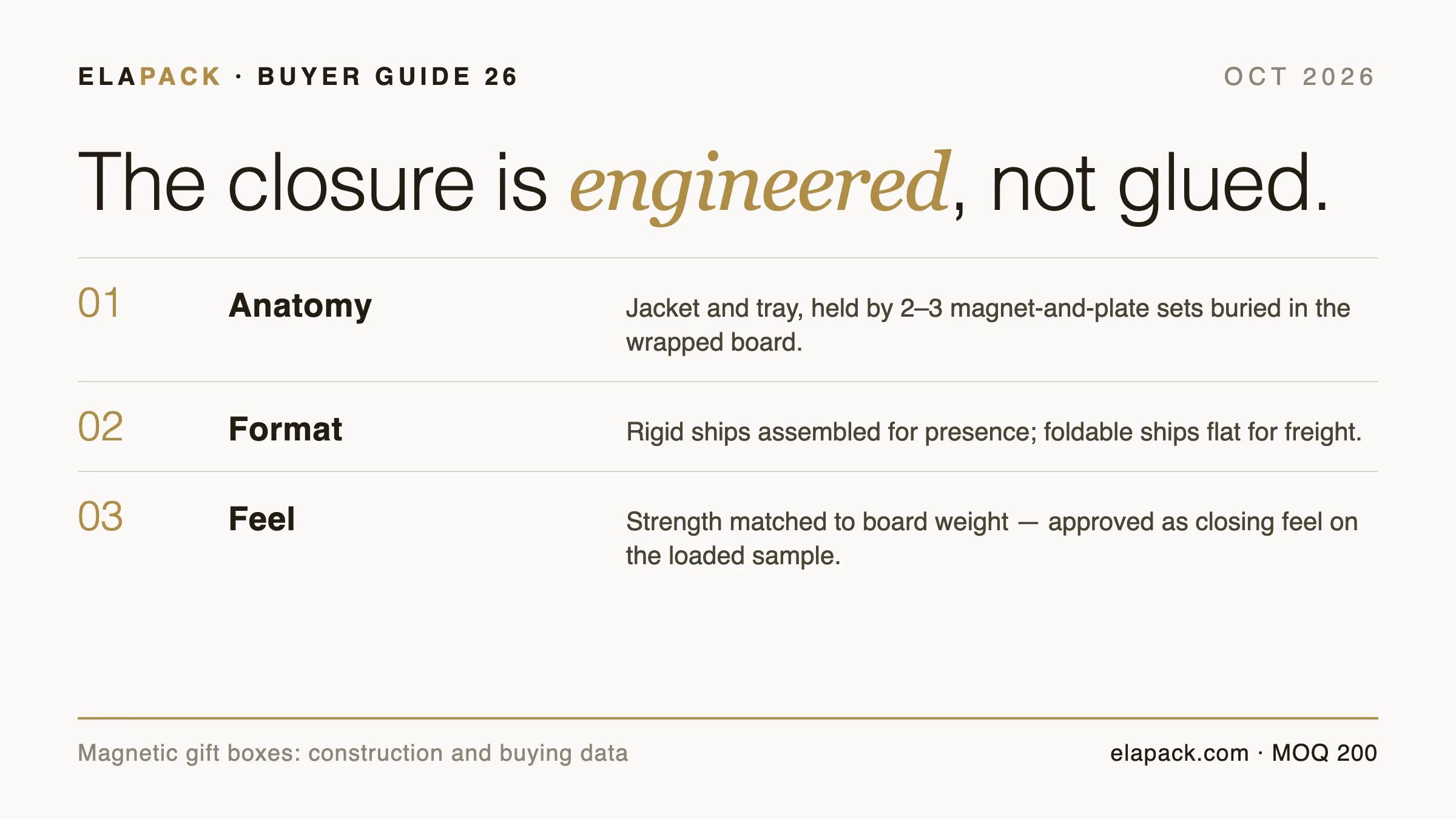
Quick answer: a magnetic box is a jacket and a tray held shut by two to three magnet-and-iron-plate sets buried in the wrapped board. The two decisions that matter: rigid (ships assembled, always premium) versus foldable (ships flat, assembles at destination), and magnet strength matched to box size and board weight — verified as closing feel on the loaded sample, not on paper.
Key facts at a glance
| Item | Figure | Source |
|---|---|---|
| Minimum order | 200 pieces per design | ELAPACK confirmed terms |
| Production lead time | 15–20 days at 200–20,000 pieces | ELAPACK confirmed terms |
| Custom sample | USD 25 plus USD 20 shipping, 3–5 days | ELAPACK confirmed terms |
| Anatomy | Jacket + tray; 2–3 magnet-and-plate sets; 4–6 structural holes per box | As published, chiefcolor.com |
What buyers call a magnetic box
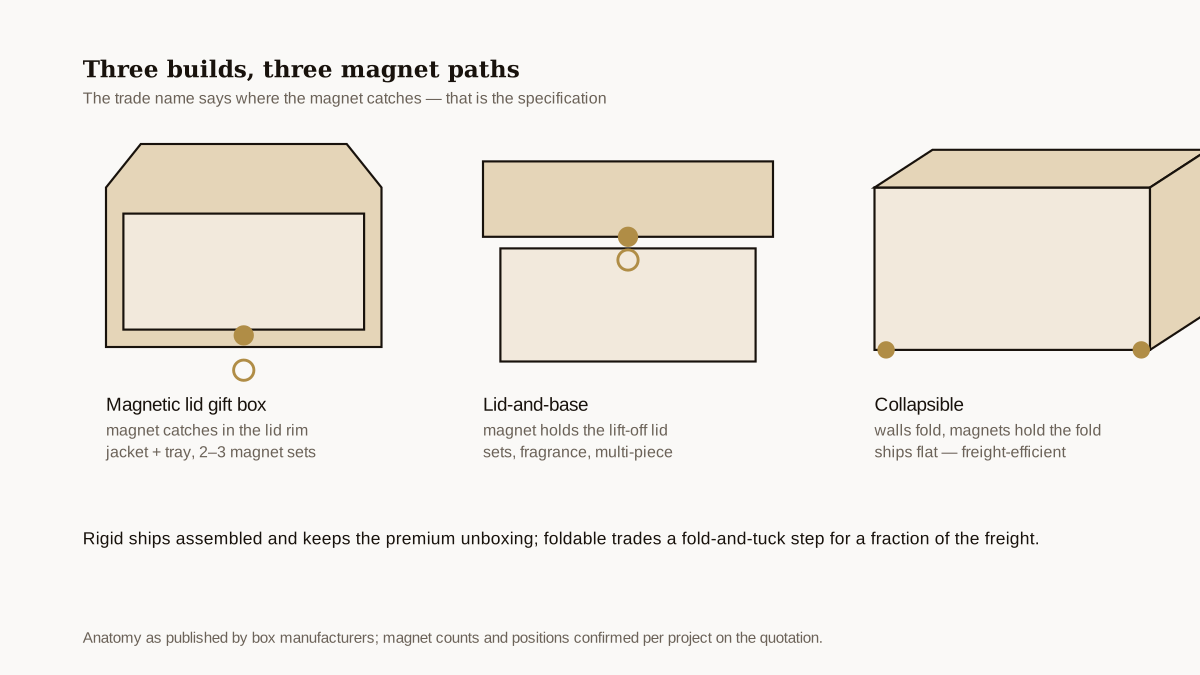
The trade names matter here because the magnet placement is the spec: magnetic lid gift box means the magnet catches in the lid rim; collapsible gift box with magnetic closure means the walls fold and the magnets hold the fold. Christmas gift boxes register as their own seasonal line — buyers re-order on season, and factories run them as seasonal production. The magnetic closure gift box is the product anchor for the line.
The magnet is a placement decision, not a feature tick — name where it catches, and the factory quotes the right build.
Anatomy: jacket, tray, and what holds it shut
A magnetic box is two working parts: the jacket — the wrapped outer shell with the closing flap — and the tray that slides or sits inside. The closure is a pairing of magnets and iron plates (thin ferrous discs) set into the structure: a typical foldable magnetic box carries two to three sets, which means four to six holes engineered into the board, and large formats more (a published example runs to fourteen holes on an oversized storage box). The magnets go in after the jacket is wrapped, and are fixed with glue dots so they cannot drop out in handling; the industry has moved from hand-placement to semi-automatic magnet-applying machines that fill up to three holes per pass (anatomy and assembly as published on blog.chiefcolor.com).
| Component | Role | Buyer's specification angle |
|---|---|---|
| Jacket | Wrapped outer shell, carries the flap | Wrap, finish, print — the brand layer |
| Tray | Inner carrier for product and insert | Depth, insert fit, product clearance |
| Magnet + iron plate sets | Closure pairs, 2–3 per box typical | Closing feel, hold when loaded |
| Structural holes | Housing for each magnet/plate | Count and position follow the flap design |
Every magnet set is engineered structure — flap design changes hole count, and hole count is a tooling conversation, not a decoration one.
Rigid or foldable
The two formats split on one variable: what state the box travels in. A rigid magnetic box ships fully assembled and keeps its shape — the premium unboxing, at shipping volume. A foldable (collapsible) magnetic box ships flat and assembles at destination — the freight-efficient format for e-commerce and events, with the same closure once built (formats compared as published on richpkg.com and packagingoftheworld.com). The decision rule is logistics-driven: assembled boxes cube out containers and closets; flat boxes trade a fold-and-tuck step for a fraction of the freight. Board grade follows either path — the rigid boxes guide covers greyboard tiers and the three-layer build beneath this closure.
Let the freight and the fulfilment step decide — premium shelf presence is rigid, mail-heavy programmes earn back the fold.
Strength, board and the closing feel
Magnet strength is matched to the box, not maximised: the working rule published by manufacturers is that strength follows the cumulative weight of lid and board, with heavier boards and larger flaps taking stronger magnets, and magnet grades stepping from N35 to N52 on the neodymium scale (references as published on packshion.com and insights.made-in-china.com). Two specification consequences follow. First, strength is verified physically: the sample review closes the loaded box — with product and insert in place — and checks the flap seats without drift, the same loaded-sample discipline the finishes guide applies to colour. Second, a magnet that is too strong fights the recipient; the target is a hold, not a snap. Specific magnet grades and positions are confirmed per project on the quotation.
Specify a closing feel, not a magnet grade — and approve it loaded, with the insert in.
Where the format travels
Magnetic closure carries across the range: the flagship magnetic gift box, watch boxes and eyelash boxes in smaller formats, and full presentations in the sets collection. The ribbon alternative — where a tied bow is the presentation rather than the closure — is the ribbon gift box; the two closures also combine, covered in the comparison guide. Q4 programmes should read the ordering-maths section of the gift card boxes guide — the holiday clock applies to this format as much as any.
What to put in your enquiry
A magnetic-box enquiry a factory can quote first time carries: format — rigid or foldable; box structure and greyboard grade; the flap design (which sets the magnet count and position); the closing-feel requirement in words — soft hold, firm hold — rather than a magnet grade; wrap and finish; insert scope from the inserts guide; quantity against the 200-piece minimum; and the shipping state — assembled or flat — so freight can be planned with production.
The bottom line
Jacket, tray, two-to-three magnet sets: choose rigid or foldable by logistics, match strength to board, and approve the closing feel on the loaded sample. Contact ELAPACK with the format, flap design and quantity, and the quotation will state the construction, magnet specification and terms that apply.