
Product facts and ordering terms below are this factory's published trade terms. Competitor prices are quoted as published on their pages, read 15 October 2026, for comparison only.
A branded cleaning cloth is the cheapest piece of brand real estate in eyewear: it travels in every case, gets used daily, and carries a logo for the life of the glasses. Yet most of what a buyer finds online is a price list — a no-minimum print shop at one end, a promotional catalogue in the middle, a factory price-per-thousand at the other — and almost nothing on the specification that decides whether the cloth cleans well, survives washing, and keeps the print intact. This guide covers that specification: weight, size, print, and care.
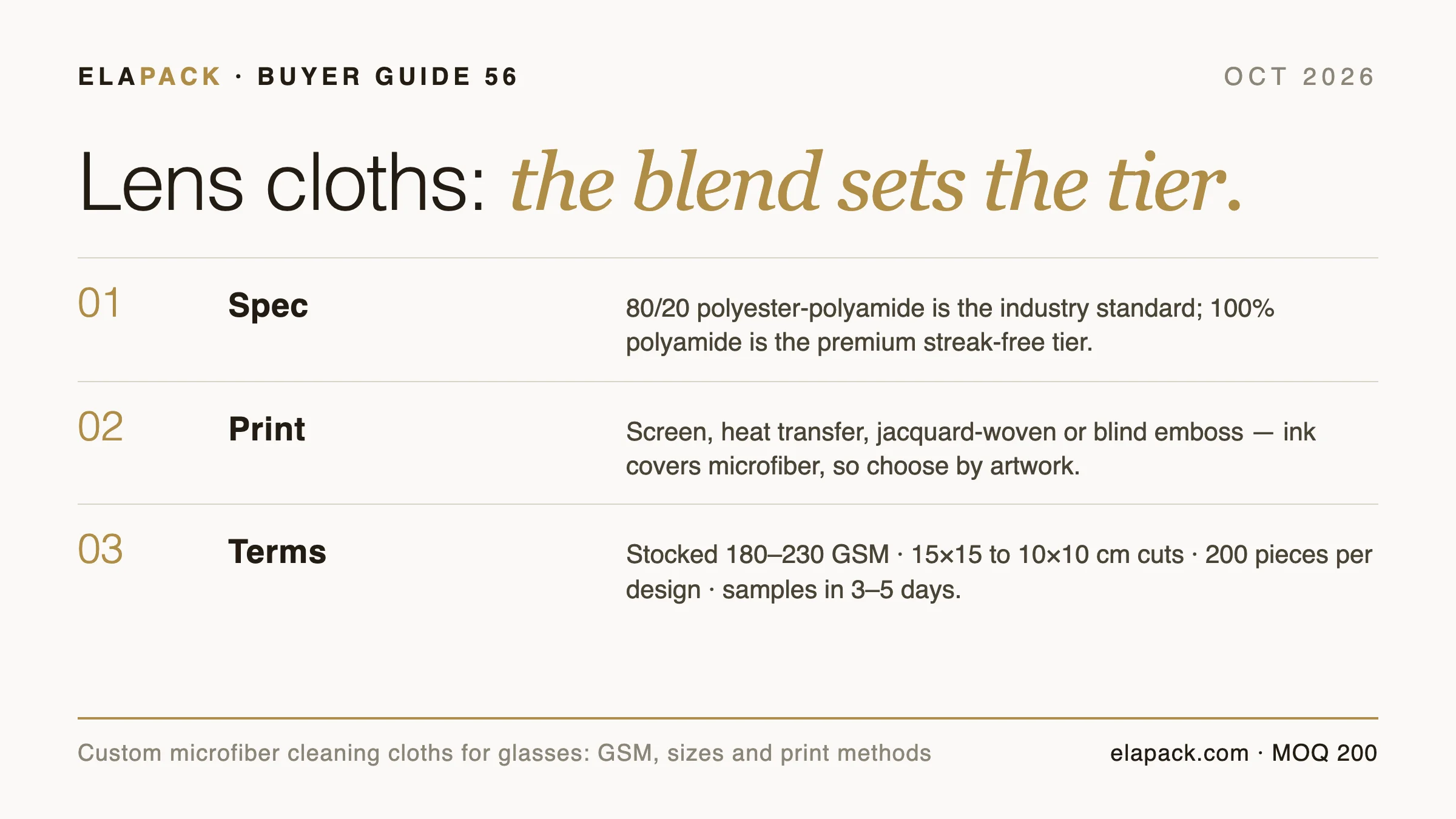
Quick answer: "microfiber" means a polyester-polyamide knit, and the blend ratio sets the tier — 80/20 is the industry standard most clients choose, 100% polyamide the premium tier for streak-free lens wiping; this factory stocks both at 180–230 GSM, custom blends on request. Standard sizes run 15×15 cm down to 10×10 cm for compact cases; print is screen, heat transfer, jacquard-woven or embossed; and a custom run starts at 200 pieces with samples in 3–5 days. Pair with a microfiber pouch from the same line for one freight, one programme.
Composition and weight: the two spec decisions
"Microfiber" names the fibre fineness, not a single recipe: every microfiber cloth is a knit of polyester and polyamide, and the ratio sets the tier. Polyester provides the mechanical cleaning bite — its fibres grab oil and grit; polyamide provides absorbency and softness. 80% polyester / 20% polyamide is the ratio the industry treats as the standard, and it is what most clients of this factory choose: the best balance of wipe, durability and cost, which is why the market runs on it. 100% polyamide is the premium tier — maximum absorbency and the softest, streak-free finish on coated and AR lenses, at a higher fibre cost — the pick of premium eyewear and camera brands. Both are stocked here at 180–230 GSM, with custom blends on request.
Weight then does the rest of the work within the tier, and the band for optics runs roughly 120 to 280 GSM. Below the stocked band the cloth turns filmy — factory listings cluster there because it is cheapest, not because it wipes well; above 250 GSM it feels premium for retail kits at a cost in fold bulk. The buyer's rule: pick the blend for the brand tier, then the weight for where the cloth lives — case insert, standalone accessory, or gift kit — not the highest number on a quote.
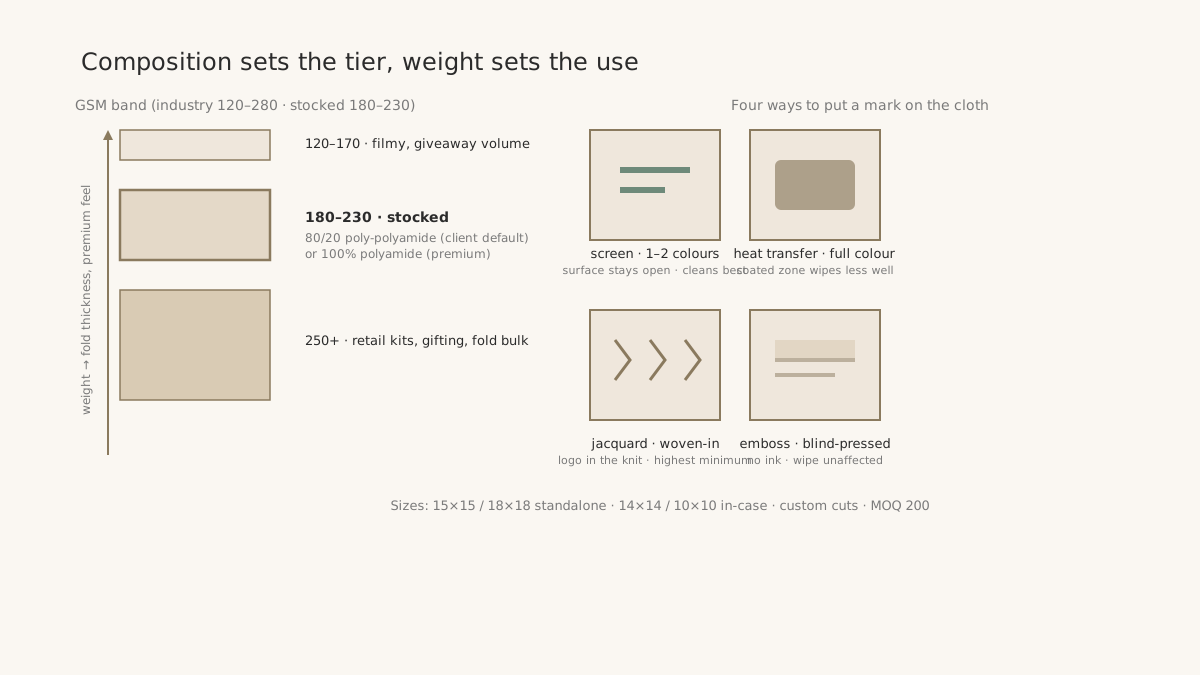
Fig. 1 — Microfiber cloth specification — GSM bands and the four print methods.
Sizes and edge finishes
Optical cloths mostly follow a small set of cut sizes: 15×15 cm and 18×18 cm as standalone accessories, 14×14 cm and 10×10 cm folded into cases, and custom cuts for oversized sunglasses or boxed kits. Two edge finishes dominate: laser-cut edges, which seal the knit against fraying at no sewing cost and suit promotional volume, and sewn-overlock edges for a finished look on heavier weights in retail kits. The specification worth writing down is the folded size — the size the cloth must collapse to inside the customer's case — because that, not the open cut, is what returns to the factory as a re-order problem when it is wrong.
Print methods and cleaning performance
The print choice interacts with the cloth's function in a way catalogues never mention: ink covers microfiber. Screen printing one or two colours leaves most of the surface open and cleans best — the standard for optics. Heat transfer reproduces full colour but lays a larger coated zone that cleans less well where the artwork sits, acceptable when the logo is compact. Jacquard weaves the logo into the knit itself — nothing sits on the surface, cleaning is unaffected, and the minimum is highest; it is the premium default for eyewear and camera brands. Embossing presses the mark into the pile with heat and pressure instead of ink — a tonal, blind-stamped logo that reads as texture rather than print, leaves the wiping surface fully functional, and suits minimal monogram marks on premium cloths. The decision sequence: artwork colour count first, then how much of the cloth the mark may cover, then budget.
Keeping a branded cloth clean
The most-searched questions in this cloth family are care questions — how to wash a microfiber eyeglass cloth — and the answer matters doubly for branded cloths, because the wash cycle is where a cheap print fails. Lukewarm water, mild detergent, no fabric softener (it coats the fibres and kills the cleaning action), air dry, and the print method above decides whether the logo survives the fiftieth wash. For a brand, publishing these instructions with the product cuts support questions and quietly demonstrates that the cloth was specified to last.
What a first run looks like
| Line item | Terms |
|---|---|
| Minimum | 200 pieces per design |
| Fabric | 80/20 polyester-polyamide or 100% polyamide, 180–230 GSM (custom blends on request) |
| Production | 15–20 working days (200–20,000) |
| Samples | stock free + USD 20 shipping (2–3 days); custom USD 25 + USD 20 (3–5 days) |
| screen / heat transfer / jacquard-woven / embossed | |
| Payment and freight | T/T or PayPal; air or sea from Shanghai or Shenzhen |
Cloth is the lightest freight in any eyewear programme, which makes it the natural companion order: a run of cloths pairs with a run of custom sunglasses pouches from the same production line, shipping together at one freight cost. Sprays and lens solutions are a separate chemical trade this factory does not supply — cloths, pouches and print are the line here.
Bottom line
Specify on function: weight by where the cloth lives, size by the folded case, print by colour count and how much surface it may cover. Start the quote with size, target weight and artwork; a sample follows in 3–5 days.