
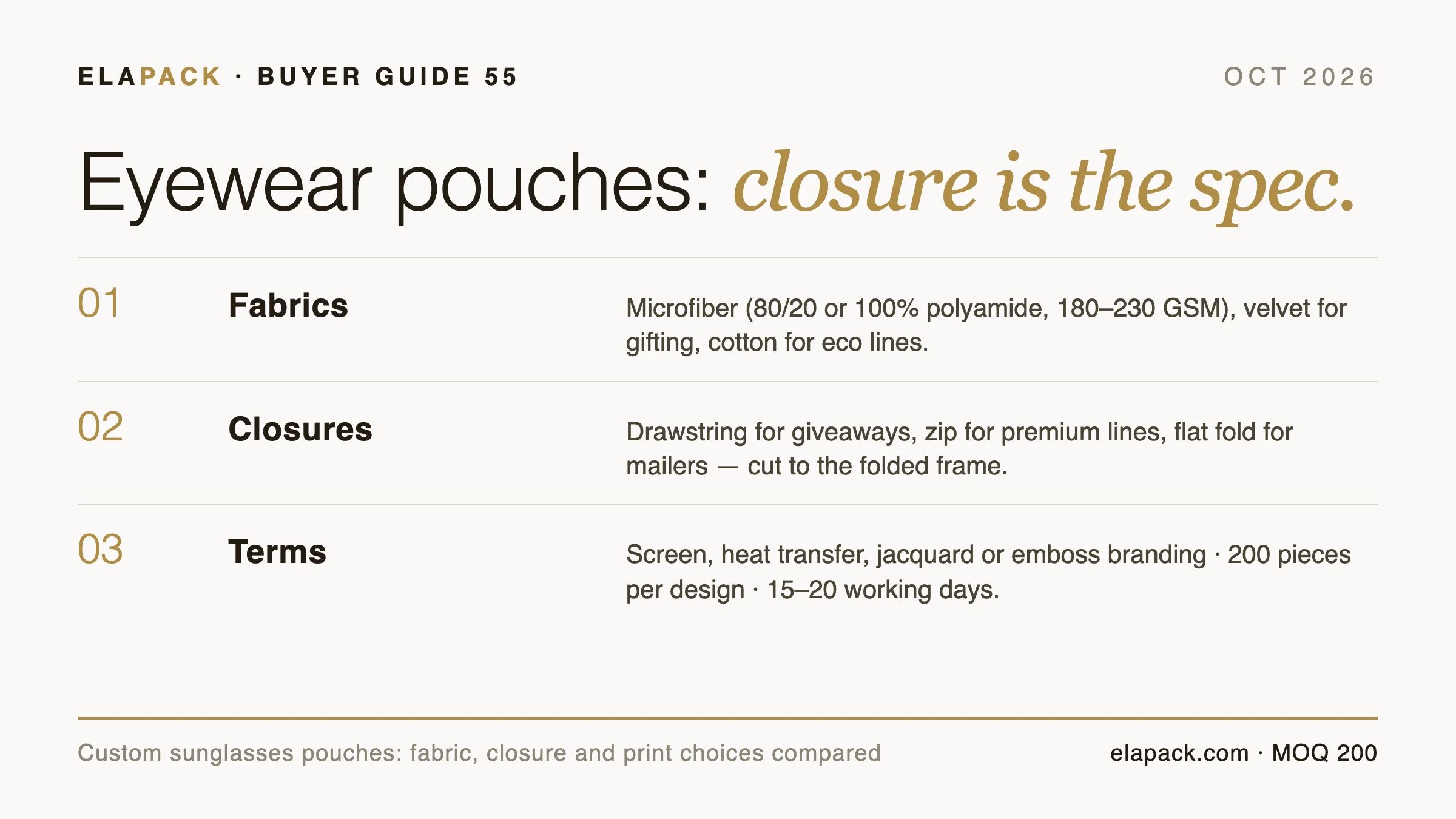
Product facts and ordering terms below are this factory's published trade terms. Competitor prices are quoted as published on their pages, read 15 October 2026, for comparison only.
A sunglasses pouch looks like the simplest item in an eyewear programme — until the specification sheet arrives. Fabric, closure, size, print method: each choice moves the unit price, the lead time and the way the pouch feels in a customer's hand. The promotional catalogues show none of this; they list a grey microfiber drawstring at one price and a full-colour print at another, and leave the brand to guess which specification fits which product line. This guide lays the choices out side by side, from a factory that sews these pouches at branded-run volumes.
Quick answer: for eyewear, microfiber is the working fabric (it cleans as well as protects), the closure follows the retail context — drawstring for giveaway and travel, zip for premium lines, flat fold for mailers — and print runs from one-colour screen at the lowest setup to full heat-transfer colour at the highest. MOQ 200 pieces per design; custom samples in 3–5 days.
Why microfiber owns the eyewear pouch
Three fabrics carry most of the market. Microfiber — the same polyester-polyamide knit used for lens cloths — is the default because a pouch sewn from it doubles as a cleaner: the customer pulls the sunglasses out and wipes the lenses with the bag. The blend ratio works here exactly as it does on the cloths: 80/20 polyester-polyamide is the industry-standard balance most clients choose, 100% polyamide the premium tier with the softest hand, both stocked at 180–230 GSM with custom blends on request. That dual function is why the microfiber variants dominate search demand across both the sunglasses and eyeglass word families, and why promotional suppliers build their catalogues around it. Velvet is the counter-choice for display and gifting contexts, where the pouch sits open in a box and touch sells. Cotton and muslin carry natural-fibre branding for eco lines at a slightly firmer hand. All three are stocked; the decision is positioning, not availability.
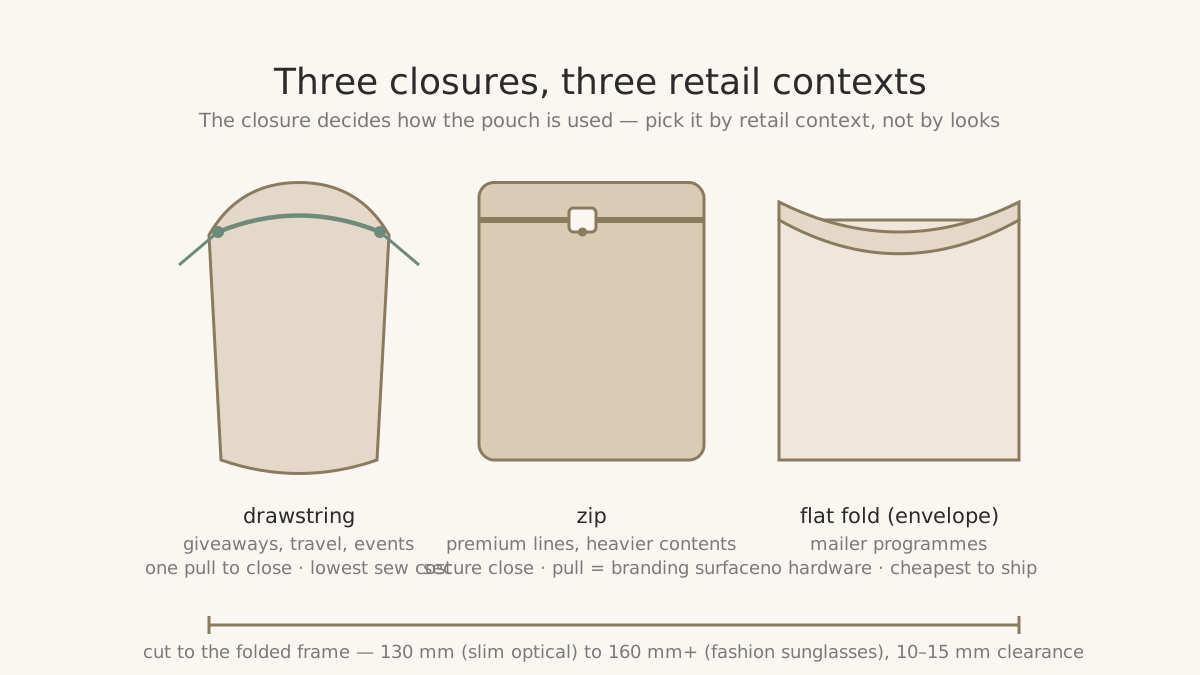
Fig. 1 — The three eyewear pouch builds — drawstring, zip and flat fold.
Closures: drawstring, zip, flat fold
The closure decides how the pouch is used more than how it looks. A drawstring closes in one pull, costs the least to sew, and suits high-volume giveaways, event merch and travel retail — it is the build behind nearly every promotional catalogue listing. A zip adds a secure close for premium lines and heavier contents (a sunglasses pouch that also carries a cloth and a small care card), at a modest sewing premium; fabric zips are stocked, metal pulls add a branding surface. The flat fold — an envelope with a tuck flap and no hardware at all — is the lightest and cheapest to ship, made for mailer programmes where the pouch arrives flat with the glasses. Between them these three builds cover the eyewear market; anything else is a bespoke pattern.
Print methods and what each costs in setup
Screen printing prices per colour — one colour in one position is the promotional standard — and holds up at volume for simple logos. Heat transfer reproduces full-colour artwork, gradients and photographic marks, at a higher per-piece cost that falls with quantity. Woven-in or jacquard construction puts the logo into the fabric itself for premium microfiber builds, at the highest minimum. The specification question to answer first is not "which print" but "how many colours does the mark actually need" — most eyewear logos are one or two, which is why screen remains the volume default. A print method should be chosen on the artwork, not the catalogue page.
Sizing to the glasses, not the shelf
Pouches are cut to contents, and eyewear spans a wide span: slim optical frames fold to 130–140 mm, fashion sunglasses run to 160 mm and above, and oversized or wraparound styles need a bespoke pattern. A pouch with 10–15 mm of clearance closes easily and stops the glasses sliding; a pouch sized "generously" lets them rattle — the failure mode behind most re-order requests. The specification that matters is the folded length and width of the actual frame, measured hinge to hinge and across the widest lens point, sent with the quote.
What a first run looks like
| Line item | Terms |
|---|---|
| Minimum | 200 pieces per design |
| Production | 15–20 working days (200–20,000) |
| Samples | stock free + USD 20 shipping (2–3 days); custom USD 25 + USD 20 (3–5 days) |
| Fabrics | microfiber, velvet, cotton, satin — stocked |
| Payment and freight | T/T or PayPal; air or sea from Shanghai or Shenzhen |
Between the promotional 100-piece run and the 1,200-piece factory order sits the band most young eyewear brands actually buy in — 200 to 500 pieces, one or two designs, custom fabric and full specification. That band is what this factory serves. Pair the pouch with a branded microfiber cloth from the same production line and the same freight; the cloth guide covers its specification separately. For the full eyewear packaging programme — boxes, inserts, pouches — the eyewear packaging guide maps the components.
Bottom line
Specify the pouch like the product it is: fabric by positioning, closure by retail context, print by the artwork's colour count, size by the folded frame. Start the quote with frame dimensions and target volume; the pattern and sample follow.