
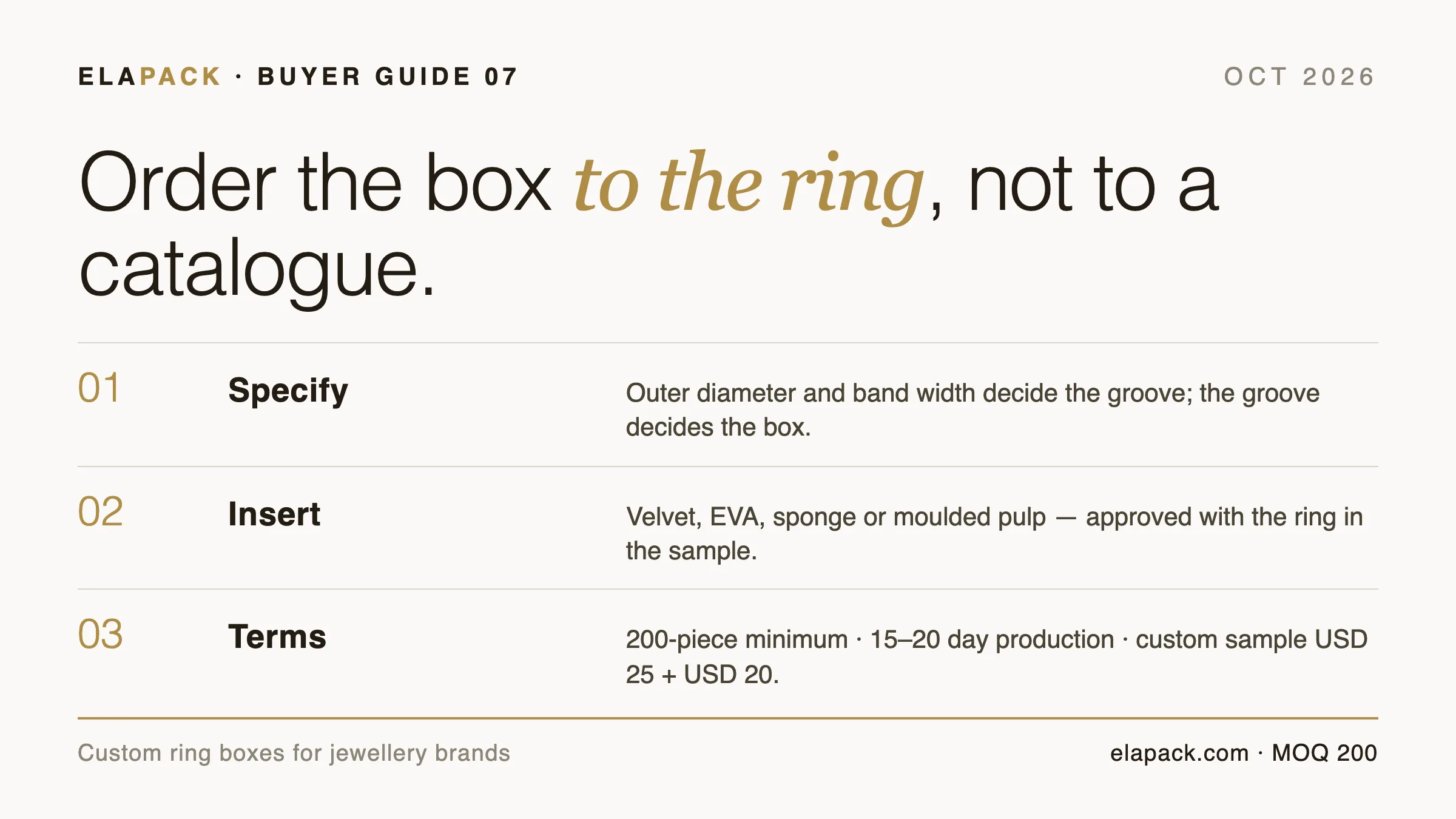
A ring box should be selected around the rings you actually sell. The outer dimensions alone do not describe the slot, the space above the setting or the way the customer removes the ring. For a collection with several settings, a sample plan is more useful than choosing one box from a photograph and assuming the rest will fit.
Read box and insert dimensions as a matched specification
Westpack's catalog provides a useful example of why dimensions need context. One extra ring-box insert measures 44 × 44 × 15 mm and is listed for particular 50 × 50 × 32 mm box models. Its page also identifies a thinner insert for shallower models. These are documented product combinations, not an industry-wide clearance rule. Westpack foam insert listing
| Published catalog example | Insert dimensions | Scope of the example |
|---|---|---|
| Foam insert SKU 00272004100 | 44 × 44 × 15 mm | Listed with particular 50 × 50 × 32 mm boxes |
| Paperboard insert SKU 30282000100 | 44 × 44 × 7 mm | A separate catalog construction, not a drop-in equivalent |
The second row comes from a separate Westpack paperboard insert listing. Neither row is an ELAPACK stock specification. The table illustrates a reading habit: identify what each measurement belongs to before comparing dimensions across quotations.
For a custom project, ask for the proposed box dimensions, usable internal space and insert dimensions as separate fields. Add the product dimensions and orientation. A setting held upright and a ring laid flat are different design briefs, even when the ring itself is unchanged.
Start with custom jewelry boxes and the custom ring box product page to discuss the intended format. Our recommendation is to approve a combination of ring, insert and box. Approving only the empty exterior leaves the most important interaction unresolved.
Use the collection to decide which samples to review
Do not choose a representative ring only because it sells most often. Our suggested sample set includes the tallest setting, widest band and any unusually shaped piece within the range intended to share the package. These are selection criteria, not a fixed number of samples or a guarantee that the extremes cover every design.
For each version, record the insertion position, how the ring is retained, what touches the setting and how it is removed. Close the actual lid during the review; do not assess headroom from the open box alone. Where you cannot establish a fit from the available measurements, flag that version for physical review rather than declaring it compatible.
GIA recommends jewelry storage with appropriate separation, including padded individual slots, to help avoid pieces contacting one another. That supports careful attention to contact and separation, but it is not a standard for a custom ring insert or proof of shipping performance. GIA jewelry-care guidance
If one insert does not suit the full collection, consider quoting separate insert versions within the proposed box family. For lids that should open one-handed, the magnetic closure versus ribbon tie comparison weighs two closure routes used on small rigid boxes. Compare that option with separate box formats before deciding. The goal is not to force the fewest components; it is to make the differences visible and manageable. Review the broader jewelry packaging options if a pouch or another component will also be included, because the complete presentation should be considered alongside the ring-box decision.
Keep product versions visible in the order brief
A useful enquiry identifies the rings each packaging version must accept. We suggest a compact schedule containing the ring reference, product dimensions, proposed box, proposed insert, logo revision and quantity. Mark untested pairings explicitly. This gives a supplier something more precise to assess than a total quantity and a photograph of the collection.
Ask the quotation to distinguish the box from any additional pouch, bag or other component. If you are comparing a full packaging set, state whether packing and assembly are requested; do not assume they are included. Similarly, ask for the applicable sample scope and charges rather than treating a sample policy for another product as the terms for this project. Standard ELAPACK orders start at 200 pieces with a 15–20 day production window after sample approval.
At approval, retain the product-to-insert record with the sample reference. If the setting, insert material or slot construction changes, review the affected combination again. This is a suggested change-control practice, not a claim that a particular sample has already passed an ELAPACK test.
We have deliberately not supplied a universal ring-box size or clearance figure. The catalog examples above demonstrate the importance of matched specifications, while your product dimensions determine the question to put to the designer. Send ELAPACK your ring range and packaging quantities to request a proposal. Include the versions you hope to share so that the response can explain where common packaging is feasible and where a separate sample is needed.