
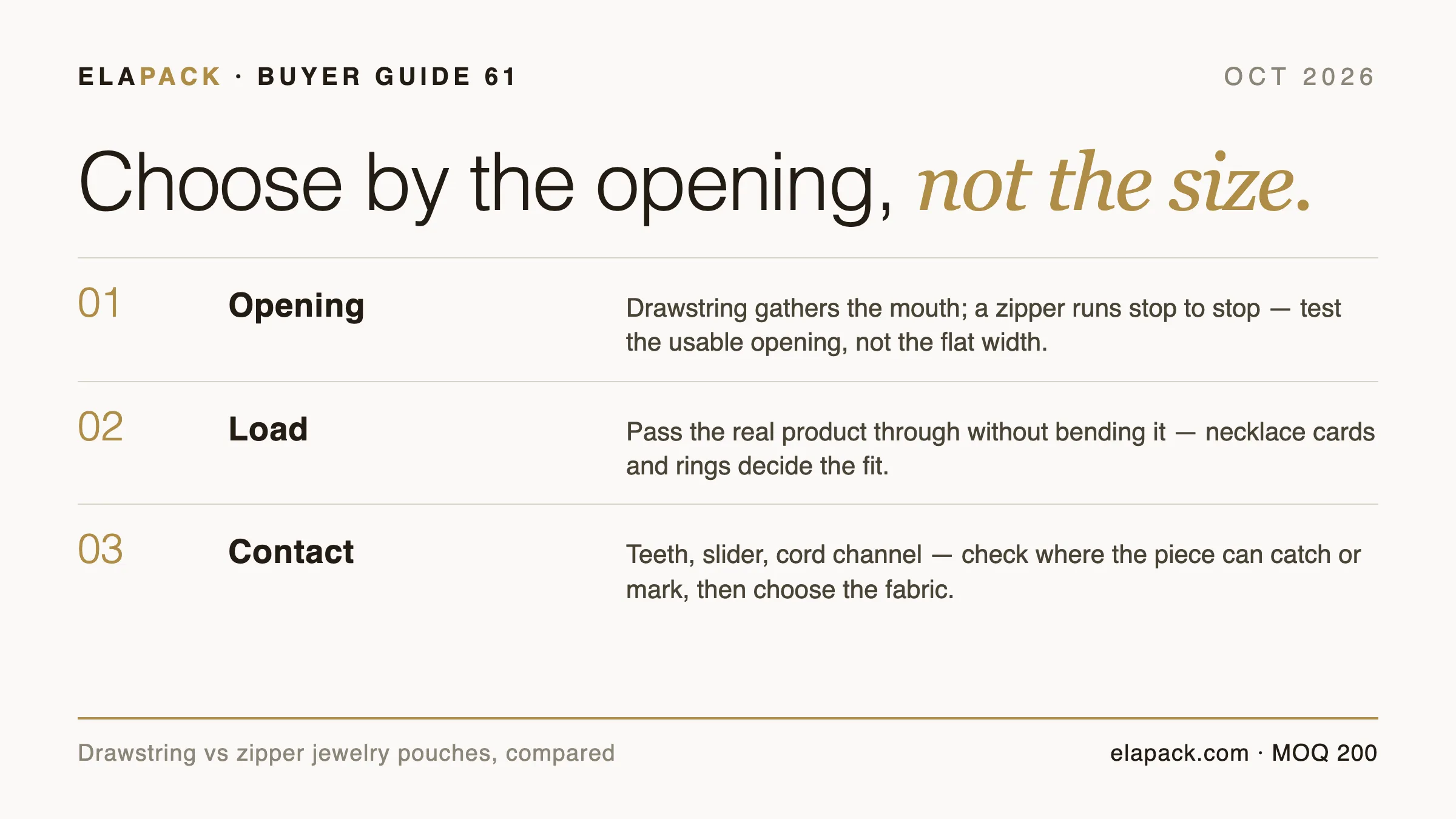
Both closures can hold a small product, but they change how a packer loads it and how a customer removes it. The visible pouch size is only part of the specification: the usable opening, pull action and internal contact points may decide whether the pouch works. This article narrows the closure decision within the broader custom jewelry pouch guide.
Measure the opening around the real product
A drawstring pouch gathers fabric around the mouth. That can make the opening smaller than the flat pouch width. A zipper pouch has a defined zipper length and stops at both ends; the usable opening may also be shorter than the outer width. Measure the widest part of the item or the card it will be packed on, then try moving that item through the actual opening without bending it.
For a necklace, include the card, chain arrangement and any protective sleeve in the test. For a ring or small accessory, consider how the customer will find and lift the piece without digging into a deep pouch. A visual mock-up cannot settle this question. Ask for a physical sample of the chosen custom pouch style with the product inserted, removed and reinserted several times.
Neither closure automatically prevents tangling, scratching or tarnish. Those outcomes depend on the product, fabric, internal separator and use conditions. A zipper can also create a contact point at the teeth or slider. YKK's zipper handling guidance describes how fabric can become caught near a slider. For jewelry, test the chosen construction with the actual item and any lining; YKK's guidance is not evidence about a specific ELAPACK product.
The drawstring decision also involves the gathered opening after closure. Check whether a small loose component could move through the remaining gap, and whether the cord stays in the intended position during ordinary handling. For a zipper style, inspect the inner edge, slider and any protective flap with the product in place. These checks reveal possible contact points; they do not establish that one closure is tamper-proof or universally better in transit.
Compare the packing routine and customer action
Have a packer assemble a small trial with the same number of components that will ship. Record whether cords must be tied, whether a zipper pull snags a ribbon or tag, and whether a card corners the opening. Then give the closed sample to someone who has not seen the assembly. If they struggle to find the opening, the issue may be the design rather than the material.
| Buyer question | Drawstring sample | Zipper sample |
|---|---|---|
| Can the full item pass through? | Test gathered mouth at intended cord tension | Test opening between zipper stops |
| Can it be opened one-handed? | Try cord pull and knot | Try slider pull and edge grip |
| Where can the item catch? | Cord channel and gathered seam | Teeth, slider and lining |
| How will it be stored? | Observe loose cord and pouch shape | Observe zipper profile and pull tab |
The table is a sample-test plan, not a ranking of protection or durability. If a pouch is offered in several fabrics, repeat the test on the intended fabric because stiffness changes handling. ELAPACK's muslin drawstring pouch and leather envelope pouch illustrate different closure approaches, but a project quote must specify the actual material and construction.
Put the closure details in the RFQ
State finished pouch size, usable opening required, product dimensions, fabric, lining, cord or zipper colour, logo method, and units per artwork version. Ask what the sample will validate: appearance, opening fit, or both. If different products share one pouch size, give the supplier each item envelope and request a fit recommendation instead of assuming one sample covers every SKU.
Use the jewelry box category to check whether the pouch must fit inside a box, and use the pouch category for available styles. Send the product dimensions and closure preference for a conditional quote. A no-cost sample request can be made, but confirm the exact sample scope, timing and shipping terms for the project.