
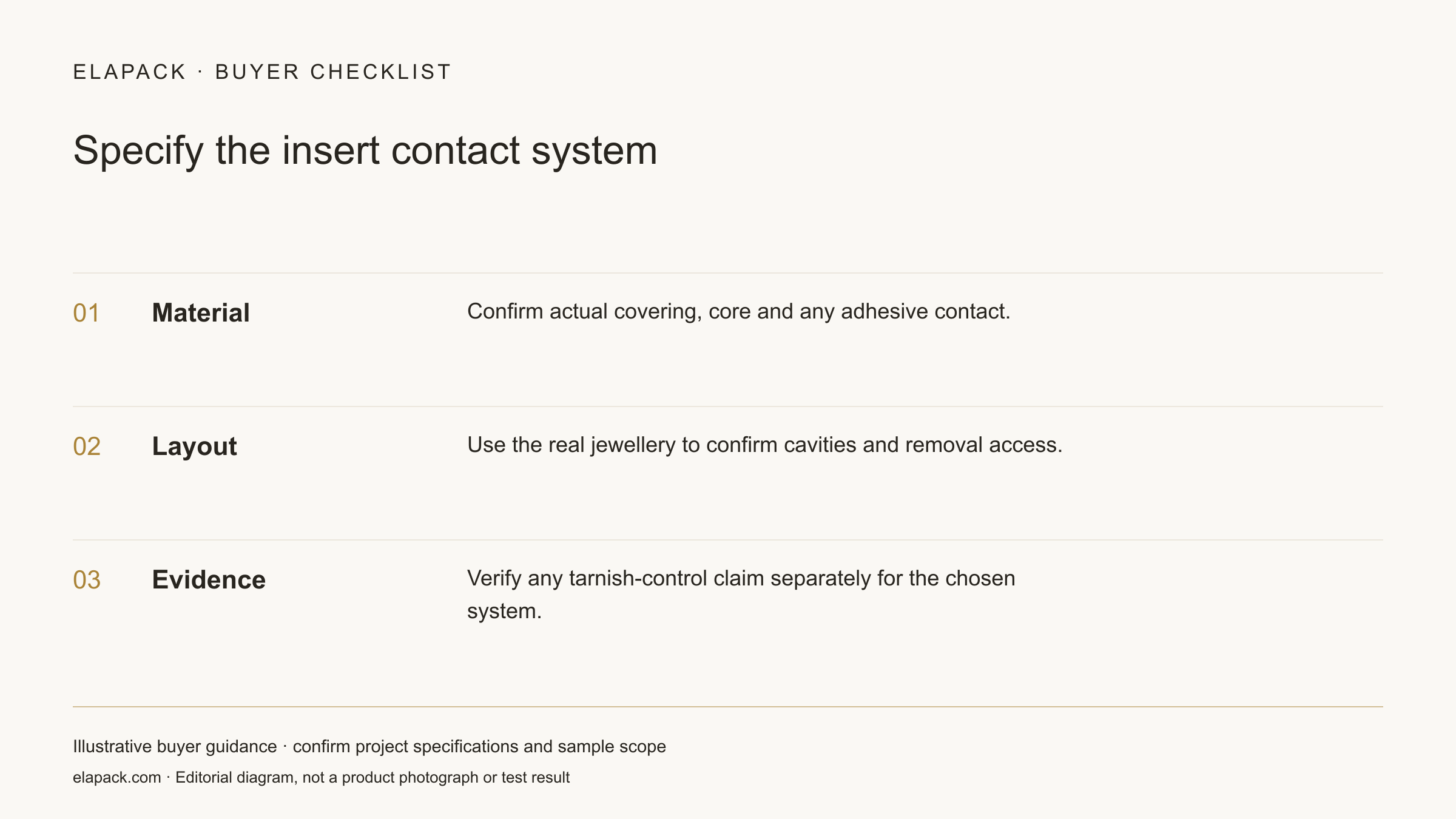
Insert construction, cavity and lining descriptions below are industry references as published by jewelry-packaging and jewellery-care suppliers (sources named inline). Any anti-tarnish requirement needs a specified material and applicable evidence; availability and performance are not established by this article. Order terms — MOQ 200 pieces, 15–20 day production, custom sample USD 30 plus USD 25 shipping, free digital dieline previews — are ELAPACK's confirmed trade terms.
A jewelry box insert is the part of the box that does the actual work: it holds the piece in place, keeps polished surfaces from touching each other, and — when the brief calls for it — slows tarnish. This page is about box inserts (the in-box liner and cavity tray), not retail display trays. If you are fitting a showcase or countertop presentation, that is the jewelry display trays guide instead; this page covers the insert that ships inside a closed box.
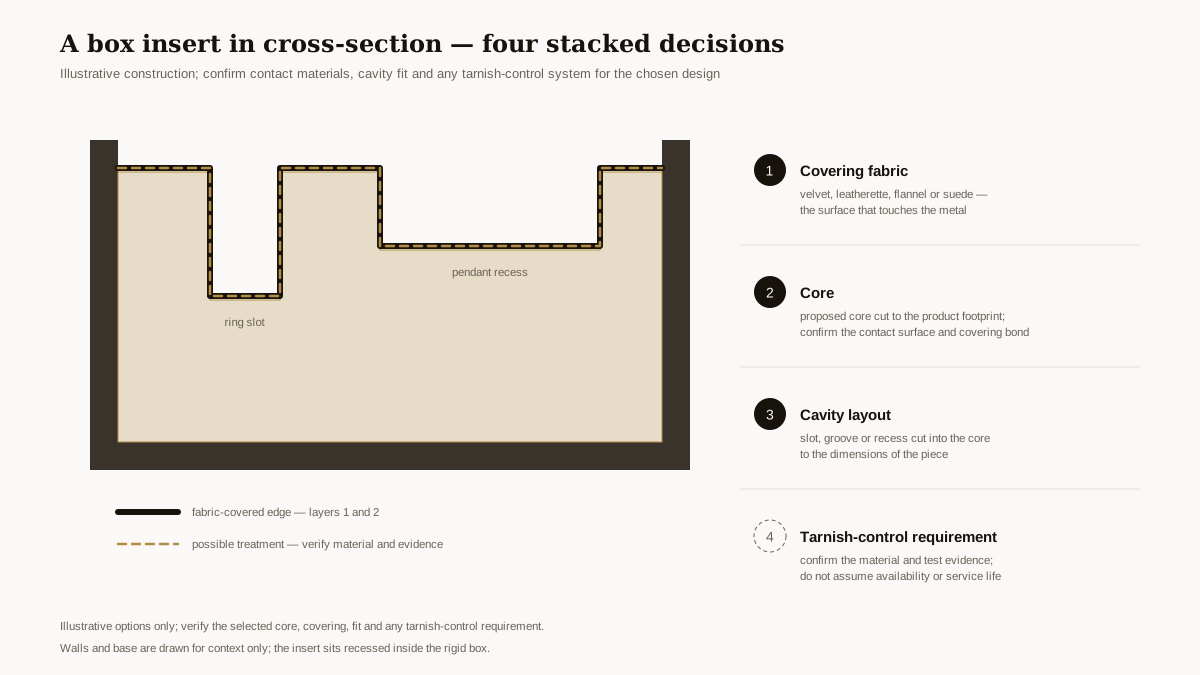
Quick answer: an insert is four stacked decisions — covering fabric, core, cavity layout and (optionally) an anti-tarnish lining. Specify the product first: rings need a slot, necklaces need chain control, bracelets need length. ELAPACK's minimum order is 200 pieces; confirm the insert construction and any tarnish-control requirement for your order before sample approval.
Key facts at a glance
| Item | Figure | Source |
|---|---|---|
| Minimum order | 200 pieces | ELAPACK confirmed terms |
| Production lead time | typically 15–20 days after sample approval and payment receipt; confirm by order | ELAPACK confirmed terms |
| Custom sample | USD 30 plus USD 25 shipping, 3–5 days | ELAPACK confirmed terms |
| Digital dieline preview | Free for structure approval | ELAPACK confirmed terms |
| Insert construction | Confirm core, covering, adhesive and cavity layout | Selected product specification and sample |
| Anti-tarnish requirement | Confirm material availability, test evidence and conditions | Supplier documentation for the selected system |
What a jewelry box insert actually does
An insert can provide positioning, separation and a chosen contact surface. Review restraint, removal and potential marking with the actual jewellery. A soft covering, bare board or foam name alone does not establish compatibility; tarnish-control requirements need separate evidence for the selected material and storage conditions.
This order matters for the enquiry. If a buyer asks for "an insert" without naming the metal and the piece dimensions, the factory has to guess at the slot, the covering and the depth. Naming the metal and plating helps define the compatibility assessment; surface condition, alloy, storage environment and duration also matter.
Takeaway: define fit and surface-contact requirements, then confirm whether tarnish-control evidence is needed for the intended storage.
Anti-tarnish: distinguish compatibility from protection
The Canadian Conservation Institute explains that silver tarnish is associated with sulfur-containing gases. Its metal storage guidance identifies some storage materials, including wool or felt, as possible sources of tarnishing gases. A soft surface is therefore not evidence of chemical compatibility.
For a silver-packaging brief, distinguish a contact material that does not accelerate tarnish from an active tarnish-control system. Ask for the exact material, applicable test method and results, enclosure conditions and any replacement instructions. Do not infer protection from the words velvet, satin or suede, and do not assume an ELAPACK anti-tarnish option without confirmation.
A specialist example is Westpack's insert listing, which separately states a tarnish-testing claim. That is the supplier's statement for its products, not independent verification or evidence for ELAPACK. Use it as a model for the documentation to request, not a performance claim to copy.
Takeaway: identify the metal and selected contact materials, then verify any compatibility or tarnish-control claim for that construction.
Cavity layout: ring slots, chain tabs and mixed trays
Choose the cavity and attachment arrangement from the actual piece. Slots, tabs, pads, supports or a mixed layout are candidates, not universal requirements. A standard insert may suit a project if its usable dimensions, contact and removal have been checked. Confirm whether any revised geometry is needed rather than assuming every layout requires a custom die.
Identify what each dimension describes before comparing inserts. Westpack currently lists a foam ring insert at 44 × 44 × 15 mm and a separate paperboard ring insert at 44 × 44 × 7 mm. These are those catalogue items’ dimensions, not an ELAPACK stock size or proof of interchangeability. Confirm the intended box model, usable cavity, insert and actual product as separate fields.
For necklaces and bracelets the same source's rule is direct: "chain tabs for necklaces, longer inserts for bracelets and cushions for watches," on its jewelry boxes page. A ring laid flat and a pendant held upright are different briefs even when the piece is the same size.
Takeaway: quote box, insert and product as three matched fields — a slot depth that fits someone else's ring is not a spec for yours.
Materials: velvet, foam, leatherette and the foam-cover bond
Possible contact constructions include fabric coverings, lined supports and other proposed materials. Confirm the actual composition, core, adhesive and surface against the jewellery. Product photographs and generic material names do not establish relative durability, availability or scratch protection.
Check surface compatibility on the actual material and product; a material name alone does not prove scratch protection. ELAPACK's custom ring boxes state the construction directly — velvet exterior with a foam insert under velvet covering — and that "foam insert with velvet covering" wording is the point. A quotation that says only "foam insert" without naming the covering should be questioned, because the contact surface and its compatibility need to be specified.
For a lighter, thinner insert, a custom white jewelry box shows the same principle in a compact format: a rigid shell with a velvet-lined cushion, sized from single-bracelet minis to multi-piece formats.
Takeaway: identify the actual contact surface and core, then verify compatibility on the selected construction.
Specifying an insert: what to put in the enquiry
The enquiry that avoids a wasted sample round lists five things: the product (ring, necklace, earring or bracelet, with dimensions and orientation), the cavity layout (single slot, chain tabs, mixed tray), the metal (to settle whether a tarnish layer is relevant), the covering material, and the quantity. ELAPACK's minimum is 200 pieces.
Confirm the product dimensions and proposed insert drawing before approval. Free digital dieline previews support structure review; confirm the required format and scope. Custom samples are USD 30 plus USD 25 shipping, with 3–5 day sample making. Production is typically 15–20 days after sample approval and payment receipt, subject to the confirmed order.
The sample is the moment the fit is decided. A stock sample settles the covering and the core; a custom sample settles the cavity — whether the ring seats without rotating, whether the chain folds once and stays put, whether the mixed tray holds every piece without contact. Send the product list and quantities and the insert recommendation comes back with the quote.