
Tray sizing, layout and lining descriptions are industry references as published by display and packaging suppliers (sources named inline); the market-size figure is Fact.MR data as cited by a published supplier guide. Order terms — MOQ 200 pieces, 15–20 day production — are ELAPACK's confirmed trade terms.
Quick answer: the trade-standard tray footprint is about 370 × 210 mm with 30–50 mm walls — choose the smallest footprint that lets a customer lift one piece without disturbing its neighbours, and ask any supplier claiming "anti-tarnish" lining which compound it actually treats.
Key facts at a glance
| Item | Figure | Source |
|---|---|---|
| Standard tray footprint | ≈ 370 × 210 mm (≈ 14.5 × 8.25 in) | As published, grainmarkleather.com |
| Standard wall height | 30–50 mm | As published, grainmarkleather.com |
| Display-stand market | USD 651.6M (2025) → 685.0M (2026), 5.1% CAGR to 2036 | Fact.MR, as cited by grainmarkleather.com |
| Minimum order | 200 pieces per design | ELAPACK confirmed terms |
| Production lead time | 15–20 days at 200–20,000 pieces | ELAPACK confirmed terms |
What a display programme covers
Display is a range decision, not a page decision: a counter programme mixes tray footprints, lining materials and piece-specific layouts — ring rows, bracelet channels, necklace pegs — and it is specified as a set so the counter reads as one system. The product side sits on the display and storage range.
Specify the tray set against the counter plan, not piece by piece — the footprint and lining must repeat across every tray.
The standard footprint, and when to leave it
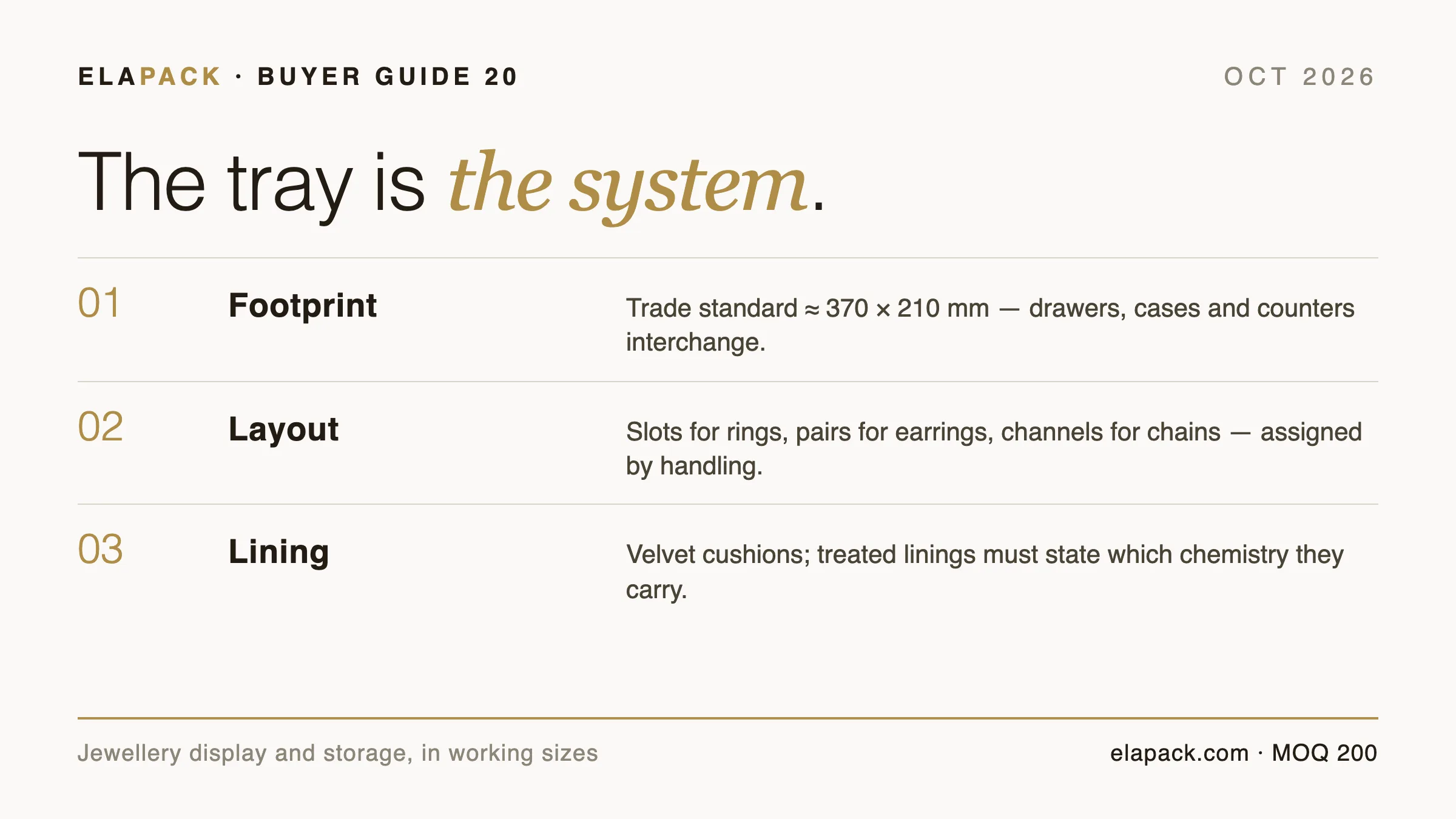
The trade standard is a tray footprint of roughly 370 × 210 mm with 30–50 mm walls, sized to fit drawer units, travel cases and vendor showcase systems (as published on grainmarkleather.com). Standardising on that footprint is what makes trays stackable and interchangeable across fixtures. The published sizing rule for deviating from it: choose the smallest footprint that lets a customer or collector lift one item without disturbing its neighbours — oversized trays create dead space and awkward reaching, and several small modular trays usually outperform one oversized decorative tray (same source). Wall height is the sightline trade-off: low walls preserve the view across a counter; taller walls secure pieces in transport but can hide small items.
Footprint is a system decision — one standard size keeps drawers, cases and counters interchangeable.
Compartment layouts by piece type
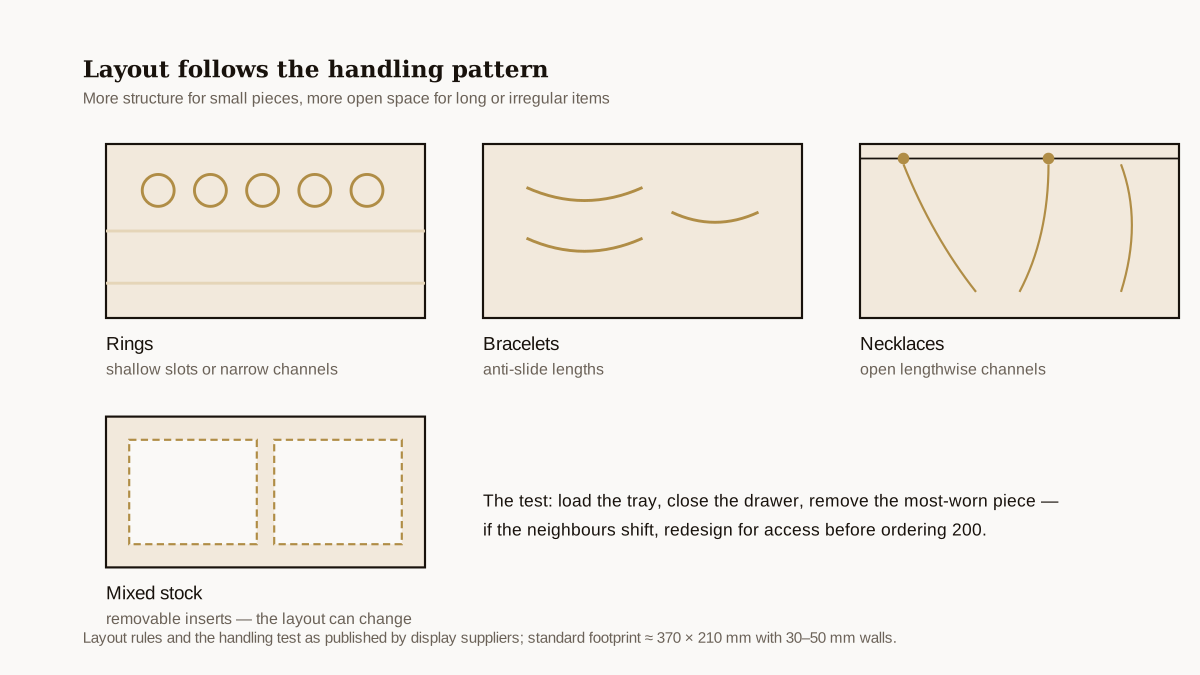
Published display guides assign structure by handling pattern: rings in shallow individual slots or narrow channels; earrings in paired positions that keep mates together; bracelets on lengths that stop sliding into neighbouring pieces; necklaces in open lengthwise space that separates chains from clasps (as published on grainmarkleather.com and gemsondisplay.com). The general rule reads: more structure for small pieces, more open space for long or irregular items, with removable inserts for changing stock and fixed dividers for stable collections. ELAPACK's display range covers the four working formats: the velvet necklace display, the acrylic earring display, the stackable jewellery tray and the velvet jewellery display set.
| Piece type | Layout that works | Watch-out |
|---|---|---|
| Rings | Shallow slots or narrow channels | Depth vs glove-and-go access |
| Earrings | Paired positions | Losing mates across compartments |
| Bracelets | Anti-slide lengths | Pieces migrating into neighbours |
| Necklaces | Open lengthwise channels | Chain–clasp tangle at the ends |
| Mixed stock | Removable inserts | Fixed dividers lock the layout early |
Linings and the anti-tarnish question
Shell materials run from wood and leather-wrapped to acrylic and metal; linings are where protection actually lives. Ordinary velvet and felt cushion pieces but do nothing about oxidation; treated polyester suede is designed to neutralise tarnish-related compounds; PEVA barriers work by excluding moisture and pollutants in enclosed cases (as published on grainmarkleather.com). The question that separates a specification from a marketing phrase: "anti-tarnish velvet" is a product description, not a specification — ask whether the treatment addresses sulfur compounds, moisture, or both, and ask for the treatment's basis in writing before accepting it as an order requirement. Published retail guidance adds that velvet tray liners are the most popular display choice because the soft pile holds pieces in place and prevents scratching (gemsondisplay.com).
Cushioning is standard; chemistry is optional — make the supplier state which one the lining actually provides.
Test the layout before you order 200
The published handling test is worth copying exactly: load the tray as it will be used, close the drawer or case, then remove the most-worn piece — if the other items shift, redesign for access. Measure the destination interior dimensions plus lifting clearance before ordering, and sort jewellery by handling pattern rather than by collection. For storage-adjacent programmes, the black leather jewellery box and the jewellery boxes guide cover the kept-piece side; complete presentations sit in the sets collection.
The bottom line
Standardise the footprint, assign compartments by handling pattern, and pin the lining claim to a stated chemistry. Contact ELAPACK with your fixture dimensions and piece mix, and the quotation will state tray footprint, layout and lining options that fit your counter and drawer system.