
Ordering terms below are ELAPACK quote-sheet terms; supplier practices are described as published by the packaging industry. We print and supply custom perfume sample cards, so read this as a manufacturer's data sheet rather than a neutral review. For the bottle, cap and gift-box side of fragrance packaging, see the [custom perfume packaging guide](https://elapack.com/news/custom-perfume-packaging-guide/); this page stays on the sample-card carriers.
Quick answer. Perfume sample cards are printed card carriers for scent — blotter strips, vials or sachets mounted on a branded card. Brands order them for counter programmes, press mailers, boutique handouts and subscription inserts: the card fixes the sample in place, posts mail-flat, and carries the brand face, scent story and instruction on one printed piece. This guide covers the four formats, what to settle at artwork stage, the three sourcing paths, shipping practice, and the ordering terms for a run — MOQ 200 per design, free dieline at quotation, custom sample USD 25 plus USD 20 shipping, 15–20 day production.
What a sample-card programme covers
Three buyer groups order these cards. Fine-fragrance brands run counter programmes and press mailers. Home-fragrance brands — candle and diffuser — put scent cards into catalogue mailings and subscription boxes, so the customer smells the fragrance before buying the candle. Subscription curators add them as monthly inserts alongside the box and void fill.
The card earns its place over a loose vial in four ways. It fixes the sample in position for transit. It posts mail-flat, so a programme ships without parcel packaging. It prints — brand face, scent story and instruction on one piece, edge to edge. And it standardises the handout: one card per scent, same size, same fold, whether the run is 200 pieces or 20,000.
The brief that reaches a printer specifies three things — sample count, vial format and card size. That triplet drives the dieline, and the formats below are the four ways it gets answered.
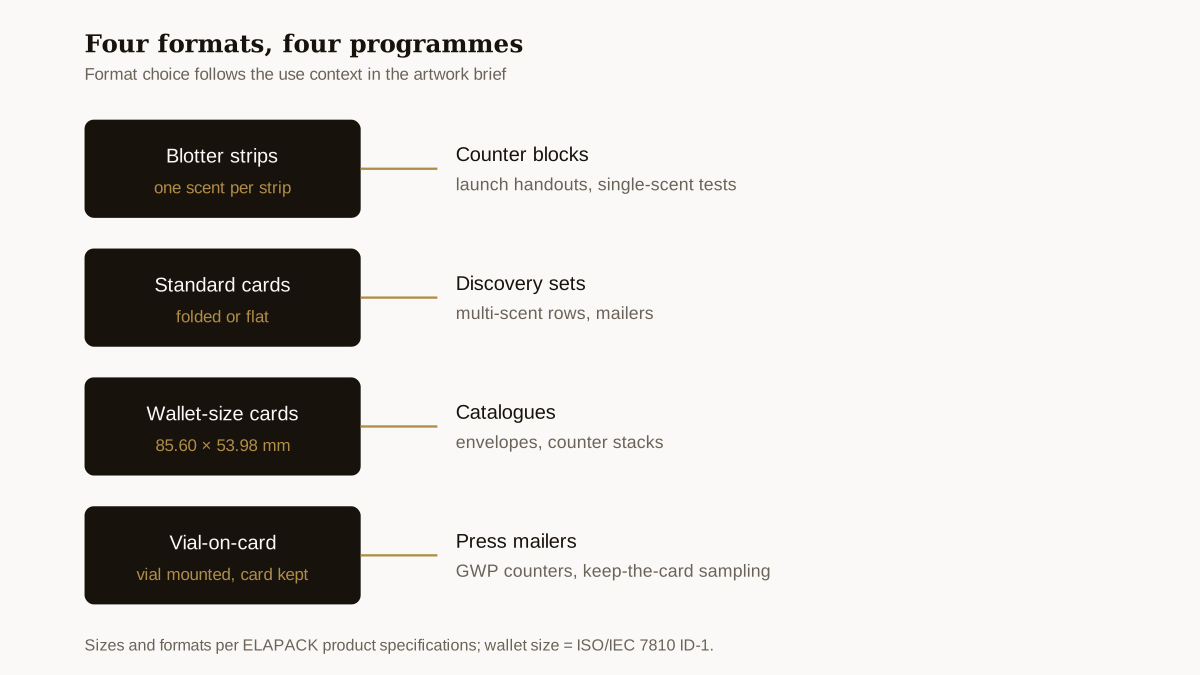
Fig. 1 — Format-to-programme mapping: the four card formats and where each one runs.
Four formats: blotters, cards, wallet size, vial-on-card
Table 1 — The four formats at a glance.
| Format | Stock and size (as published) | Typical programme |
|---|---|---|
| Blotter strips | absorbent blotter board; marketplace listings commonly 300–400 gsm | counter blocks, single-scent tests |
| Standard cards | folded or flat card, cut to sample count and vial format | discovery sets, mailers |
| Wallet-size cards | 85.60 × 53.98 mm, ISO/IEC 7810 ID-1 | catalogues, envelopes, counter stacks |
| Vial-on-card | printed card with mounted vial | press mailers, GWP counters |
The weight band is quoted as published by supplier listings — Alibaba blotter-card listings run 300, 350 and 400 gsm, and specialist suppliers such as maxi-mise describe heavy absorbent board for fragrance evaluation. ELAPACK house stock is confirmed at quotation, with the sample.
Blotter strips. The perfumery standard: narrow absorbent paper, dipped or sprayed, handed over a counter or mailed in blocks. Fine-fragrance suppliers also call them mouillettes. One strip carries one scent; blocks run into the hundreds for a launch or a counter programme.
Standard sample cards. A folded or flat printed card carrying one vial or a row of them. Layouts run from single-scent cards to multi-scent discovery sets — the card is cut to your sample count and vial format, with artwork printed edge to edge. This is the format most "custom perfume sample cards" buyers are describing.
Wallet-size cards. The credit-card format — 85.60 × 53.98 mm, the ISO/IEC 7810 ID-1 size — fits envelopes, counter stacks and wallets. It is the one format the customer can pocket, which makes the size itself worth naming in the artwork brief.
Vial-on-card. A vial mounted on a printed card: the format for press mailers and GWP counters where the customer keeps the card and uses the sample.
One boundary line for this page: the four formats above are card carriers. Standalone sample vials sold retail — decants of existing fragrances — are a consumer market with its own suppliers and price logic; nothing here covers buying 2 ml of a scent you already know.
Printing and branding the card
The card is a brand surface before it is a scent carrier. Production artwork usually carries three blocks: the brand face (logo and colour), the scent story (name, notes, one line), and the handling instruction for the vial or sachet. Artwork prints edge to edge, so the blocks live on the card itself rather than on an added label.
Logo application across our custom packaging — position, colour build, method selection — is covered in the MOQ/OEM logo guide; the same decision list applies to card faces.
Ink odour is one variable the print industry already manages. It is driven by the solvent base of the ink, and low-odour / low-migration ink classes exist for scent-sensitive print work — both facts as published in technical sources developed mainly for food-contact packaging (Daihei Ink technical notes; low-migration ink literature). When the print sits on a scent carrier, naming the ink class in the specification is the buyer-side control.
What print cannot fix is layout. The vial position, the fold line and the scent zone have to work as one dieline, which is why the dieline is drawn at quotation (free of charge) and the artwork develops against it: sample count and card size first, then the drawing, then final print files.
The candle crossover
Candle and home-fragrance brands buy the same product for a different job. They use scent cards where perfume counters use blotters: in catalogue mailings, order inserts, counter displays and subscription boxes, so the customer smells the wax fragrance before buying the candle.
The card system is identical. What changes is the fragrance application, and that gets settled at the sampling stage rather than in the artwork. Candle brands already ordering boxes for jars and tins can plan the card inside the same programme — the container side is covered in our candle packaging guide and the custom candle boxes guide; for the insert side of a monthly box, the subscription packaging collection lists the structures that pair with a scent card.
Where brands actually source sample cards
Three sourcing paths cover the market:
Marketplace blanks. Amazon and Etsy listings hold the visible results for ready-made white sample cards — small quantities, no branding, shipped from stock. Fits tests and one-off mailings; does not fit a branded programme.
Factory blanks. The middle path is unprinted cards bought in bulk from a printer, with fragrance applied in-house. You gain quantity pricing and keep application control; you give up the print.
Custom-printed factory cards. The third path is buyers approaching factories directly: your artwork, your vial layout, one dieline. This is the path this page quotes for.
Wholesale-where questions recur on Reddit and in trade communities — which is where a manufacturer's answer page earns its place.
Quantity and branding decide the path: unbranded tests at marketplace scale, branded runs from 200 pieces per design with custom print.
Shipping and protecting the sample
Shipping questions in this family cluster around the vial, not the card: community threads recur on how to mail mini perfume bottles without leaks or breakage. The card answers part of that by construction. The vial mounts on the printed card, the piece stays mail-flat, and a sampling programme posts without parcel packaging — the programmes already running on this card system are sampling programmes, subscription inserts, boutique handouts and press mailers.
For the outer side of a mailing — box, insert, void fill — the subscription packaging collection covers the structures that ship alongside a scent card.
Ordering data
Table 2 — quote-sheet terms, custom perfume sample cards.
| Item | Term |
|---|---|
| MOQ | 200 pieces per design |
| Dieline | Free, drawn at quotation |
| Cutting die | USD 50–100, one-time |
| Custom sample | USD 25 + USD 20 shipping, 3–5 days |
| Stock sample | Free + USD 20 shipping, 2–3 days |
| Lead time, 200–20,000 pcs | 15–20 days |
| Payment | T/T or PayPal |
Sample cards are die-cut products, so the cutting-die line applies to every format above — it is a one-time cost at first order. To plan a run: confirm sample count and card size, receive the dieline at quotation, approve a sample, then production.
Bottom line
Four formats cover the demand: blotters for counter blocks, standard cards for discovery sets and mailers, wallet size for catalogues, vial-on-card for press mailers. Candle and home-fragrance programmes run on the same card system. Branded runs start at 200 pieces per design, dieline free at quotation, custom sample USD 25 plus USD 20 shipping, 15–20 day production.