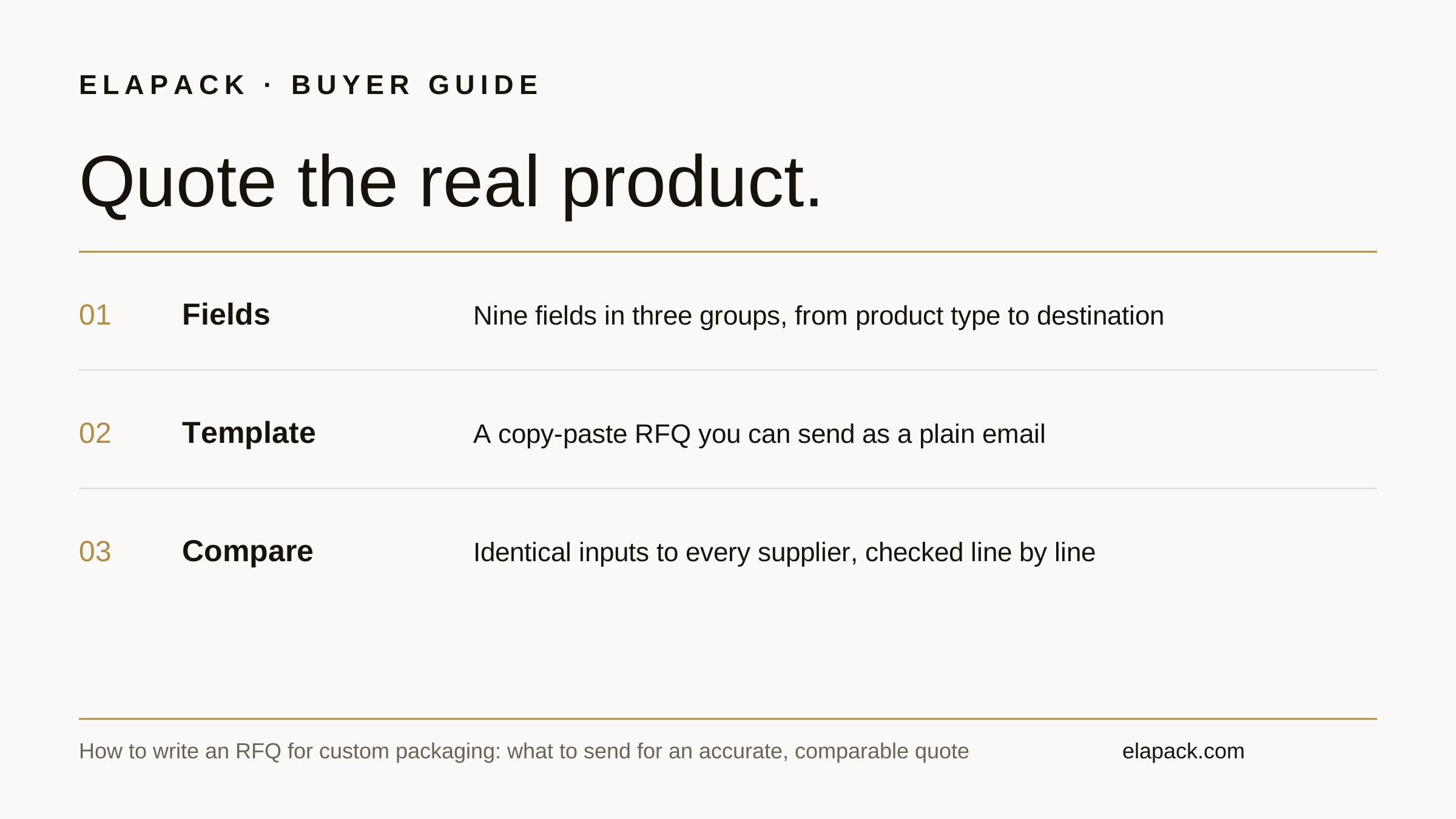
A request for quotation (RFQ) is the brief behind your price. When it is complete, a supplier can quote your actual product instead of an approximation, and you can compare replies from several suppliers on the same basis. When key fields are missing, the quote comes back with questions attached, or is built on assumptions that change later.
Key takeaways
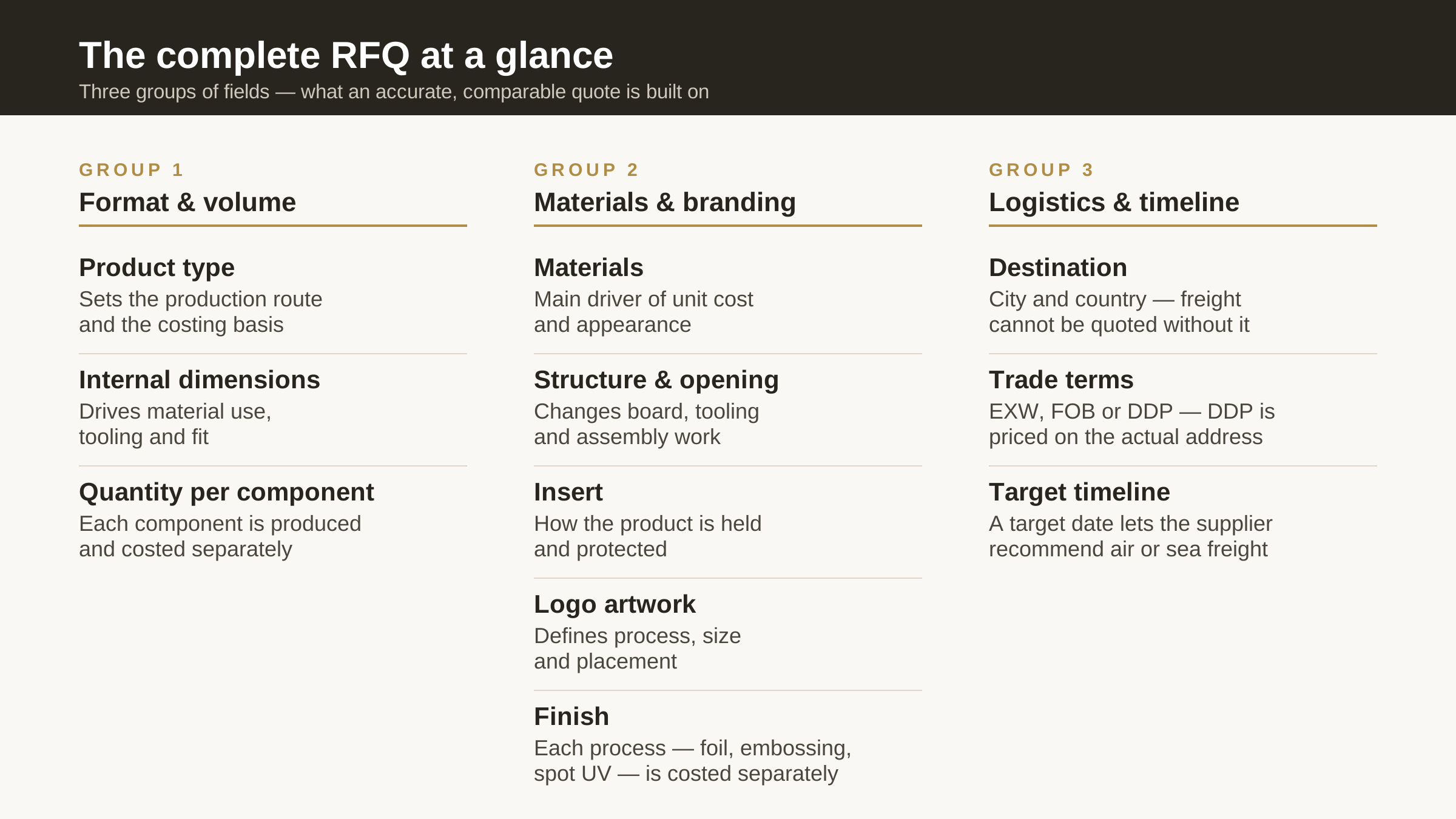
- A complete RFQ covers product type, dimensions, quantity per component, materials, structure and opening, insert, logo artwork, finish, and delivery destination and terms.
- Quantity should be stated per component, not as a total for a set, because each component is produced and costed separately.
- The most common gaps are missing dimensions, materials changed after quoting, and no delivery destination, which makes freight unquotable.
- Quotes are only comparable when every supplier received the same fields and quoted the same specification.
- At ELAPACK, quotations are replied to within 1 business day, and a custom sample confirms the specification before production.
What does a complete RFQ include?
Work through the three groups below. No formal document is needed: a clear email with these points, plus your artwork files, is enough for an accurate first quote.
1. Format, dimensions, and volume
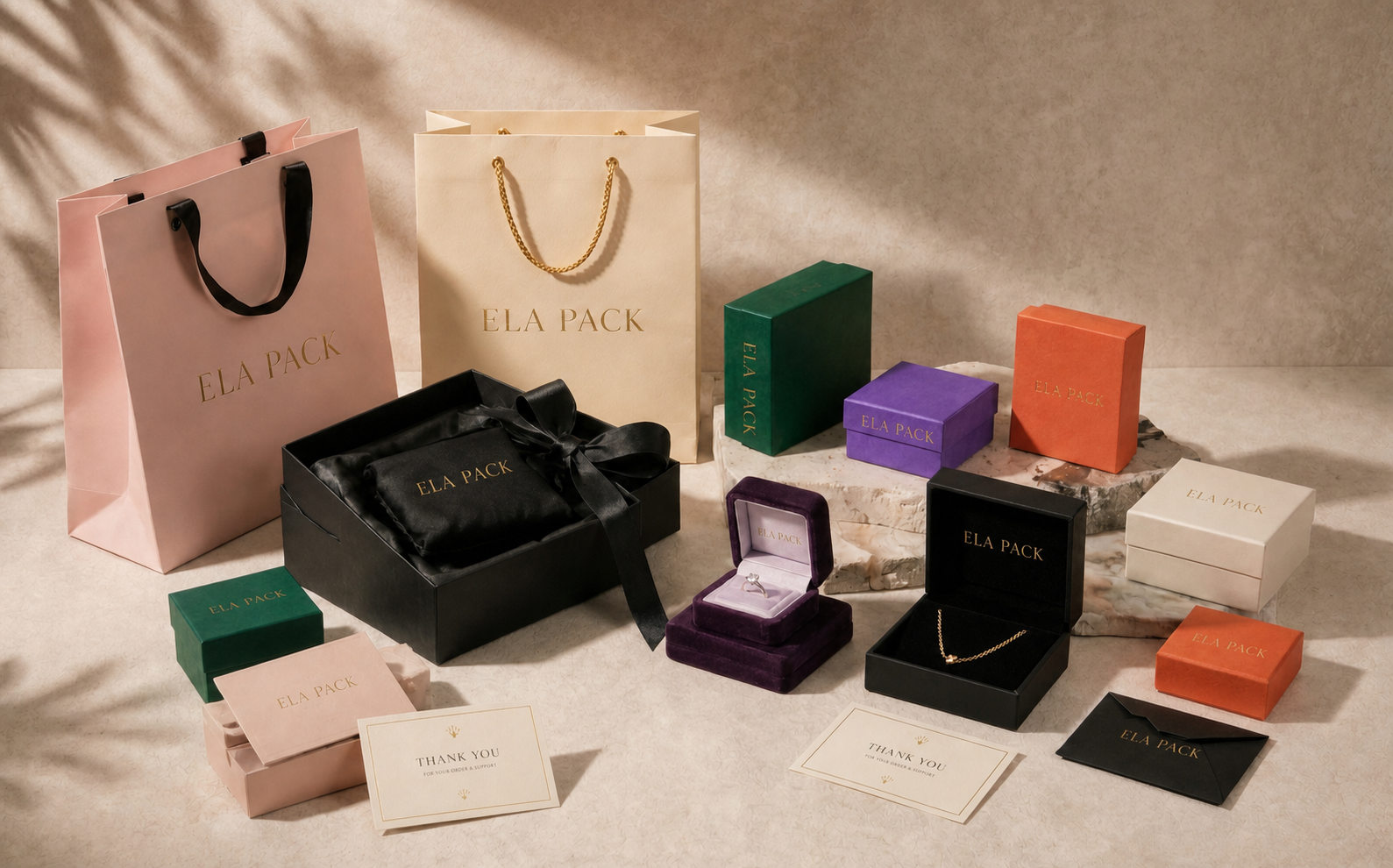
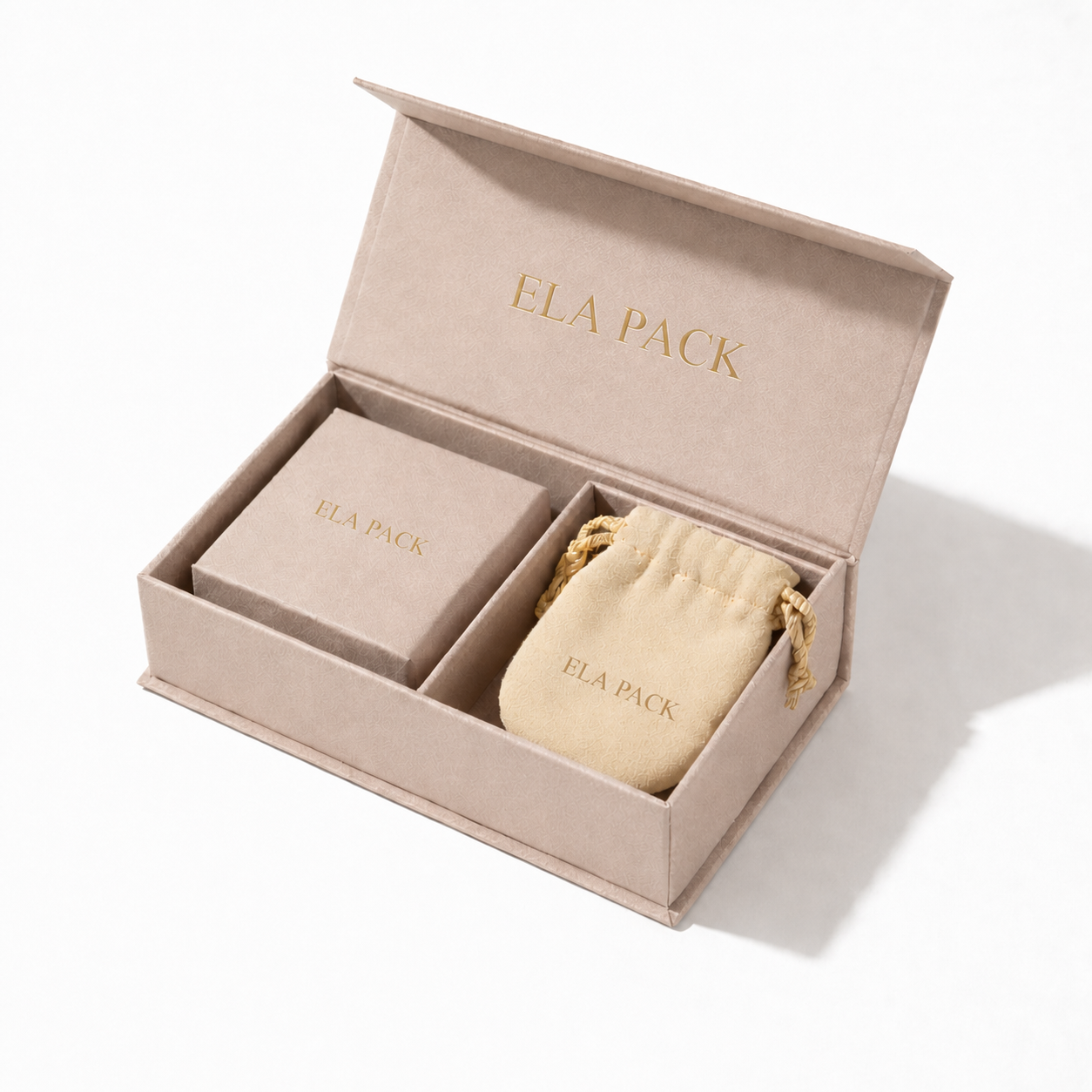
Product type. Say what you are buying: a rigid box, a drawstring pouch, a shopping bag, a ribbon, a card, or a configured set of components. If unsure which format fits, describe the product it will hold and how it will be presented. ELAPACK's main component families are boxes and pouches and bags; an RFQ can cover one component or a full set.
Dimensions. Give the internal dimensions the product needs, in length × width × height, and say what goes inside. For pouches and bags, give width × height and note anything bulky or rigid that must fit. Guessing a size from a photograph is the most common source of re-quotes, so measure the actual item, including its clearance. Our guide on how to measure a box and work out internal dimensions walks through the method.
Quantity per component. State how many pieces you need of each component. ELAPACK's minimum order quantity is 200 pieces per product or component, so 500 sets of one box and one pouch are quoted as 500 boxes plus 500 pouches, not as a single combined line. If you are testing two quantity levels, list both; pricing and production time are calculated per run.
2. Materials, construction, and branding
Materials. Name the material you have in mind for each component: board and wrap paper for a box, or a fabric such as velvet, satin, cotton or microfiber for a pouch. Attach a reference sample or a photograph of the texture if you have one. If you are undecided between two materials, ask for both to be quoted rather than changing the material after the first quote arrives.
Structure and opening. Describe how the box opens or the pouch closes: lift-off lid, magnetic flip-top, drawer, ribbon tie, drawstring, zip or envelope flap. Structure changes the board, tooling and assembly work, so it belongs in the first message, not a revision.
Insert. If the product must sit in a fitted insert, say what holds it and how: a foam, velvet-covered or pulp insert, a cavity, a slot or a card — with the cutouts named where they matter, such as ring slots, earring holes or necklace slits. Note whether the product simply rests in place for retail display or must be held firmly for parcel shipping. Insert choices are confirmed against your actual product on the sample.
Logo artwork. Attach your logo file, ideally a vector file, and state the size and position you want. If the artwork is not final, say so, and state the intended size, position and process anyway: the printing setup is arranged around them, so they belong in the first message while the file is finished. Pantone references can be supplied for close brand-colour matches; colour is then approved on the physical sample.
Finish. List the surface treatments you want: foil stamping, embossing or debossing, spot UV, lamination or a specific print treatment. Finishes are costed per process, so "logo on the lid" and "gold foil logo on the lid" are two different quotes.
3. Logistics, trade terms, and timeline
Delivery destination, terms and timeline. Give the destination city and country, say whether you want an EXW, FOB or DDP quote, and add your target delivery window or preferred shipping mode if you have one. Freight cannot be calculated without a destination; DDP is priced on the actual address because it includes taxes, duties and door delivery. Rigid boxes are bulky for their weight, so air and sea freight price very differently — a target date lets the supplier recommend the mode that fits your schedule instead of guessing.
| RFQ field | Why it matters | What happens if it is missing |
|---|---|---|
| Product type | Sets the production route and costing basis | Supplier quotes a different format than you intend |
| Dimensions | Drives material use, tooling and fit | Quote is an estimate; re-quote once sizes are confirmed |
| Quantity per component | Each component is produced and costed separately | Set pricing cannot be broken down or compared |
| Materials | Main driver of unit cost and appearance | Quote assumes a standard material you may not want |
| Structure and opening | Changes board, tooling and assembly | Price shifts when construction is revised |
| Insert | Determines how the product is held and protected | Fit and protection are left unquoted |
| Logo artwork | Defines process, size and placement | Printing cannot be costed accurately |
| Finish | Each process is costed separately | Quote covers a plainer specification than expected |
| Destination, terms and timeline | Freight, duties and mode depend on the address and schedule | Only an ex-works price can be given, no landed cost |
Copy-and-paste RFQ template
Copy the template below into your email or the contact form and fill in your own project details:
- Components required: [e.g., rigid drawer box + microfiber drawstring pouch]
- Product held inside: [e.g., sterling silver pendant necklace on a card]
- Internal dimensions (L × W × H): [e.g., box 90 × 90 × 32 mm; pouch 80 × 80 mm]
- Quantity per component: [e.g., 500 boxes + 500 pouches — also quote 1,000 of each]
- Materials and colours: [e.g., 1200gsm greyboard wrapped in matte off-white textured paper; warm grey microfiber pouch]
- Structure and closure: [e.g., sliding drawer box with ribbon pull; double-drawstring pouch]
- Insert details: [e.g., velvet-topped foam insert with two necklace slits; must hold firmly for parcel shipping]
- Logo and finish: [e.g., champagne gold foil stamping on box lid, 35 × 12 mm; one-colour printed logo on pouch — vector AI file attached]
- Destination, terms and timeline: [e.g., DDP to Austin, TX, USA; needed in hand by August 15]
What do buyers most often leave out?
Three gaps account for most delayed or revised quotations.
The first is unmeasured or external-only dimensions. An RFQ that says "a box for a necklace" without measurements forces the supplier to assume a size, and outer dimensions alone still leave wall thickness and insert depth unaccounted for. Board consumption and tooling are calculated from the internal dimensions, so the quote moves as soon as real sizes arrive. A two-minute measurement at the start prevents a second round of pricing.
The second is materials changed after quoting. A quote is built on a specific board, paper or fabric. When the material changes after the price is given — a different wrap, a heavier fabric, a new insert — the costing is redone and the two numbers are no longer comparable. If you are choosing between materials, ask for parallel quotes on each in the first RFQ.
The third is no destination. Without a city and country, no supplier can quote freight, and a DDP landed price is impossible. Buyers who compare unit prices alone often find the ranking reverses once delivery is added. Include the destination even if the final address is not fixed; a city is enough for a first calculation.
A smaller, frequent gap is late artwork. A logo's size, position and process affect cost, so state them in the RFQ, with the file to follow.
How can you compare quotes from several suppliers on equal terms?
Send every supplier the same RFQ, word for word. Comparable quotes start with identical inputs: the same dimensions, quantity per component, materials, destination and terms. If one supplier quotes a thinner board or a different insert, the prices are not measuring the same product.
Then compare line by line, not just on the total. Check that each quote covers the same components, insert, finish and delivery basis. An EXW price and a DDP price are not comparable until freight and duties are added to the first. Ask each supplier to state their assumptions wherever your RFQ left a choice open, so they are visible rather than buried in the price.
Finally, compare how the specification will be confirmed. A low quote on an unconfirmed specification carries revision risk. A physical sample, checked against your product and artwork, turns a quote into an agreed specification — so ask each supplier about sampling cost and timing before deciding on price alone.
How does the ELAPACK quotation process work?
Send your RFQ through the contact page with the fields above and your artwork attached. ELAPACK replies within 1 business day. The quote can be given on EXW, FOB or DDP terms; a DDP quote includes destination taxes and duties and door delivery, priced on your destination.
The next step is a sample, so the specification is checked physically before any bulk order. A custom sample costs USD 30 plus USD 25 shipping and is made in 3–5 days; the sample fee is deductible against the confirmed first order. Stock samples are free, plus USD 25 shipping. Finished-sample photos or video can be sent before dispatch on request, and bulk production proceeds only after you confirm the sample by email. Our guide to custom packaging samples explains what to check when it arrives.
After sample approval and payment, production takes 15–20 days for 200–20,000 pieces and 30–35 days for 20,000–50,000 pieces. Because the RFQ defined the specification, sample and production run are checked against the same document: size within the agreed tolerance, colour against the approved reference, each component at its stated quantity.
Questions buyers ask
Can I get a quote before my artwork is final?
Yes. State the logo's intended size, position and process in the RFQ and note that the file will follow. The quote will be accurate for materials, structure and quantity; printing is confirmed once the artwork is supplied and checked on the sample.
Why is quantity quoted per component instead of per set?
Each component — box, pouch, ribbon, card or cloth — is produced in its own run with its own materials, so each is costed separately. ELAPACK's minimum is 200 pieces per product or component, and quoting per component keeps set pricing transparent.
Can you quote DDP to my address?
Yes. Quotes can be given on EXW, FOB or DDP terms. A DDP quote includes destination taxes and duties and door delivery, calculated from your destination — so include the city and country in the RFQ even if the final address is confirmed later.
How long does the full process take?
The quotation is replied to within 1 business day. A custom sample is made in 3–5 days (USD 30 plus USD 25 shipping, deductible against the confirmed first order). After sample approval and payment, production takes 15–20 days for 200–20,000 pieces and 30–35 days for 20,000–50,000 pieces, with shipping time separate.
Ready to price your packaging?
Send your RFQ — or copy the template above — with your artwork files through our contact page. You will receive an itemised quotation within 1 business day.
Sources
- ELAPACK confirmed ordering terms, as published on elapack.com product and sample pages: MOQ 200 pieces per product or component; custom sample USD 30 plus USD 25 shipping, made in 3–5 days, deductible against the confirmed first order; stock samples free plus USD 25 shipping; production 15–20 days for 200–20,000 pieces and 30–35 days for 20,000–50,000 pieces after sample approval and payment; quotation replies within 1 business day; EXW, FOB and DDP terms, DDP including destination taxes and duties and door delivery.
- Independent supplier guidance consulted on internal-versus-external dimensions and quotation practice (DGM Packaging, PakFactory, Pakko), on volumetric weight and freight-mode selection (Freightos; Utouch Packaging), and on jewellery insert terminology (Everwin, Dackaging, Winnerpak).