
Selection guidance is not a product specification or performance guarantee. ELAPACK commercial terms below reflect owner-confirmed policies; project scope, design allocation and sample contents require order confirmation.
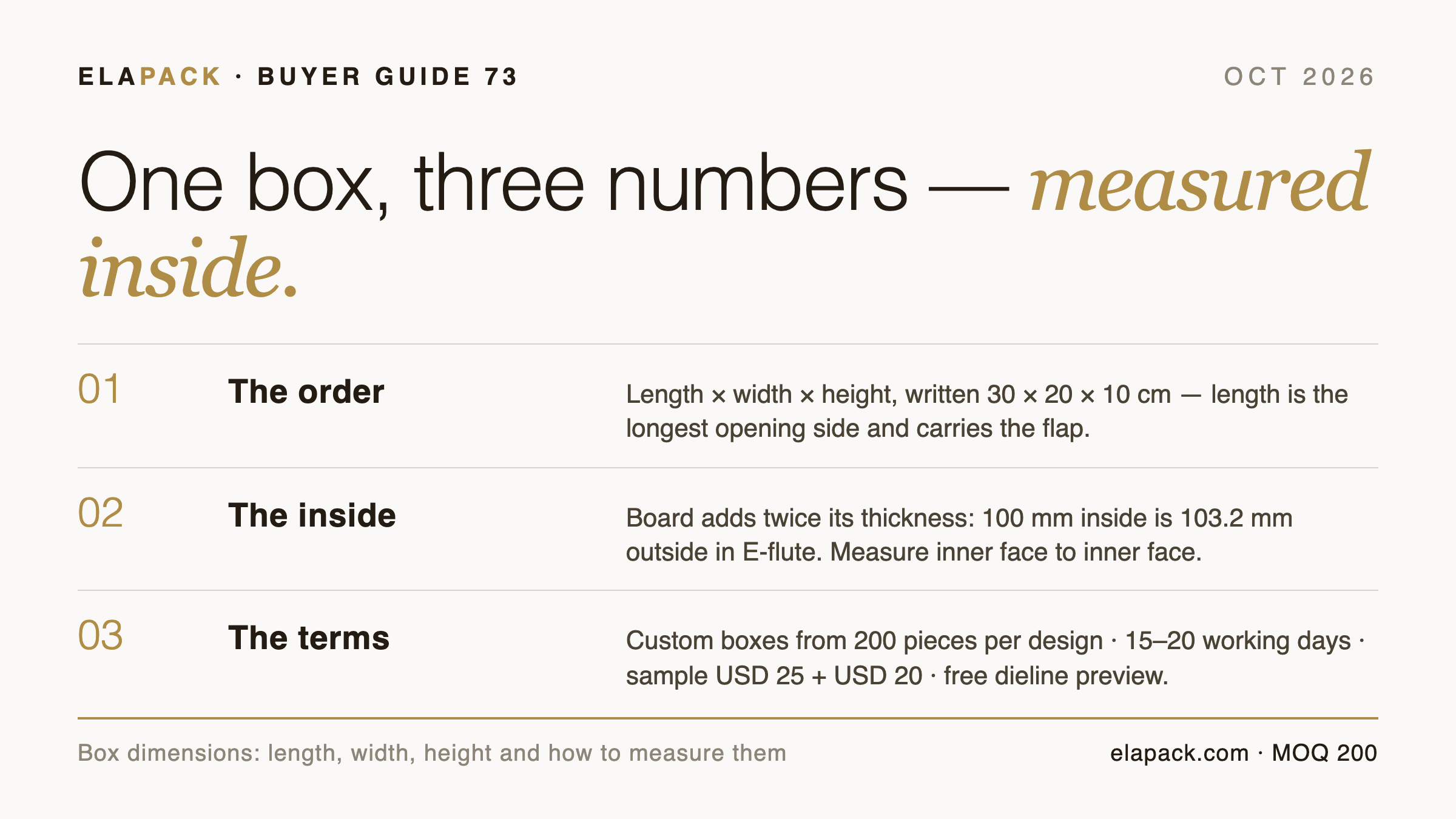
Box dimensions are three numbers — length × width × height, quoted as inside measurements — and they decide whether a custom box fits the product inside it and what the parcel rate costs outside it. This guide sets out the convention suppliers quote by, how to measure an existing box, and how to measure a product when there is no box yet.
Key takeaways
Box dimensions follow one convention — length × width × height, quoted as inside measurements — and mixing up any of the three is the fastest route to a box that does not fit.
- Dimensions are written length × width × height: length is the longest side of the opening, width the shorter side, height the remaining dimension.
- Listed box dimensions are inside dimensions; the board thickness sits outside the measured space.
- Acceptable manufacturing variance runs to ±1/8 in, so record measurements to one decimal and confirm critical fit on a sample.
- Carriers bill the higher of actual and dimensional weight, so unused volume in an oversized box is paid for on every parcel.
Last updated November 2026.
What order do box dimensions go in?
Length first, then width, then height. When a supplier writes 30 × 20 × 10 cm, the 30 is the length, the 20 is the width and the 10 is the height.
The convention comes from the box itself, not from a style choice:
| Dimension | How to identify it | In 30 × 20 × 10 cm |
|---|---|---|
| Length | The longest side of the opening — on a shipping carton, the longest side with a flap | 30 cm |
| Width | The shorter side of the opening — the other flap side | 20 cm |
| Height | The remaining dimension, top to bottom; on a carton it does not include the flaps | 10 cm |
Uline states the carton version plainly: length is “always the longest side of the box that has a flap”, width is the flap side shorter than the length, and height is “the only dimension without a flap”. A lid-and-base gift box has no flaps, but the same logic applies to its opening: length is the longest side of the lid line.
Two variations appear in real quotations. Some suppliers write L × W × D and list the third figure as depth rather than height — the same measurement under a different label, worth confirming before quotes are compared. Others put height first or reverse the sequence, which is why a number sequence alone is not a safe specification: send the three figures with a labelled sketch or a marked photo, and state the unit with every number. A figure that reaches a supplier as inches when it was measured in centimetres is a remake, not a rounding error.
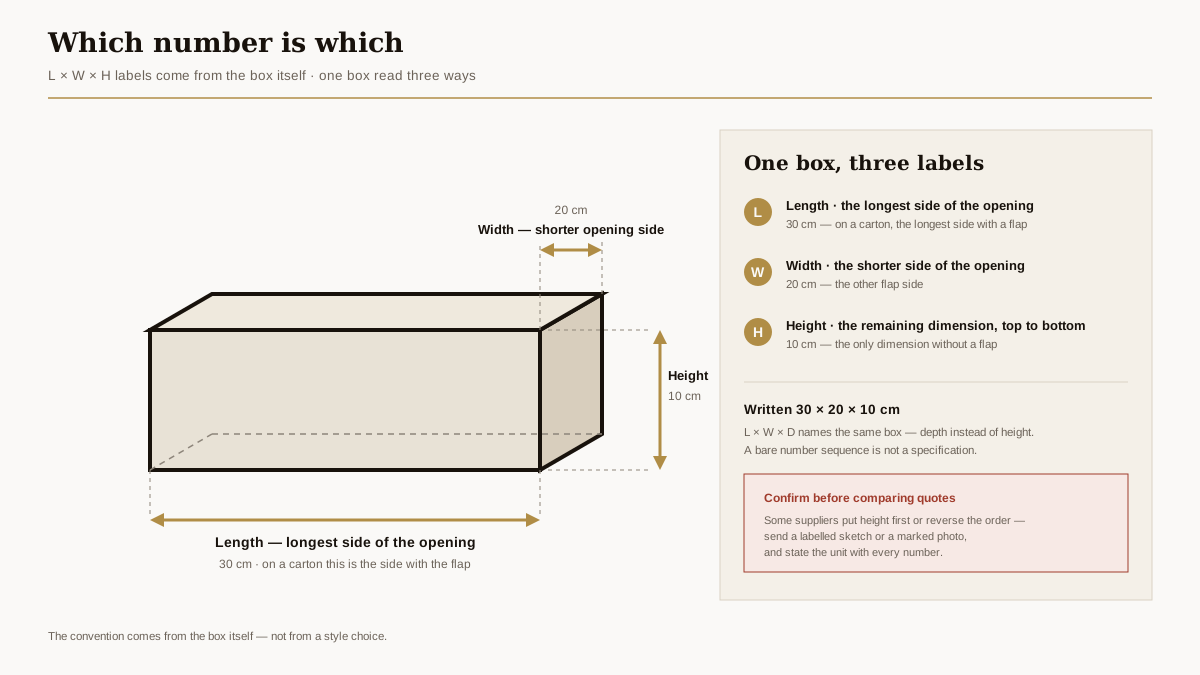
Some converters label the third dimension depth — L × W × D and L × W × H describe the same box, so the sketch and the unit matter more than the letter.
Are box dimensions inside or outside?
Inside. “Listed dimensions are always inside dimensions” is how Uline answers this for stock cartons, and custom-box suppliers work the same way: the figures in a quotation describe the cavity the product sits in, not the outside of the shell.
Quantifying the wall: inside to outside conversion
To translate inside cavity dimensions into finished outside measurements, you must add the board caliper of two opposing walls plus paper wraps:
| Construction | Typical board caliper | Wall addition (2 × wall) | Outside growth |
|---|---|---|---|
| Folding carton (SBS) | 16–24 pt (0.4–0.6 mm) | +1.0–1.2 mm (≈ 0.04 in) | Minimal profile; near-identical outside and inside |
| E-flute corrugated | 1/16 in (1.6 mm) | +3.2 mm (≈ 1/8 in) | Standard rigid mailers and tuck-tops |
| B-flute corrugated | 1/8 in (3.2 mm) | +6.4 mm (≈ 1/4 in) | Heavy-duty shipping boxes |
| Rigid greyboard box | 1.5–2.5 mm (1,000–1,600 gsm) | +4.5–5.5 mm (≈ 3/16 in) | Adds wrap paper (157 gsm) and turn-in seams |
A 100 mm necklace therefore needs a cavity longer than 100 mm, not an outside length of 100 mm — the board and wrap sit between the two figures. The construction rows are unpacked in the custom rigid boxes guide.
This is where reorders go wrong. Measuring the outside of an existing box and sending those figures as the specification produces a new box whose cavity is smaller than the original by two wall thicknesses — the most common way a reordered box comes back too tight. Measure the old box inside, or measure the product and let the cavity be engineered around it.
Both sets of numbers are real; they answer different questions. Inside dimensions answer whether the product fits. Outside dimensions answer what the parcel costs and how much shelf the box takes — the sections below start from the inside, and the shipping section works from the outside.
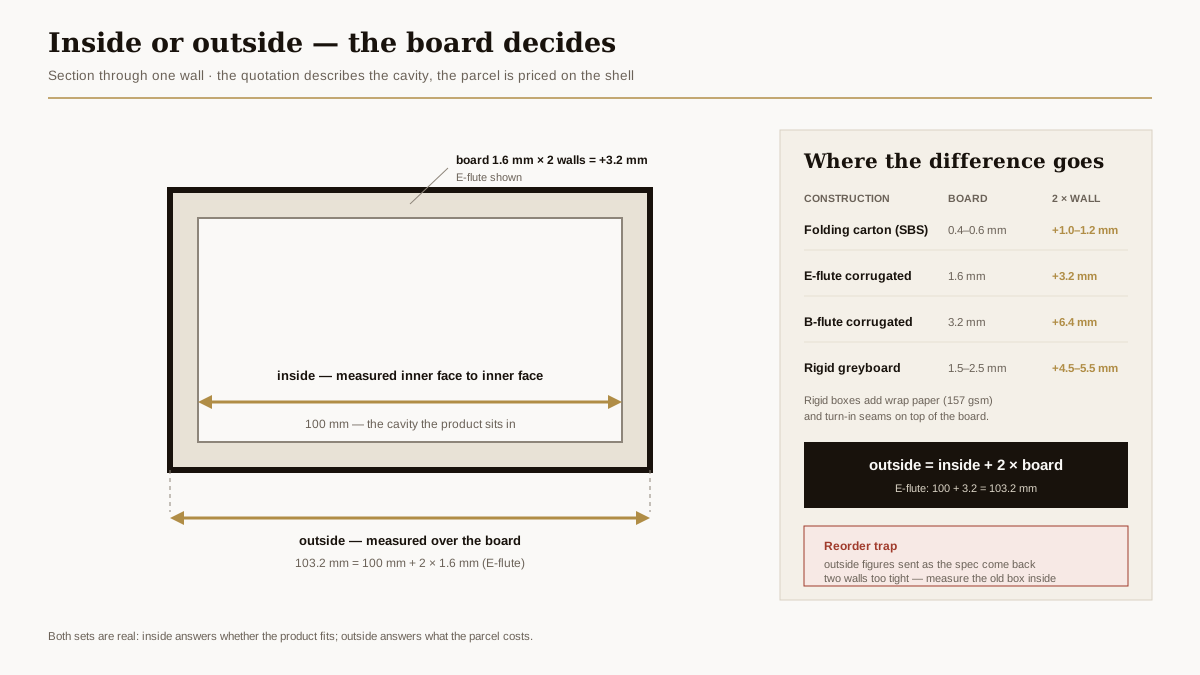
A rigid gift box adds more wall than a folding carton, so identical inside dimensions produce visibly different outside boxes across constructions.
The telescoping lid vacuum rule
For two-piece rigid boxes (lift-off lid and base), outside growth does not stop at wall thickness. The lid must incorporate an internal clearance allowance of 1.5–2.0 mm wider than the base exterior. A zero-tolerance lid traps air inside, creating a vacuum lock that frustrates customers attempting to slide the box open.
How do you measure a box?
With a ruler or a tape, inside edge to inside edge, length first — and the box open, so the reading describes the cavity the product actually occupies.
- Open the box and stand it upright. Measure the longest side of the opening from one inside edge to the other: this is the length.
- Measure the shorter side of the opening the same way, inside edge to inside edge: this is the width.
- Measure from the inside bottom to the inside top edge: this is the height. On a carton with flaps, the height does not include the flaps.
- Record each figure to one decimal with the unit stated. Volume, when a carrier calculation needs it, is length × width × height.
One decimal is not fussiness. Uline quotes an acceptable manufacturing variance of ±1/8 in on stock cartons, and custom production runs its own tolerance — a product that exactly equals the cavity dimension leaves no room for that variance, which is why fit-critical orders are confirmed on a physical sample rather than on the drawing.
Treat a printed size as a claim to check, not a fact to copy. Manufacturing variance applies to the carton in hand as much as to the one in the catalogue, so measure the box you actually have.
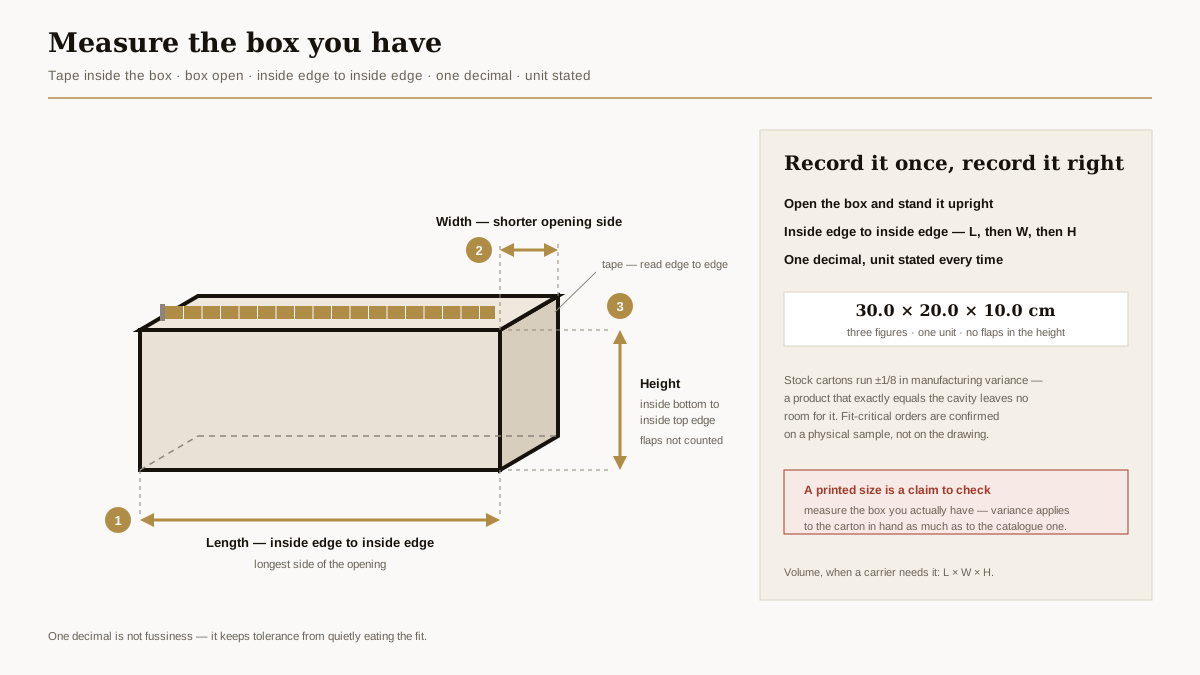
Manufacturing variance runs to ±1/8 in on stock cartons — measuring to one decimal keeps the tolerance from quietly eating the fit.
Measuring a product for a custom box
Most buyers ordering custom packaging do not have a box to measure. They have a product and a slot in a range, and the measurement starts from the product.
Take the product's three dimensions at their widest points: longest, widest, tallest, including anything that sticks out. A necklace is measured with its chain laid as it will sit, not folded. A ring is measured across the band and over the setting. Ring boxes at ELAPACK are quoted from exactly those figures — band width, setting height and the number of rings per box — because the insert cavity is cut to the piece, and the specification stage confirms dimensions, slot layout, materials and closure together.
Do not add your own clearance allowance. Cavity clearance belongs to insert engineering: a die-cut slot, a foam cavity and a platform each hold the same product with different gaps, and the number that matters is confirmed on a filled sample, not guessed at order time. Send the product dimensions and the insert requirement, and ask the supplier to propose the cavity.
The “Double-Allowance” trap: why buyers must send net product dimensions
When ordering custom boxes, buyers frequently add a “safety buffer” to their product measurements before submitting specifications. If your perfume bottle is 50 mm wide, do not submit it as 55 mm.
Packaging structural engineers automatically engineer insert tolerances based on material behavior:
- High-density EVA foam: engineered with a snug interference fit (-0.5 mm to 0 mm) to grip glass or jewelry firmly.
- Die-cut folding cardboard: engineered with a +1.5 mm to +2.0 mm clearance to prevent paper snagging.
- Velvet-wrapped platforms: engineered with a +3.0 mm allowance to accommodate compressed fabric pile.
If you add 5 mm and the factory engineer adds another 3 mm, the resulting cavity is 8 mm oversized. The product rattles inside the box during transit, and jewelry chains emerge tangled. Provide net, unpadded dimensions at the widest points, and specify whether you prefer a loose drop-in fit or a friction grip.
A quotation a factory can work from first time:
| Field | What to send | Why it changes the quote |
|---|---|---|
| Product dimensions | Three figures at the widest points, with units | Sets the cavity |
| Items per box | One product or a set — for example, rings per box | Sets the insert layout |
| Insert or cavity need | Slot, platform, foam cavity — or a request to propose one | Sets the engineering |
| Existing box that fits | Its inside dimensions | A shortcut when a fit already exists |
| Closure | Lid-and-base, magnetic, ribbon | Changes structure and height |
| Quantity and need-by date | Stated against the order terms | Sets sampling and production scheduling |
ELAPACK order terms for custom boxes: minimum 200 pieces; production typically 15–20 days after sample approval and payment receipt; a custom sample at USD 30 plus USD 25 shipping, built in 3–5 days; and a digital dieline preview free for structure approval. The preview is the drawing that shows your dimensions as flat panels before anything is cut — how to read one is covered in the die cutting and dielines guide.
For a worked jewelry example of an insert matched to a product, see the custom ring boxes guide; the specification fields these measurements land in are set out in the spec sheet guide. Send the product dimensions, items per box and quantity to request the dieline preview with your quotation.
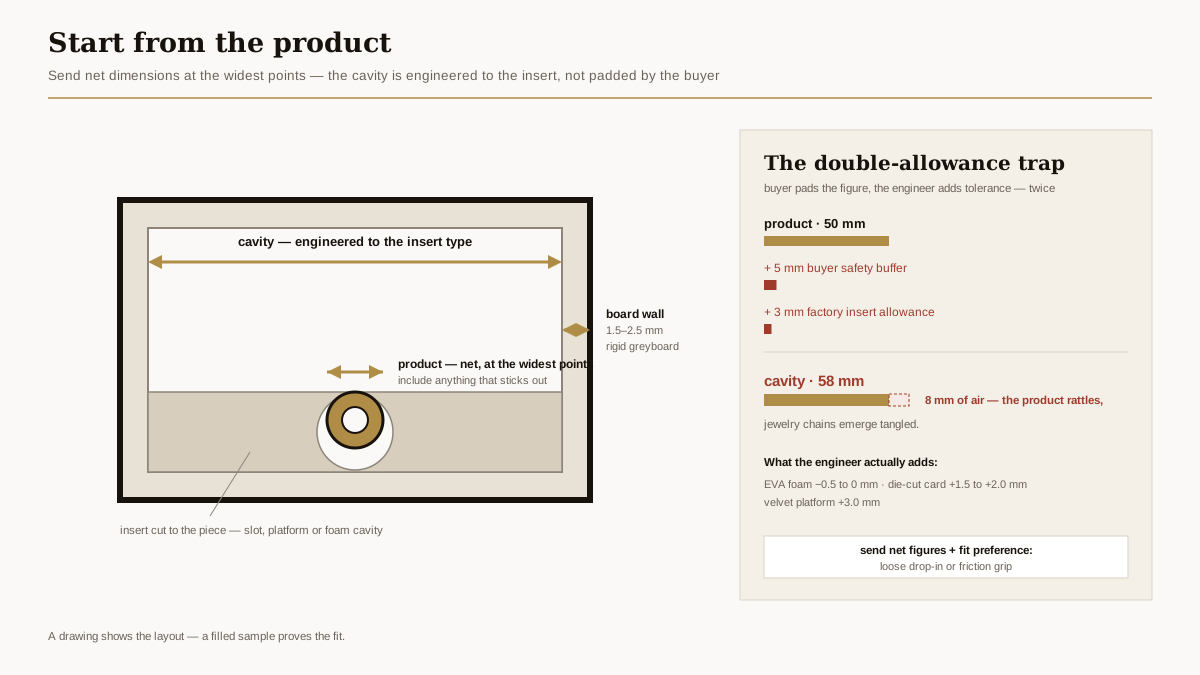
A drawing shows the layout; a filled sample proves the fit — cavity and closure are approved on the assembled sample, not on the dieline alone.
How box dimensions change the shipping bill
Once the box is packed, the outside dimensions take over. Major parcel carriers — FedEx, UPS, DHL and USPS — charge based on the greater of the actual scale weight and the dimensional (DIM) weight.
The DIM formula and the round-up rule
For commercial parcel accounts across the US, the standard domestic dimensional formula is anchored by a published divisor:
Dimensional weight (lbs) = length × width × height (inches) ÷ 139
(For international metric shipments, carriers benchmark volumetric weight as length × width × height (cm) ÷ 5000 kg. Retail counter rates without an account use a 166 divisor.)
Crucially, under FedEx and UPS operating rules (updated August 2025 and followed by USPS in July 2026), carriers round each fractional dimension up to the nearest whole inch before multiplying.
Consider an e-commerce box measuring 10.25 × 8.25 × 5.25 in with an actual weight of 3 lbs:
- The carrier rounds the measurements up to 11 × 9 × 6 = 594 in³.
- Divided by 139, the dimensional weight is 4.27 lbs, rounded up to a billed weight of 5 lbs.
- A fraction of an inch on each panel shifts billable weight by two full pounds across thousands of shipments.
For oversize parcels, carriers check length plus girth, where girth is twice the width plus twice the height. Easyship's current figures for the three major US carriers:
| Carrier | Max weight | Max length | Max length + girth |
|---|---|---|---|
| USPS | 70 lb | 130 in, Retail Ground only, with an oversized charge | 108 in |
| UPS | 150 lb | 108 in; longer parcels are labelled oversized | 165 in |
| FedEx | 150 lb | 119 in | 165 in |
Girth is 2 × (width + height): a 30 × 20 × 10 cm box has a 60 cm girth and 90 cm of length plus girth, well inside every cap above, while a long display box crosses the line while still feeling small.
Avoiding the $25–$38 additional handling surcharges (AHS)
While maximum carrier caps terminate at 165 inches, carriers penalize bulky boxes long before that ceiling. FedEx and UPS impose steep additional handling surcharges (AHS) — frequently adding $25 to $38+ per carton — if a box breaches any of three critical thresholds:
- Longest side exceeds 48 inches;
- Second-longest side exceeds 30 inches;
- Length plus girth [L + 2(W + H)] exceeds 105 inches.
Right-sizing your outer box to sit safely at 47 inches or beneath the 105-inch combined band is where freight budgets are protected.
The cost lever for a custom-box buyer is right-sizing. The smallest box that still protects the product is the cheapest to ship on every order, because dimensional weight is charged per parcel, not per product. Confirming the packed dimensions against your carrier's current rules before the dieline is finalised — rather than after the first shipment is billed — is where that saving is decided.
For EU-bound shipments, right-sizing is a regulatory check as well as a cost lever: the PPWR caps the empty-space ratio in grouped, transport and e-commerce packaging, so check the empty-space ratio against the PPWR cap when the outer box dimensions are set.
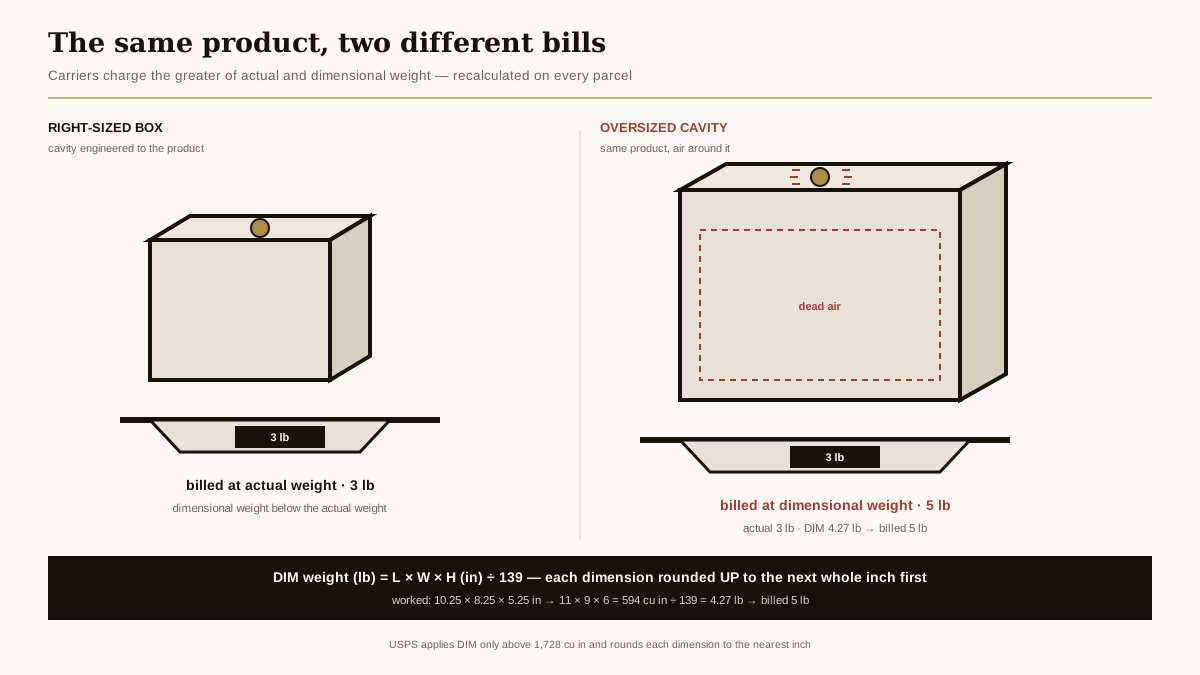
Dimensional weight is recalculated on every parcel — an oversized cavity around a small product is a recurring charge, not a one-time design choice.
Sources
- Uline, “How do you measure a box?”, Uline Customer Service FAQ — https://www.uline.com/CustomerService/ULINE_FAQ_Ans?FAQ_ID=57
- vMeasure, “How to Measure a Shipping Box” — https://vmeasure.ai/how-to-measure-shipping-box
- Easyship, “How to Measure a Box for Shipping” — https://www.easyship.com/blog/how-to-measure-a-box-for-shipping
- CedCommerce, “UPS Matches FedEx's Dimensional Weight Change: What Sellers Need to Know Before August 18” — https://cedcommerce.com/blog/ups-matches-fedexs-dimensional-weight-change-what-sellers-need-to-know-before-august-18/
- Commerce Catalyst, “Dimensional Weight Shipping” — https://commercecatalyst.ai/blog/dimensional-weight-shipping
- GoatLabels, “Additional Handling Fees on Heavy B2B Parcels” — https://goatlabels.io/blog/additional-handling-fees-on-heavy-b2b-parcels
Frequently asked questions
Which side of a box is the length?
The longest side of the opening — on a shipping carton, the longest side with a flap. Width is the shorter opening side and height is the remaining dimension.
Are box dimensions inside or outside?
Inside. Listed dimensions are always inside dimensions; the board thickness sits outside the measured space, and the outside measurement is the one used for shipping and storage calculations.
What does the D stand for in box dimensions?
Depth — the same third dimension as height. A supplier writing L × W × D means the same measurement as L × W × H; confirm which convention a quotation uses before comparing figures.
How do you measure a box for shipping?
Measure the packed parcel outside — length, width and height — for carrier size rules and dimensional weight, and measure the box inside when specifying or reordering the box itself. The two sets of numbers answer different questions.
Is the length always the longest side?
On a box, yes — length is the longest side of the opening. General math usage is less fixed, which is why packaging figures should be confirmed with a labelled sketch rather than a bare number sequence.
What should I send a supplier for a custom box quote?
The product's three dimensions at their widest points with units, the number of items per box, the insert or cavity need, the inside dimensions of any existing box that fits, the closure preference, and the quantity with a need-by date.
---
Eliminate box sizing errors before cutting mass production dies
Don’t let rounded-up inches, vacuum-locked lids or oversized dimensional freight inflate your packaging budget.
Send your product dimensions (L × W × H at widest points), product photos and target order quantity to ELAPACK’s structural desk. Within one business day, our packaging engineers will:
- Calculate your exact cavity clearance and generate a production-ready 2D vector dieline preview free of charge.
- Provide precise inside versus outside dimensions to verify carrier freight and dimensional weight brackets.
- Lock your specification into our agile MOQ 200 manufacturing schedule, with custom physical prototypes dispatched in 3–5 days.
[Request Your Free Custom Box Dieline & Sizing Audit →](https://elapack.com/contact/)