
Regulatory facts below are anchored to the European Commission's packaging waste page and the EUR-Lex official summary of Regulation (EU) 2025/40, read on 14 October 2026; items marked as-published are compliance-service readings, not official text. This page is a procurement reading, not legal advice, and its regulatory readings are rechecked weekly against the official sources.
The PPWR reaches box specifications through two levers: what the box is made of and how big it is. The material lever — recyclability grading from 2030 — has its own page in the PPWR recyclability grades guide; the volume lever is this one. The full timeline, from entry into force on 11 February 2025 to application on 12 August 2026, is in the PPWR buyer's guide.
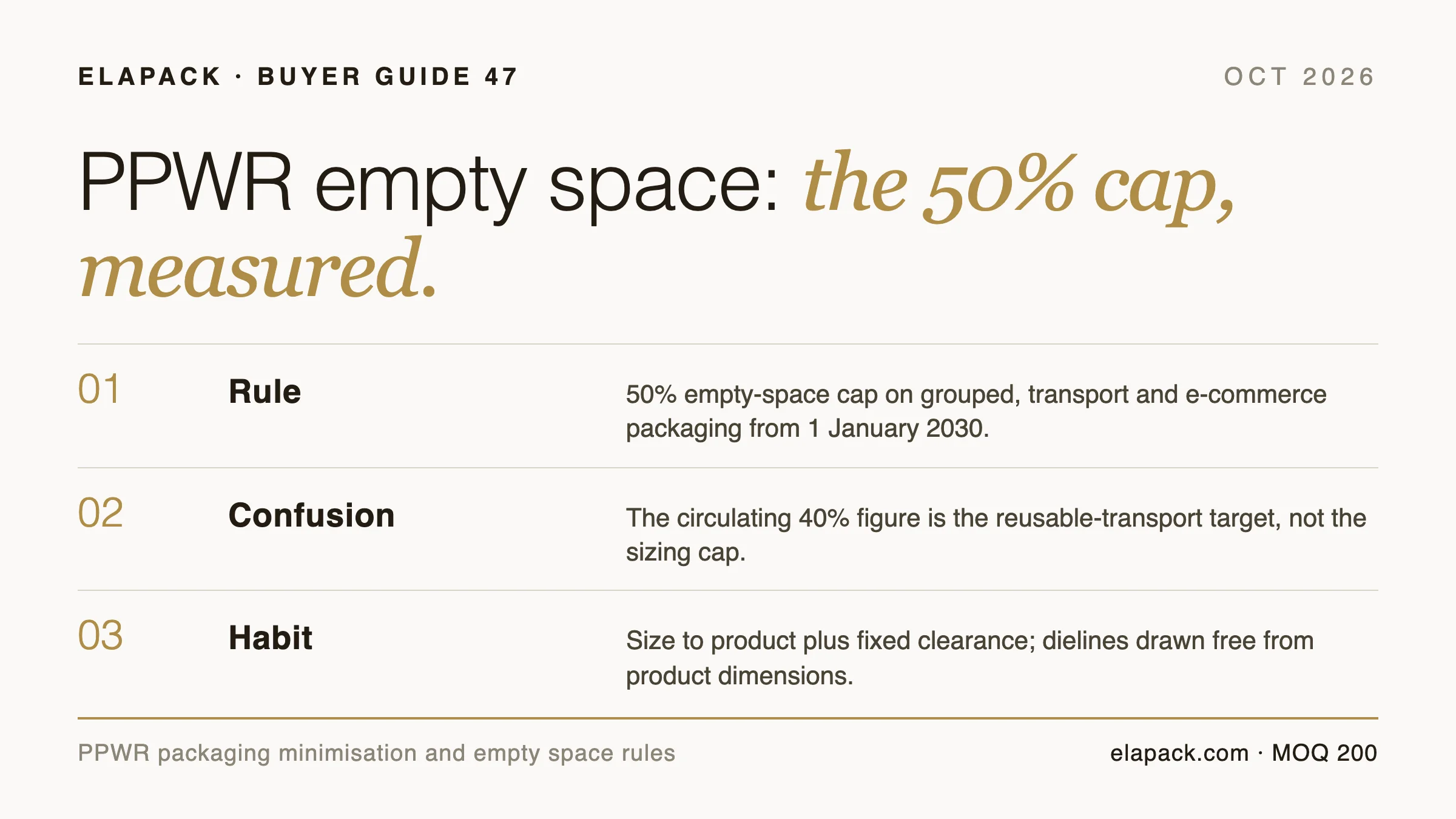
Quick answer: from 2030, the grouped, transport and e-commerce packaging you fill must not exceed 50% empty space, and filler counts as empty space in compliance readings of the rule. Sales packaging must minimise empty space while staying functional, and double walls or false bottoms used to inflate perceived volume are prohibited unless the shape is protected by design rights or trademarks. The "40% by August 2026" figure circulating in advisories is a different duty — the reusable-transport target. The buyer's move is one habit: size to the product plus a fixed clearance, on a dieline drawn from your product dimensions.
What the rule actually says
Four sentences in the official summary carry the whole rule for box buyers.
| Official fact | What it says | Anchor |
|---|---|---|
| Empty-space cap | by 2030, grouped, transport and e-commerce packaging must not exceed 50% empty space | EUR-Lex summary |
| Sales packaging | must minimise empty space while maintaining functionality | EUR-Lex summary |
| Weight and volume | must be minimised; marketing requirements and consumer acceptance do not justify more packaging | EUR-Lex summary |
| Perceived volume | double walls and false bottoms prohibited unless protected by design rights or trademarks | EUR-Lex summary |
| Governing article | Article 24 | as-published by compliance analyses |
The first row is the number that made the rule famous. The other three matter just as much to a custom-box programme: the sales-packaging duty means the gift box itself is in scope for minimisation, the weight-and-volume sentence removes "but it looks premium bigger" as a defence, and the perceived-volume clause names the luxury trade's two oldest tricks directly. A double-wall build or a false-bottom insert used to make a box feel fuller is the exact construction the regulation lists — from 2030 it survives only where the shape itself is protected by design rights or trademarks.
Takeaway: one hard cap (50%, transport layer, 2030) plus three minimisation duties that reach the retail box itself.
Where the 40% number comes from
Two figures circulate in packaging advisories: a 50% empty-space cap and a 40% requirement with an August 2026 date attached. The second is a different duty wearing a similar hat. The official summary's 40% is the reusable-transport target — by 2030, 40% of transport packaging must be reusable — and some advisories compress the two into a single rule stamped with the regulation's general application date. A buyer who plans against a 40% cap in August 2026 is fixing the wrong number at the wrong time: the empty-space duty is 50%, and its date is 2030. What actually switched on on 12 August 2026 is the documentation machinery — declarations, technical files, supplier information duties — covered further down this page.
Takeaway: if an advisor quotes 40% and August 2026 in one breath, they are describing the reuse target, not the sizing cap.
How the ratio works and how to measure it
The regulation does not put a tape measure in your hand, so the method below follows compliance-service explanations of the rule (as-published), not official text. The ratio compares what your products occupy with the internal volume of the packaging around them — and in those readings, filler is not exempt: paper, air pillows and shredded void fill all count as empty space, because the rule is written to stop shipping air.
Measurement is three numbers and a division:
- Internal volume of the filled box, in centimetres: length × width × depth.
- Volume of the product as it sits in the box, including any fixed tray it stands in.
- Ratio = (box volume − product volume) ÷ box volume.
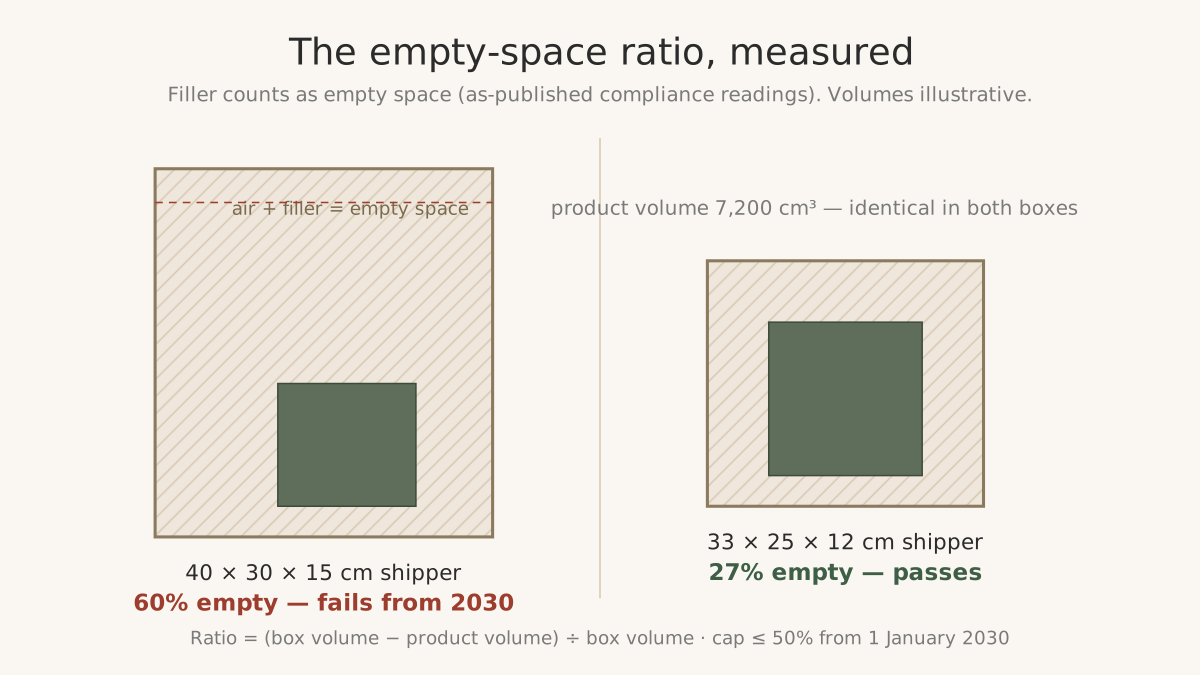
Fig. 1 — The same 7,200 cm³ product in two shippers: 60% empty fails the 2030 cap, 27% passes.
| Illustrative build | Internal volume | Product volume | Empty-space ratio | From 2030 |
|---|---|---|---|---|
| Oversized shipper, 40 × 30 × 15 cm | 18,000 cm³ | 7,200 cm³ | 60% | fails the cap |
| Right-sized shipper, 33 × 25 × 12 cm | 9,900 cm³ | 7,200 cm³ | 27% | passes |
The numbers are illustrative, not regulation text — but the gap between the two rows is the entire project. No material change, no grade calculation: the same product in a smaller box is compliant.
Takeaway: the ratio is arithmetic, not chemistry — a tape measure and the internal dimensions settle it before any supplier is contacted.
Which packages the cap actually touches
The cap covers three layers: grouped packaging (a shrink-banded multipack of sales units), transport packaging (the shipper carton) and e-commerce packaging (the box the online customer receives). For a custom-box buyer the mapping is direct: a rigid gift box travelling inside a shipper is sales packaging within transport packaging, and the 50% cap applies to the shipper you fill. The gift box carries the other duties — minimisation, and the perceived-volume clause above.
This is where the regulation and the luxury format meet honestly. Where a tall build is functional — a candle box sized to a fixed-height vessel, a watch box whose pillow sets the depth — the functionality language is the defence. Where the height is theatre — a deep lid over a shallow product, a false floor lifting a ring into "presentation position" — the construction is named. The build mechanics of the boxes themselves are covered in the rigid boxes guide and the gift box collection; the compliance question is always whether the volume works for the product or for the shelf.
Takeaway: the cap bites the shipping layer; the retail box answers the minimisation and perceived-volume clauses instead.
The sizing habit that satisfies it — and cuts freight
A 50% empty-space cap rewards the same habit freight bills already reward, because air ships at billed weight. Volumetric pricing charges for the space a carton occupies, so every avoidable centimetre is paid for twice: once in board, once in freight. Four working rules:
| Decision | Effect on the ratio | Effect on freight |
|---|---|---|
| Size to product plus fixed clearance | ratio drops directly | volumetric weight drops |
| Fitted insert instead of loose filler | box drops a size without transit damage | fewer void-fill purchases, denser cartons |
| Low-profile structure where the product allows | depth is the multiplier that inflates ratios most | shallow boxes stack |
| Flat-fold or one-piece formats | transport layer ships flat before filling | maximum units per container |
The clearance figure matters more than it looks: the 6–13 mm product-to-wall allowance documented in the candle boxes guide is tight enough to keep ratios low and loose enough to protect corners in transit. Inserts do the rest — a fitted tray holds the product at the box wall so filler is not needed at all, and the packaging inserts guide compares the materials. The artefact that ties it together is the dieline: drawn from your product dimensions before any board is cut, it is simultaneously the sizing document, the compliance evidence and the freight calculation. Ours are drawn free at quotation.
Takeaway: right-sizing is the rare compliance duty that pays for itself — the cap, the board cost and the freight bill all move on the same centimetre.
What to ask for at quotation
The PPWR's evidence duties are already live — the regulation applied from 12 August 2026 — and the official summary states two of them plainly: manufacturers must carry out conformity assessment and draw up an EU declaration of conformity, keeping the technical documentation for five years, and suppliers must provide manufacturers with the information that documentation requires. For a buyer, three lines on a purchase order capture the practical side:
| Ask | What it proves |
|---|---|
| Internal dimensions as built | the ratio can be computed on receipt, not estimated |
| Material composition statement | feeds the recyclability grade file in the grades guide |
| Declaration-of-conformity status | the five-year paper trail exists before the order does |
Suppliers who answer those three precisely are the ones the manufacturer vetting checklist is designed to find — specificity about dimensions, materials and documents is the same competence at every scale. The sample stage verifies the rest: a stock sample settles board and build quality, a custom sample settles the final dimensions before the run, and the samples guide lists the costs and timings. Order terms themselves — 200-piece minimums, 15–20 day runs, tooling — are set out in the 2026 factory data page.
Takeaway: dimensions, composition, declaration — three asks, one order, file complete.
The 2026–2030 sequence
Live since 12 August 2026: the documentation machinery — conformity assessment, declarations, five-year technical files, supplier information duties, and the country-by-country EPR layer described in the buyer's guide. Arriving on 1 January 2030: the specification wall — the 50% empty-space cap, recyclability grades, the Annex V format prohibitions, and the 40% reusable-transport target from the confusion above. Between the two dates, every redesign is a compliance event: size it to the product, state its composition, file its documents. A box right-sized in 2027 for freight reasons meets the 2030 cap without a second project — the buyer's advantage of starting the habit inside the current order cycle rather than the regulatory one.
Takeaway: the paperwork started in August 2026; the dimensions are judged in 2030; the habit is worth starting on the next order.
Bottom line
The 50% cap is a 2030 date with a 2026 habit attached. It will trouble buyers whose boxes were sized for shelf theatre; it will not register with buyers already sizing to product-plus-clearance and shipping denser cartons. ELAPACK draws dielines free from your product dimensions and states material composition at quotation — the two supplier behaviours the empty-space era rewards. Start a quote with your product dimensions and target quantities.