
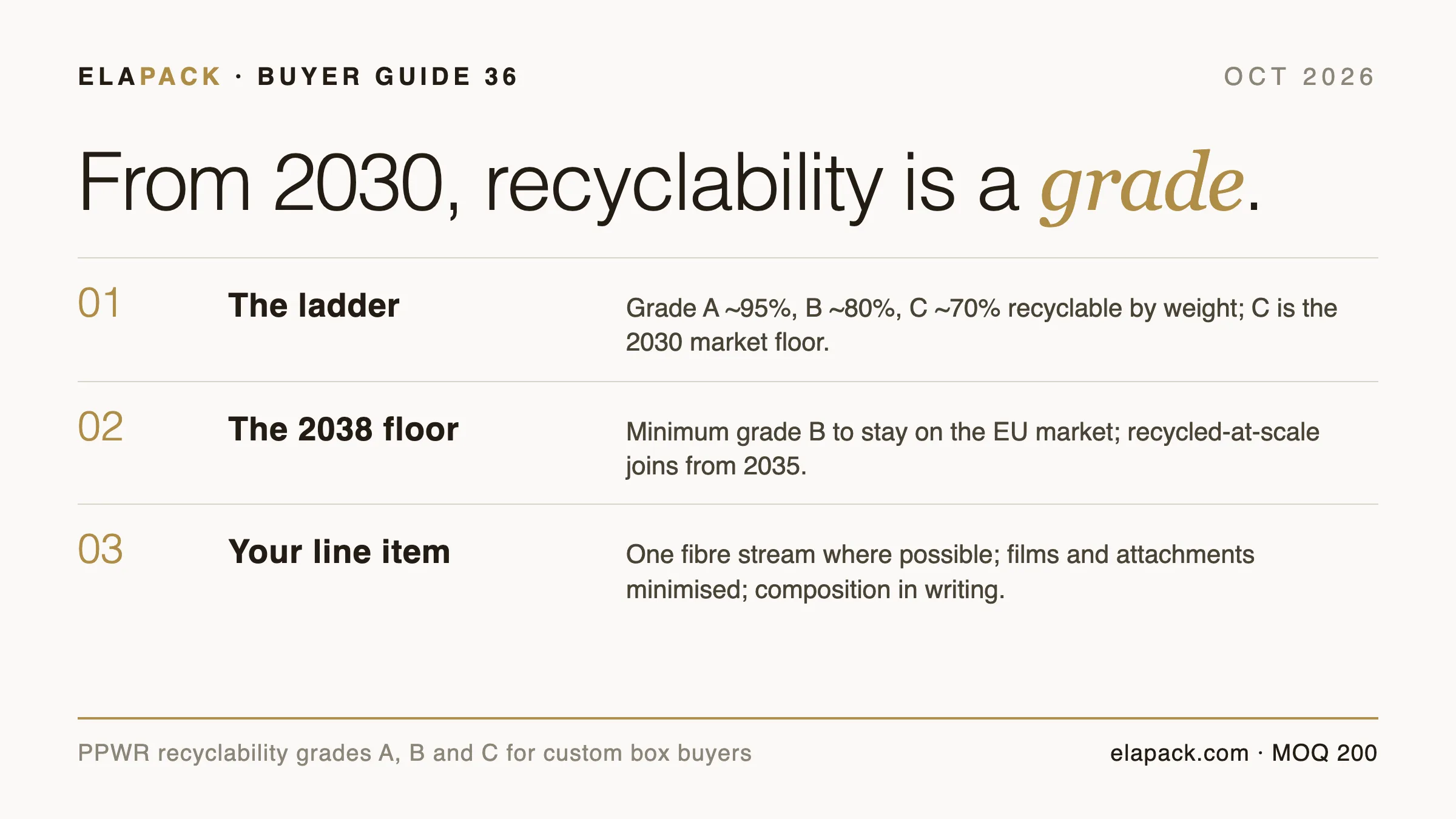
Grading facts below are anchored to Regulation (EU) 2025/40 on EUR-Lex (recital 28: design-for-recycling grading from 1 January 2030, recycled-at-scale from 2035, minimum grade B from 1 January 2038) and the European Commission's packaging waste page, read 11 October 2026. Percentage thresholds for grades A/B/C are the regulation's grading methodology as consistently reported by compliance analyses of the official text, and are labelled as such. This page is a procurement reading, not legal advice.
From 1 January 2030, recyclability stops being a marketing word and becomes a graded market condition — packaging below grade C cannot stay on the EU market, and from 2038 the floor rises to grade B (EUR-Lex, recital 28). For custom-box buyers that makes material composition a specification line item, starting now. The companion PPWR buyer's guide covers the full regulation timeline; this page goes deep on the one mechanism that changes box specifications.
Quick answer: the PPWR grades packaging A, B or C against design-for-recycling criteria, with minimum grade C required from 1 January 2030 and minimum grade B from 1 January 2038, plus a recycled-at-scale test added from 2035. For custom boxes: single-material paper constructions grade cleanest; every added material layer (laminations, foils, window films, textiles) is a variable to ask about. The buyer's action is one line in the purchase order: state the material composition and the design-for-recycling position of this build.
The grades at a glance
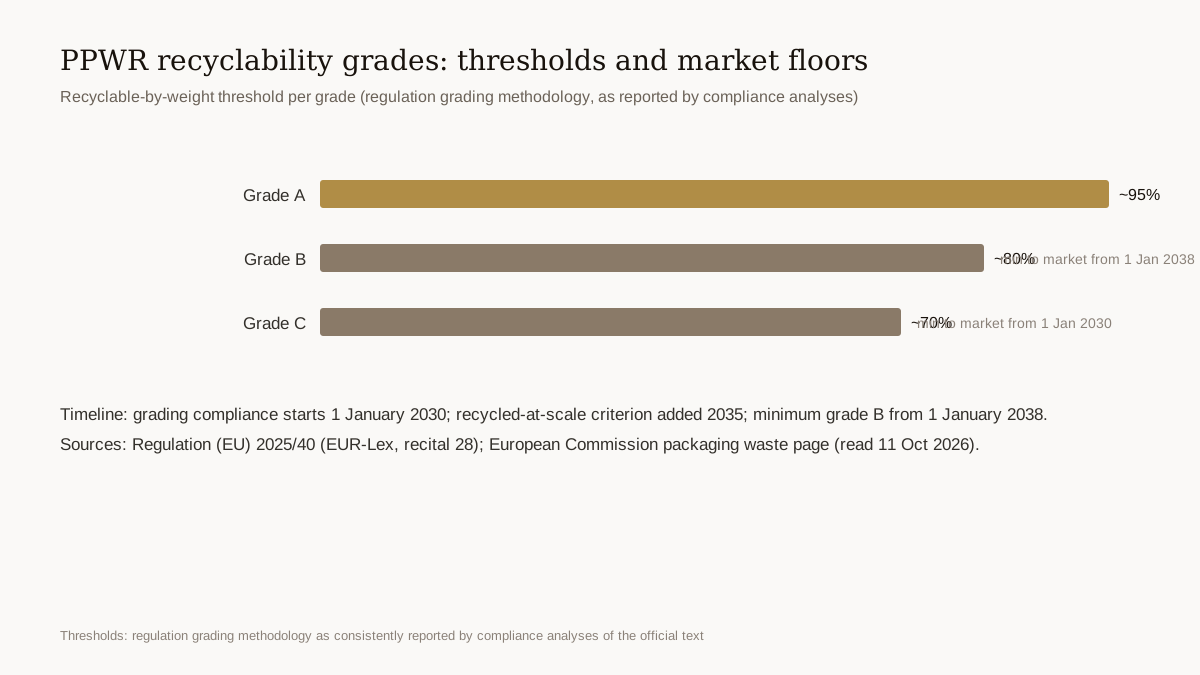
| Grade | Recyclable-by-weight threshold (as reported from the grading methodology) | Market meaning |
|---|---|---|
| A | around 95% | top tier |
| B | around 80% | minimum to market from 1 January 2038 |
| C | around 70% | minimum to market from 1 January 2030 |
Dates from EUR-Lex recital 28: grading compliance starts 2030-01-01; the recycled-at-scale criterion joins 2035; grade B becomes the floor 2038-01-01. The Commission frames the headline goal as all packaging recyclable in an economically viable way by 2030.
What drives a custom box up or down the scale
These are design considerations, not legal classifications — the formal criteria arrive via Commission delegated acts — but the material logic is already knowable:
| Build element | Grading consideration | Buyer question |
|---|---|---|
| Single-material paperboard (kraft, SBS, corrugated) | cleanest recycling path | is the box one fibre stream? |
| Greyboard + paper wrap (rigid) | same fibre family; adhesives are the variable | what adhesive, how much? |
| Lamination / soft-touch film | polymer layer on a fibre box | is a non-laminated finish available? |
| Foil stamping | small-area decoration; negligible mass | — |
| Window film (PET/APET) | mixed-material separation problem | can the window be reduced or dropped? |
| Textile wraps and ribbons | non-fibre attachments | are they separable? |
The finishes themselves trade off differently now: the surface finishes comparison shows embossing and foil as tactile luxury with minimal material addition, while full-coverage films carry the bigger grading question. The same logic runs through inserts — the corrugated-versus-foam choice in the inserts guide is now also a grading consideration, and PVC-window questions follow the PVC bags material boundary your supplier states.
The 2026–2030 buying sequence
Now: get material composition statements on every quote — a supplier who cannot state composition today cannot evidence a grade in 2029. At each redesign: prefer one fibre stream, minimise films and non-paper attachments, right-size (the PPWR's 50% empty-space cap on transport packaging rewards the same habit). Before 2030: request the design-for-recycling position in writing; compliance analyses of the regulation describe declaration-of-conformity duties that make this paperwork part of the sale either way.
This is also a vetting signal: factories that answer composition questions precisely — the manufacturer vetting checklist tests exactly this kind of specificity — are the ones that will carry you across the 2030 line without a redesign scramble.
Bottom line
The grade ladder is long (2030 for C, 2038 for B) but the specification habit starts at your next order: one fibre stream where possible, attachments minimised, composition in writing. ELAPACK states material composition at quotation and builds rigid and folding paper programmes to specification — start a quote with the grading questions from this page attached.