
Search-volume figures come from a Semrush US database export dated 7 October 2026 (cleaned keyword set; food-packaging terms excluded). Industry frameworks are credited to their publishers; supplier terms other than ELAPACK's are quoted as published, for comparison only. Terms marked as ELAPACK figures are confirmed 2026 trade terms, used here as worked examples of what a good answer looks like — the framework works for vetting any factory, including this one.
This guide is for the buyer who has shortlisted packaging manufacturers and needs to choose one before the first order. Around 14,000 US searches a month go into supplier-selection words — packaging companies, packaging manufacturers, packaging companies near me — and the ranking results are supplier pages, not vetting methods; this page is the method.
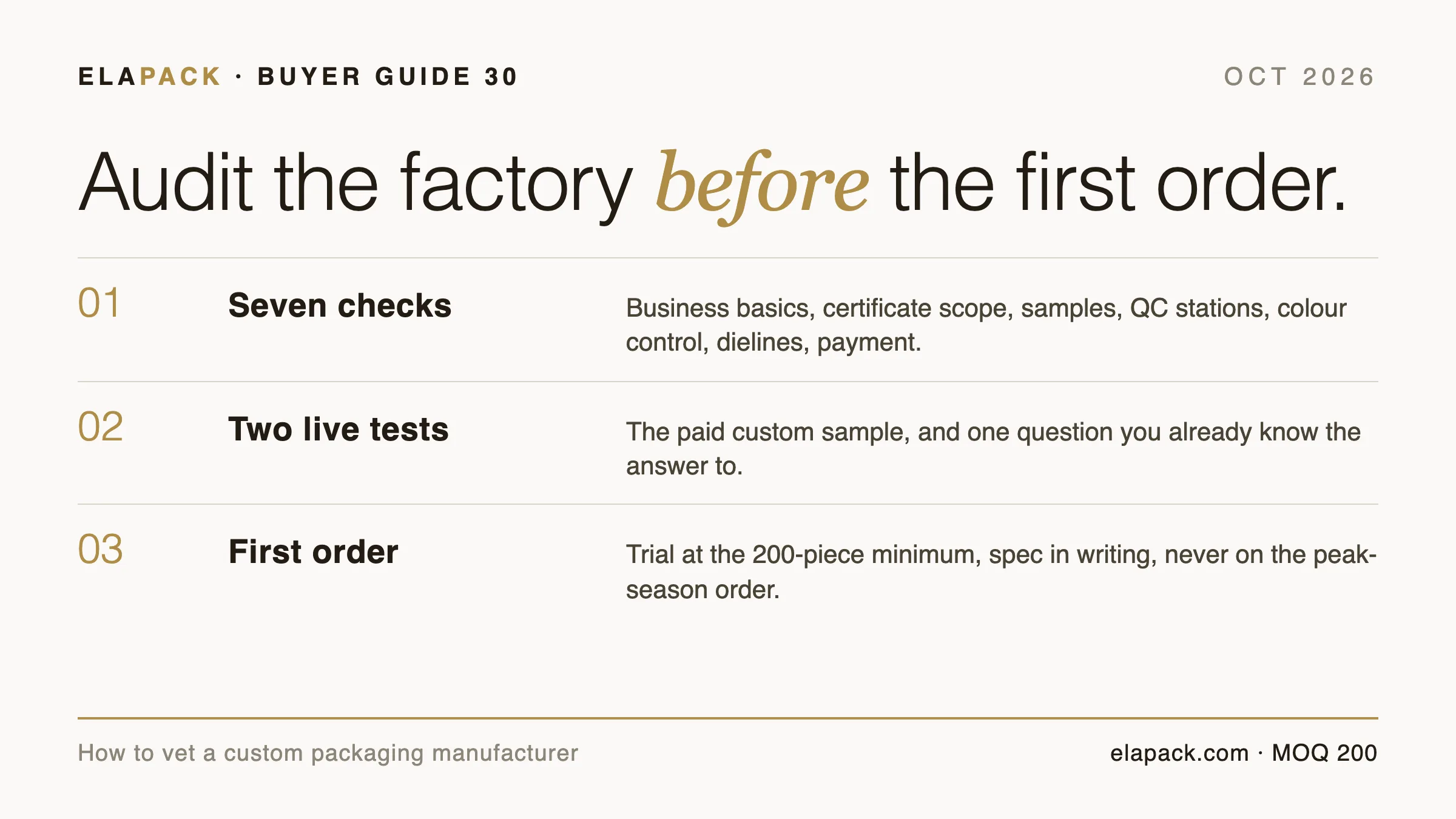
Quick answer: vet a factory on seven checks in order: business basics, certificate scope (not certificate names), sample policy, QC process, colour control, engineering support, payment terms. Two live tests beat all desk research: order the paid custom sample, and ask one question you already know the answer to. A factory that passes both is safe for a first order at trial quantity.
Key facts at a glance
| Item | Data |
|---|---|
| Head word | packaging services — 2,900 US searches/month (Semrush, 7 Oct 2026) |
| Local-intent words | packaging companies near me (1,300, KD 10), packaging company near me (590, KD 12) |
| Framework sources | Specright (manufacturer vs supplier), industry vetting checklists |
| Worked-example terms | ELAPACK confirmed 2026 terms (MOQ 200, 15–20 days, sample policy) |
| The two live tests | paid custom sample; one known-answer question |
| Excluded from this page | food-packaging supplier words (out of scope for this factory's lines) |
What buyers actually search

The cluster divides into three intents: directory words (packaging companies, packaging manufacturers), local words (near me, KD 10–12 — these map to map listings and directories, not articles), and specification words (custom packaging supplier, KD 51 — hard heads, soft tails). The absence of any vetting-guide content on these results is the gap this page fills: buyers searching for a factory get factories, never a method for choosing one.
Manufacturer, supplier or broker
The distinction Specright publishes is the one to memorise: a manufacturer makes your packaging on its own lines; a supplier may make some products and source the rest; a broker makes nothing and resales. None is disqualified — but each changes what you verify. For a manufacturer, verify the factory (certificates, QC, lines). For a supplier, verify which items are in-house and which are bought in, because the bought-in items carry the longer lead time and the weaker quality control. For a broker, verify the actual factory behind every item, or you are vetting a website. Ask directly — will this item run on your own lines? — and note the answer for the audit trail.
The seven checks
1 — Business basics
Company age, export record, and who signs. A factory trading since well before the pandemic with a stable legal name has survived freight crises and material swings — that history is data. Red flags: a trading name with no legal entity behind it, and a quotation with no company chop or signature. Check one: ask for the business licence and export record; a manufacturer answers in a day.
2 — Certificates: read the scope, not the logo
An ISO 9001 badge on a homepage proves nothing; the scope text on the certificate is everything. ELAPACK's own certificate reads, in full, Production and sales of paper and textile packaging products — which is exactly the scope a paper-and-textile packaging buyer should demand to see. Check two: ask for the certificate and read the scope line; if the scope does not name your product family, the certificate does not cover your order.
3 — Sample policy
The sample stage is the cheapest audit in sourcing. Terms that respect both sides: a free stock sample with shipping paid by the buyer, and a paid custom sample at a nominal fee. ELAPACK's published terms — stock sample free with USD 20 shipping (2–3 days), custom sample USD 25 + USD 20 shipping (3–5 days) — are a fair benchmark for factory-direct custom. A factory that refuses custom samples before payment, or quotes a custom sample at production-price levels, is telling you how the programme will run. Check three: order the custom sample before the production order, every first time — the [packaging samples guide](https://elapack.com/news/custom-packaging-samples-guide/) lists what to verify when it arrives.
4 — QC process, in stations not adjectives
Every factory says strict quality control; few can name the stations. A real process has a count and a sequence. ELAPACK's, as one worked example, runs six stations from incoming material through in-line checks to pre-shipment AQL inspection — a number you can ask any factory to match or better. Check four: ask the factory to list its QC stations in order; hesitation is the answer.
5 — Colour control
Colour is where packaging programmes quietly fail — box wrap, pouch fabric and ribbon drift apart across batches. A controlled process names its steps; ELAPACK's four-step chain (artwork and Pantone review, material and surface test, on-press control, sample approval before bulk) is the structure to demand, with the honest caveat every factory should give: final colour can shift slightly with material, coating and print method — the colour tolerance guide covers how to set acceptable bands. Check five: ask how Pantone references are held across substrates; a factory without a written answer will hand you three shades of navy and call them a match.
6 — Engineering support
Does the factory quote from your sketch, or from a dieline it drew for you? Engineering support at quotation — a free digital dieline drawing, vector-file acceptance, tooling costs named separately — is the difference between a packaging programme and a print order. ELAPACK's terms again as the benchmark: free dieline drawing at quotation, and die tooling quoted separately at USD 50–100 when a new die is genuinely needed — the die cutting and dielines guide explains why that number is small and why it matters that it is separate. Check six: ask for the dieline before you commit; a factory that cannot draw your box cannot be responsible for it.
7 — Payment and communication red flags
Fair terms for first orders balance both sides: a deposit with balance against inspection or documents, not 100% in advance from a new buyer. Communication red flags: quotes that arrive without an expiry, answers that change the specification instead of correcting it, and any pressure to skip the sample stage. Check seven: put the payment schedule, the lead time and the sample terms in writing before the deposit — the [factory data page](https://elapack.com/news/custom-packaging-moq-sample-lead-times-2026/) shows what a published terms table looks like.
The ten questions to send any factory
| # | Question | Passing answer looks like |
|---|---|---|
| 1 | Will this item run on your own lines? | yes, or a named partner with the same checks |
| 2 | May I see your ISO certificate scope? | scope names your product family |
| 3 | What are your sample terms? | free stock + nominal custom fee |
| 4 | List your QC stations in order | a count and a sequence, same-day |
| 5 | How is Pantone held across substrates? | a written process, plus the shift caveat |
| 6 | Do you draw the dieline? | free at quotation, tooling named separately |
| 7 | Lead time at my quantity? | a band tied to quantity, in writing |
| 8 | Payment schedule for a first order? | deposit + balance against documents |
| 9 | What is your MOQ? | a number with a reason (see the MOQ and OEM guide) |
| 10 | What does a spec sheet from you include? | the lines in the spec sheet guide |
Score it: seven or more solid answers is a quotable factory; five or fewer is a website.
First-order risk control
Structure the first order as a trial: one product, the minimum quantity (200 pieces at ELAPACK), the paid sample approved first, and a written spec sheet holding every variable. If the trial ships clean, the second order is where the programme economics start — and the rigid box and jewelry packaging overview guides cover how to structure the bigger programmes. Never trial a factory on your peak-season order; trial on the order whose delay you can survive.
Bottom line
Fourteen thousand searches a month and no method in the results — so carry this one. Run the seven checks, send the ten questions, and trial at minimum quantity with an approved sample. ELAPACK publishes its own answers to all ten on the factory data page and the about page — vet this factory with the same checklist, that is the point of writing it down. Ready to run the checks on a live quote? Request one here.