
Component descriptions summarise ELAPACK's published product ranges and its confirmed order terms (MOQ 200 pieces, 15–20 day production, custom sample USD 25 plus USD 20 shipping). Each component named here has its own deep-dive guide, linked where it appears.
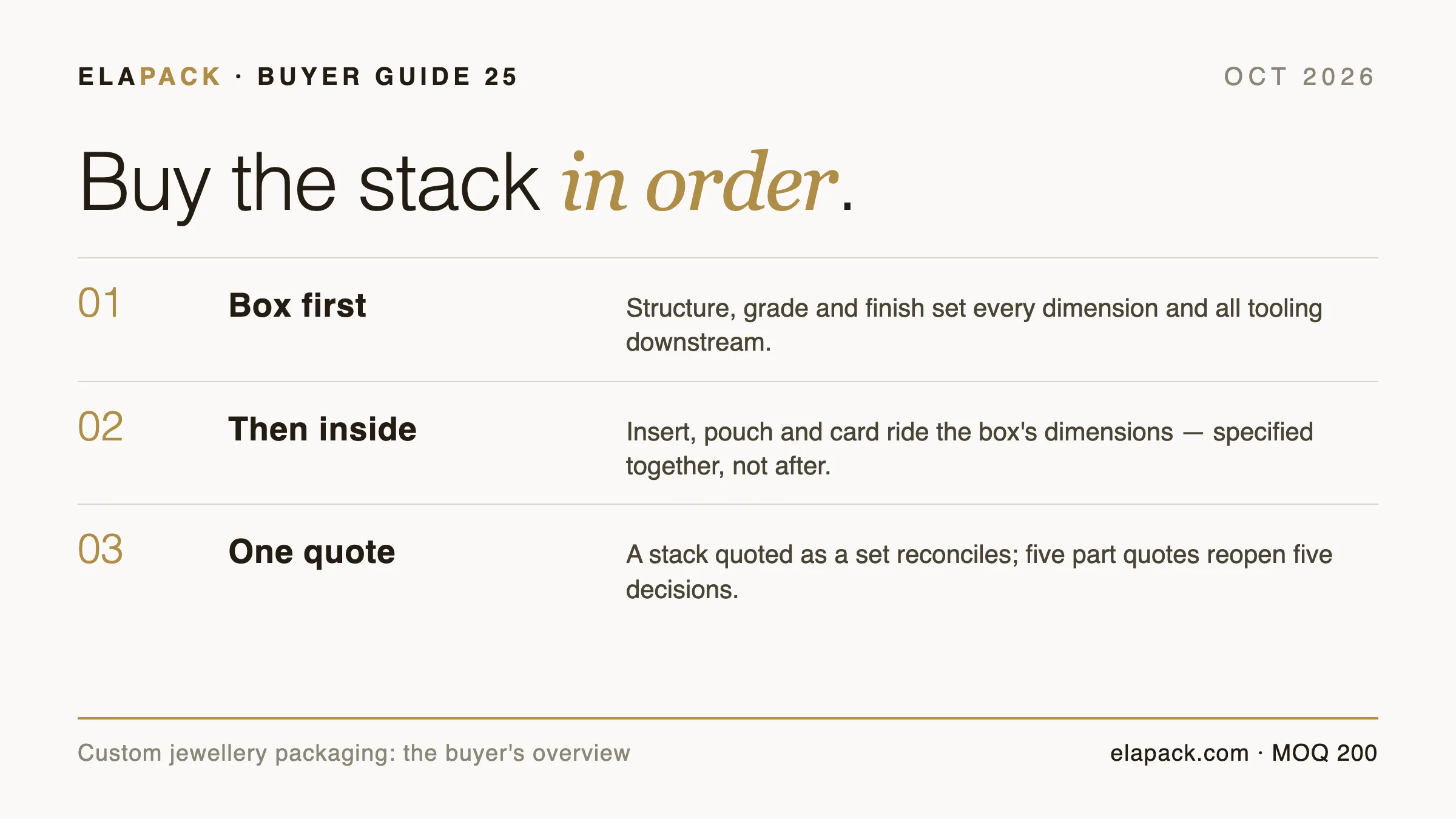
Quick answer: buy the stack in this order — box structure, insert, pouch, card, display — because each choice constrains the next. The box takes the longest and carries the tooling; the pouch and card ride its dimensions; the display mirrors the box's layout. One supplier quoting the stack as a set beats five quotes for five parts.
Key facts at a glance
| Item | Figure | Source |
|---|---|---|
| Minimum order | 200 pieces per design, all lines | ELAPACK confirmed terms |
| Production lead time | 15–20 days at 200–20,000 pieces | ELAPACK confirmed terms |
| Custom sample | USD 25 plus USD 20 shipping, 3–5 days | ELAPACK confirmed terms |
What "jewelry packaging" covers
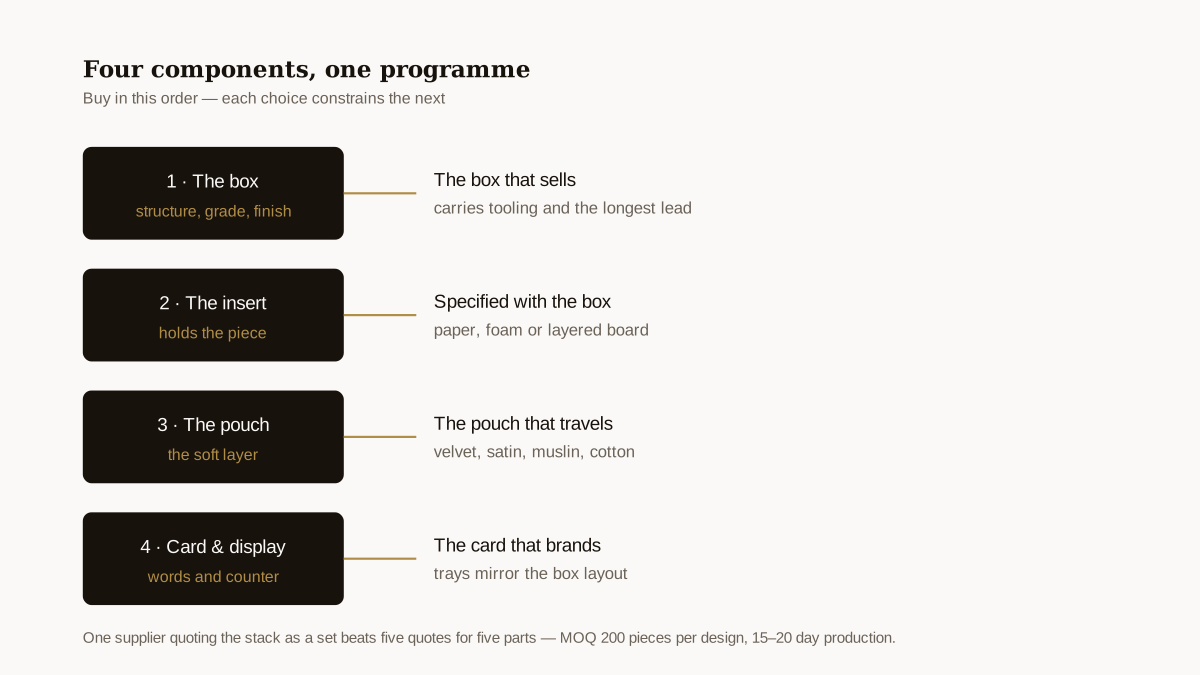
"Jewelry packaging" spans four component families — boxes, pouches, trays and cards — and buyers usually need a coordinated set rather than one piece: the box that sells, the pouch that travels, the tray that displays, the card that brands. Each component has its own guide below; this page is the map that keeps them to one specification language. The product catalogue side lives on the jewellery packaging page; this guide is the decision layer above it.
Order the components as one programme — one specification language across box, pouch, tray and card — and they arrive as one unboxing.
The stack, in buying order
1. The box
Structure, board grade and finish set everything downstream — dimensions, tooling, unboxing. The full decision path is the custom jewellery boxes guide; the construction layer beneath (greyboard, three-ply build, twelve structures) is the rigid boxes guide. Ring programmes narrow further into the ring box guide with sizing and insert data.
2. The insert
What holds the piece: paper systems, EVA/PET/PE foams, or layered board at up to 40% space-and-cost saving — the packaging inserts guide compares them on weight, fragility and lift. The insert is specified with the box, not after it.
3. The pouch
The soft layer that travels with the piece: velvet, satin, muslin, cotton, microfiber — compared in the jewellery pouch guide and the material comparison. The logo method on it has its own guide in logo on custom pouches.
4. The card
Care cards, message cards, gift cards — specified with the insert's slot, printed to the same colour discipline as the box. The colour review process that keeps box, pouch and card reading as one set is the colour tolerance guide.
5. The set, and the display
Complete presentations — box, fitment, pouch, card quoted as one object — sit in the sets collection; the counter-and-drawer side is the display and storage guide. Display mirrors the box layout: what sits in the tray should sit in the box the same way.
Each layer constrains the next — sequence the programme and the quotes reconcile; buy out of order and every later choice reopens an earlier one.
What a one-supplier brief looks like
A stack brief a factory can quote as a set carries: the piece list with dimensions and weights; the box structure and grade per format; insert system per format; pouch material and logo method; card scope; the quantities per line against the 200-piece minimum; artwork in vector with Pantone references; and the delivery window. The quotation fields that make offers comparable across suppliers are catalogued in the specification sheet guide. For small brands starting the stack, the MOQ and sampling economics — what a first 200-piece order actually buys — are worked in the MOQ, sample and lead-time guide.
The bottom line
Buy box → insert → pouch → card → display, quote the stack as one object, and approve colour across every layer at once. Start on the jewellery packaging catalogue, then contact ELAPACK with the piece list and quantities — the quotation will cover the stack as a programme, not as parts.