
Regulatory facts below are anchored to official European Union sources — the European Commission packaging waste page and Regulation (EU) 2025/40 on EUR-Lex — read on 11 October 2026; items marked as-published are competitor or compliance-service readings shown for comparison and are not official text. Search volumes are Semrush US numbers read the same day from a logged-in session. This page is a procurement-side reading, not legal advice.
The EU's Packaging and Packaging Waste Regulation is now law, it reaches every brand that ships boxed goods into the EU regardless of size, and the buyer-side search demand is real and growing: ppwr alone carries 720 US searches a month, ppwr regulation 320 — yet the ranking results are law firms and compliance services, not packaging procurement guidance. This page is the buyer's version.
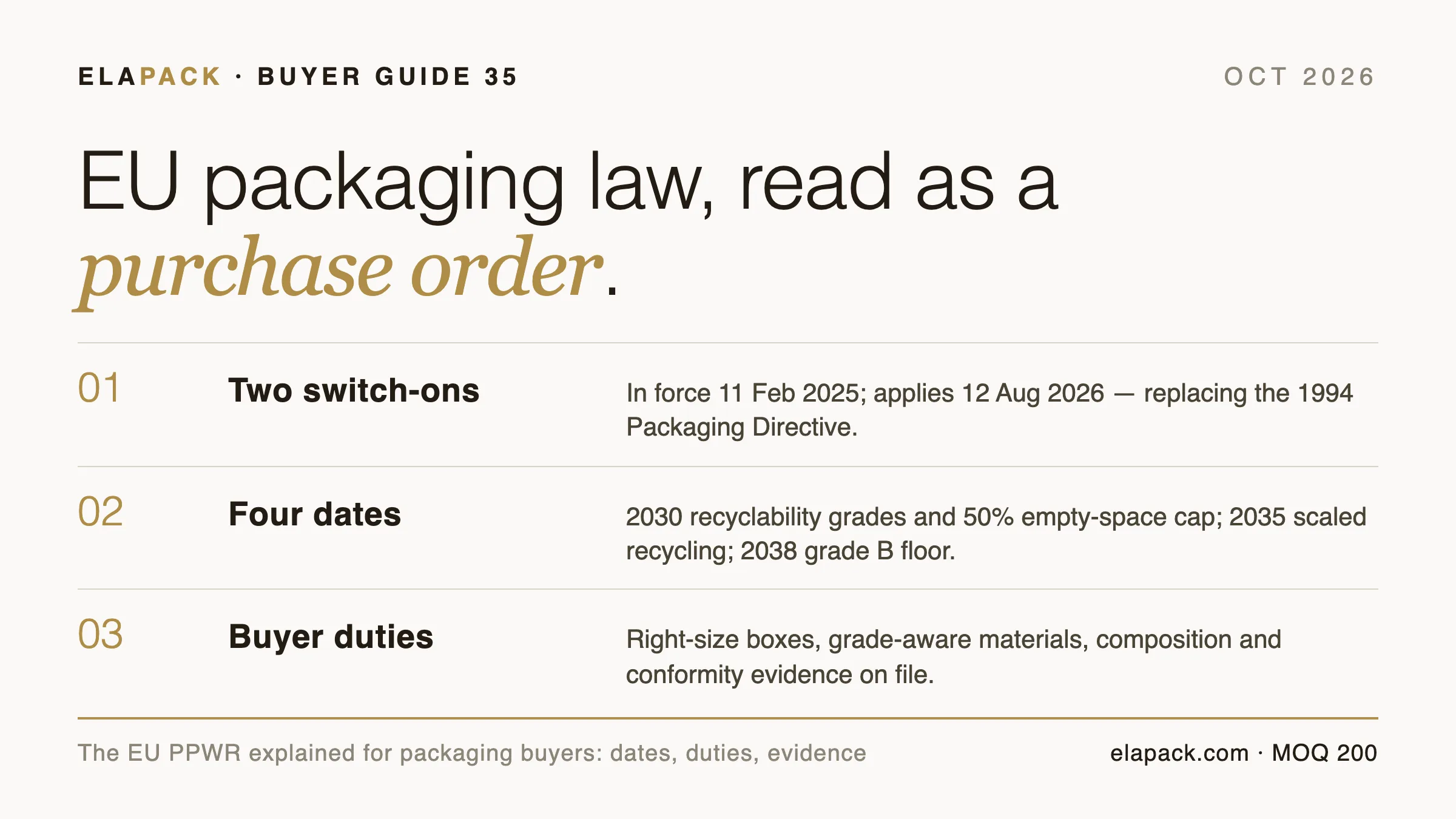
Quick answer: Regulation (EU) 2025/40 entered into force on 11 February 2025 and applies from 12 August 2026, replacing the 1994 Packaging Directive. For a packaging buyer it sets four dates that change specifications: recyclability grading from 1 January 2030 (minimum grade B from 2038), a 50% empty-space cap on grouped, transport and e-commerce packaging, recycled-content targets for plastic packaging, and evidence duties that shift document requests onto your supplier. Nothing in it requires you to stop buying custom packaging; all of it requires you to start asking your supplier different questions.
Key facts at a glance
| Item | Data |
|---|---|
| Official name | Regulation (EU) 2025/40 (PPWR) |
| In force / applies | 11 February 2025 / 12 August 2026 (European Commission, official page) |
| Replaces | Directive 94/62/EC, generally repealed 12 August 2026 |
| Demand head | ppwr — 720 US searches/month, KD 34; ppwr regulation 320/KD 35 (Semrush, read 11 Oct 2026) |
| Buyer entry words | eu packaging regulation ppwr news 70/KD 26; eu packaging regulation news 2026 70/KD 11 |
What buyers actually search

Heads sit at KD 34–48 (hard for a new site) but the news and timeline words run KD 11–26 — the practical entry is the deadline-and-duty intent, which is exactly the procurement angle the law-firm results do not serve.
The timeline a buyer plans against
| Date | What changes | Official anchor |
|---|---|---|
| 11 Feb 2025 | Regulation in force; reuse-format rules for new reusable packaging begin | Commission page |
| 12 Aug 2026 | General application; Directive 94/62/EC generally repealed | Commission page |
| 1 Jan 2030 | Packaging must be recyclable per design-for-recycling grades A/B/C; empty-space ratio capped at 50% for grouped, transport and e-commerce packaging | EUR-Lex, recitals 28 and 84 |
| 2035 | Recycled-at-scale criterion added to the grading | EUR-Lex, recital 28 |
| 1 Jan 2038 | Minimum grade B to stay on the market | EUR-Lex, recital 28 |
Grades A, B and C correspond to roughly 95%, 80% and 70% recyclable-by-weight thresholds under the regulation's grading methodology, as consistently reported by compliance analyses of the official text.
What the PPWR actually asks a buyer to do
1 — Right-size your boxes. The 50% empty-space cap (EUR-Lex recital 84) turns box sizing from a cost preference into a compliance matter for e-commerce and transport packaging. Sizing to the product plus clearance — the 6–13 mm discipline in the candle boxes guide — is already the compliant habit.
2 — Ask recyclability questions at quotation. From 2030 the grade attaches to the packaging you place on the market. Single-material paper constructions (kraft, SBS, corrugated — see the rigid boxes guide) have the clearest grading path; mixed-material builds need their supplier to state material composition. The deep-dive on grades is the PPWR recyclability grades guide.
3 — Collect evidence from your supplier. Compliance services reading the regulation describe a Declaration of Conformity duty for packaging placed on the market (Article 39 / Annex VIII, as reported by compliance analyses) and technical-file retention duties — which in practice means your purchase orders should request material composition and conformity documents, the way the manufacturer vetting checklist already recommends requesting certificate scopes.
4 — Mind the per-country layer. The PPWR harmonises design rules but extended producer responsibility registration remains country-by-country in practice (as published by EPR compliance services) — an obligation on the brand, not the box factory, and one to raise with your own compliance adviser.
What it does not change
The PPWR does not ban custom packaging, rigid boxes, printed wraps or luxury formats; it grades their recyclability and caps empty space on the logistics layer. Substance restrictions with PFAS thresholds apply to food-contact packaging — a scope this site's products do not cover — and heavy-metal concentration limits continue from the prior regime (figures as-published by compliance analyses). For non-food custom packaging buyers, the practical centre of gravity is the three dates above plus evidence flow.
Bottom line
12 August 2026 is the switch-on date; 2030 and 2038 are the specification dates. Between now and then, the buyers who fare best will have sized boxes properly, chosen materials with a grading path, and put document requests into their purchase process. ELAPACK quotes custom packaging programmes with material composition stated and free dielines — the two supplier behaviours the PPWR era rewards.