
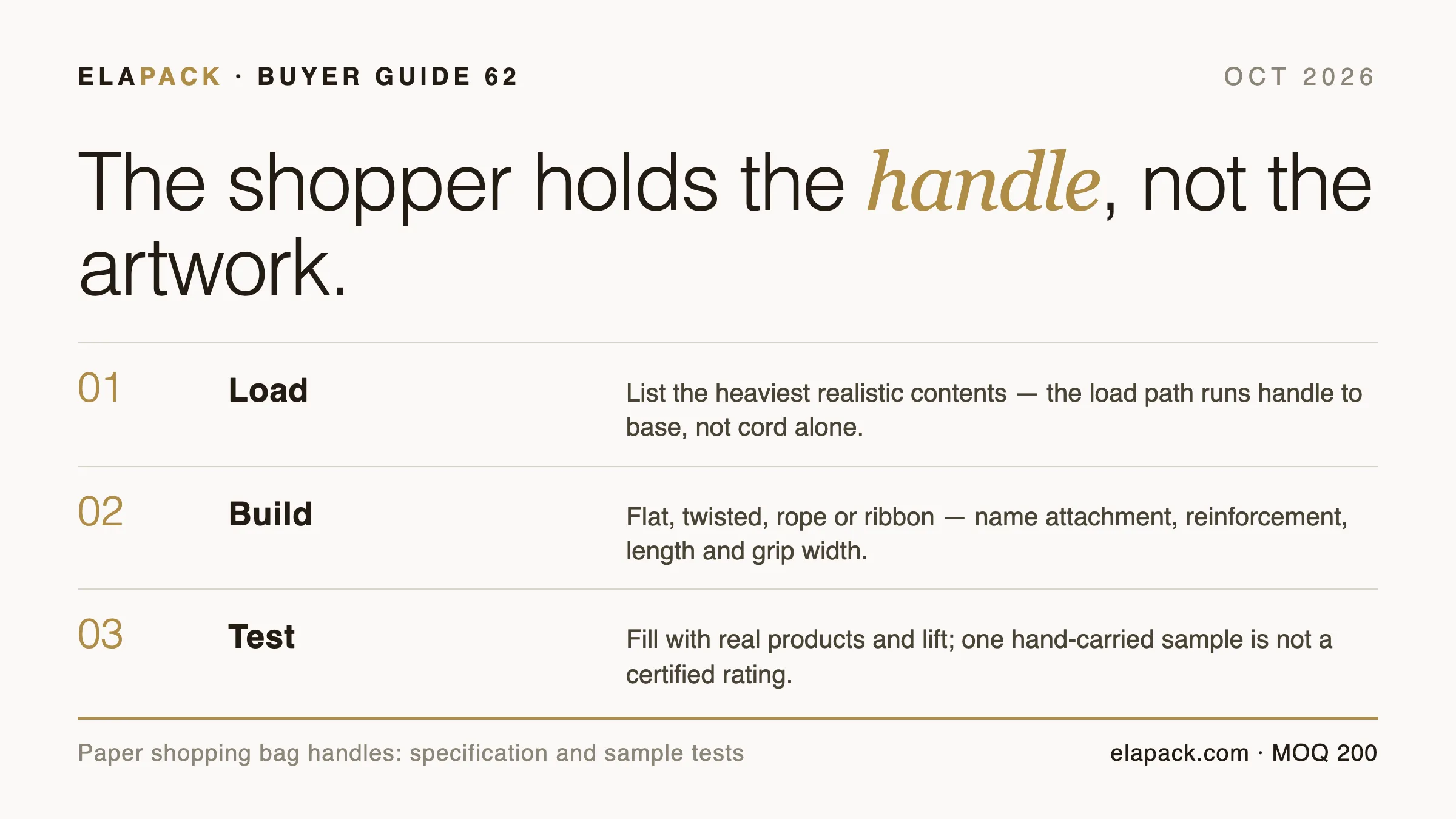
A shopper holds the handle, not the artwork. If the handle is uncomfortable or detaches under the intended load, the bag fails its practical job regardless of print quality. This guide focuses on handle attachment and buyer testing. For the wider material and branding choices, see the custom shopping bags guide.
Define the carried load before choosing a handle
List the heaviest realistic combination of products that could be placed in one bag. Include boxes, tissue or inserts if they are normally handed over together. Record whether the bag will be carried briefly in-store, across a shopping district, or reused. These are project inputs; no handle material alone determines safe capacity without the actual bag construction and test.
Paper bag handles may be flat paper, twisted paper, rope or ribbon. Packhelp's paper bag catalogue shows market examples of these options. Their catalogue is a competitor reference, not a statement that all variations are offered by ELAPACK. Ask the supplier to identify the attachment method, reinforcement patch, handle length and grip width for each proposed design.
Treat the handle, punched opening, top fold, sidewall and base as one load path. A stronger cord does little if the paper tears where it is attached. If a proposed design uses an eyelet, internal patch or folded cuff, ask what problem that detail addresses and compare the complete sample under the same load. A material name alone is not a load rating, and a reinforced top does not eliminate the need to inspect the bag base.
The Paper Bag industry group's quality guidelines discuss bag quality and the connection between handle construction and performance. A standard or test method should be cited only if the actual offered bag has been tested to it. For a custom order, request the method, sample size, load and pass criterion in writing if a performance claim matters.
How the handle is attached decides how it fails
Handle attachment falls into a few structural families, and the family — not the material name — decides where the bag gives way:
- Machine-glued. Twisted and flat paper handles are glued to a reinforcement patch inside the bag at machine speed. A handle bonded straight to a single layer of paper tears that layer out under load; the patch spreads the force and moves the failure point.
- Hand-threaded. Rope and ribbon handles pass through the turned top — the top edge folded back on itself, usually over a strip of card, to form a reinforced lip — and are knotted or crimped behind it. An eyelet punched through a single thickness of paper is a perforation, and a perforation is where the paper tears.
- Die-cut. The opening is cut into the bag itself: nothing to detach, but the load is limited by the paper around the opening, and heavier die-cut bags need a reinforcement board inside that area.
Two requirements follow whatever the type. A turned top on any threaded handle, without exception. And a reinforcement patch on any glued handle — ask to see it in the sample. If a rope-handle quotation does not mention a turned top, ask, because the difference is not cosmetic.
Assembly also drives how the price behaves with quantity, not just how the bag holds. Machine-gluing gets cheaper with volume; hand-threading does not, because ten times the quantity is close to ten times the threading. A volume discount means something different on each family (why factories set minimums).
Test the assembled bag with the real contents
Fill a sample with the intended products and lift it by the handles. Repeat the action at the likely pace and distance, then inspect the handle joint, paper around its attachment, base folds and top edge. If the bag carries a rigid jewelry box, check whether corners press into the bag side while it hangs. A static photo of a loaded bag will not show how it feels to carry.
| Sample observation | Record what happened |
|---|---|
| Handle pull | Did attachment or knot move? |
| Grip | Was it comfortable with the full load? |
| Bag body | Did the top edge, side or base distort? |
| Did handling scuff a critical area? | |
| Repeat | Did the same issue appear on other samples? |
This is a buyer's trial checklist, not a certified strength test. If formal capacity is required, agree on a recognized method and acceptance criteria with the supplier before ordering. One successful hand-carried sample cannot establish a guaranteed safe load for a production run.
What the approved sample must show before sign-off
A loaded trial proves the design; the sign-off sample proves the production intent. Before approving, check that the sample carries the quoted structure, not only the quoted look:
- The attachment method named in the quotation is the one in your hands. Open the top fold and look inside the bag for the reinforcement patch.
- Both handles are the same length and drop, with matching knots or crimps end to end.
- Any eyelet sits in the turned top, not through a single layer of paper.
- The gusset is sized from the product, with corners clear of the bag side while it hangs.
Keep the approved sample as the reference for the run — it is what a receiving inspection compares against when cartons arrive (how to inspect a delivery against the approved sample).
On load claims, hold one line firm: a single load rating quoted across a range of bags is a marketing figure. Ask what the bag was tested at in your own size and paper. Where reuse matters, the European industry scheme tests carriers under EN 13590 and marks certified bags with the weight and volume they may carry; its published threshold for a high-quality carrier is 6 kg carried home, reused up to five times.
If no physical sample exists yet, that is where the process starts — stock samples and custom prototypes, with their terms and lead times, are laid out in how sampling and minimum order quantities work.
The specification lines that change the quote
A handle quotation is only comparable when the same lines appear on every sheet. Put these in the RFQ:
| Line | What to write | Why it moves the quote |
|---|---|---|
| Dimensions | Width × gusset × height | Gusset depth is the dimension most often specified badly — size it from the product |
| Paper | Grade and weight | Long-fibre virgin kraft carries more at the same weight |
| Handle | Type and material | Sets the assembly family and the hand feel |
| Attachment | Glued to patch / threaded through turned top / die-cut | Hand-threading prices differently with volume |
| Reinforcement | Patch, turned-top card, eyelet, board | Invisible in photos, decisive in failure |
| Handle drop | Carried in hand or on the shoulder | Drop changes handle length and knot position |
| Intended load | Heaviest realistic contents | The basis for any strength discussion |
| Print and packing | Area, technique, per-carton quantity | Sheet size, run length, freight volume |
Send the same sheet to every supplier, so the comparison lands on structure rather than on how each offer is packaged.
On sizing, you do not need an in-house engineer to guess a gusset or a handle drop. Send the product dimensions and the carry scenario, and a free digital dieline preview turns them into a checkable dieline before anything is committed. Ask for the dieline preview
Make the quotation compare like with like
Put bag dimensions, paper specification, handle type, handle attachment, reinforcement, intended load, print area and packed quantity on one sheet. Ask for a physical sample of the exact configuration. A price comparison between rope handles and flat paper handles is incomplete if the papers, reinforcements or carton packing differ.
Use the paper shopping bag product page as a visual reference and the pouches and bags category for alternatives when a soft bag is more appropriate. Send the loaded-product list and bag specification for a conditional quote. If a load claim is needed, ask what evidence supports that exact custom construction.
Questions buyers ask about bag handles
Which handle is strongest?
Structure decides. In published comparisons, cotton rope through a turned top comes out strongest, with twisted paper on a well-made reinforcement patch close behind at considerably lower cost. But any ranking depends on your paper, size and load distribution — which is why the loaded sample, not the material name, is the real test.
Do rope handles cost more than paper handles?
Rarely because of the rope itself — because of the assembly. Machine-glued paper handles get cheaper as quantity rises; hand-threaded rope flattens early, since ten times the quantity is close to ten times the threading. On small runs the gap is narrow; on large runs it widens.