
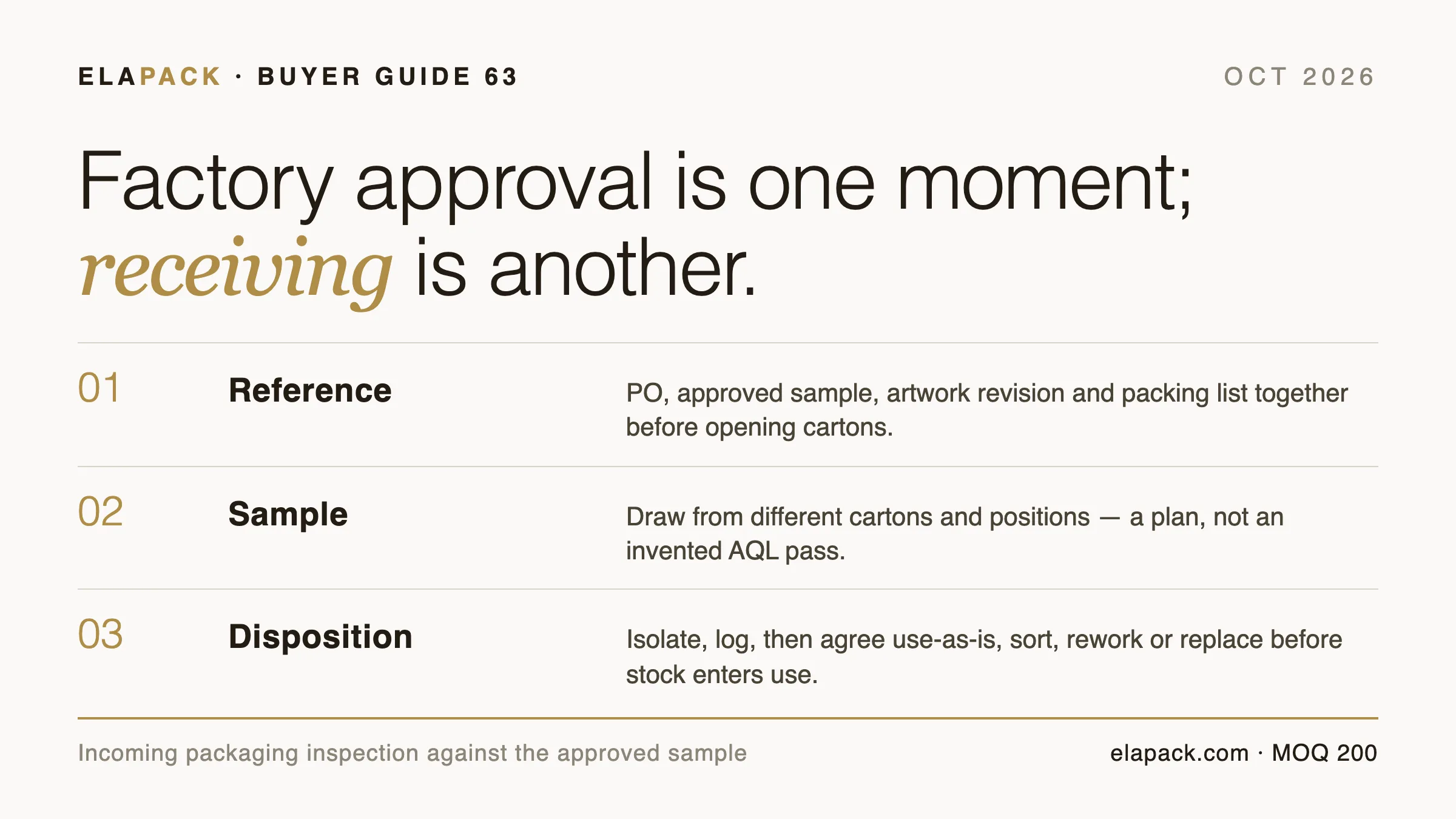
Factory approval and warehouse acceptance are two different moments. A buyer still needs to check whether the shipment received matches the approved version, quantity and packing condition. This guide begins at delivery; the earlier manufacturer vetting guide addresses supplier selection before the order.
Assemble the reference set before opening cartons
Keep the purchase order, approved physical sample, final artwork revision, component specification, carton labels and packing list together. If the approved sample was later changed, identify which revision governs the shipment. A photograph can help locate a sample, but it cannot always show colour, closure fit or surface defects reliably.
Count received cartons and compare their labels with the packing list before mixing stock into storage. Note any damaged cartons, wet areas, crushing or broken seals, and photograph the condition before unpacking. This record helps identify whether a problem was visible on arrival or discovered inside. It does not by itself establish responsibility for damage; that depends on contract terms and shipment evidence.
Select units from different cartons and positions, including cartons that look intact. The ASQ overview of attribute sampling explains why a sampling plan must define the lot and acceptance rules. A buyer should not invent an “AQL pass” after seeing a few good boxes. If a formal acceptance plan is needed, agree on its standard, sample size, defect classes and disposition before production.
The label “AQL 2.5” is not a complete inspection instruction. A formal plan also needs a defined lot, inspection level, sampling type, defect classifications, and acceptance and rejection numbers under the selected standard. The current ISO 2859-1 scheme concerns statistical lot acceptance; it does not supply a universal compression force, colour tolerance or moisture limit for every custom box. Put such product-specific criteria in the agreed specification if they matter.
Compare function and appearance separately
For a box, check dimensions, assembly, lid fit, insert position, printing and visible marks against the approved sample. For a pouch, check finished size, usable opening, seam condition, closure action and branding. If a gift set has several components, compare each component and then assemble a complete set. The multi-component quote guide explains why a component list matters; receiving confirms that the listed parts arrived together.
| Check | Evidence to retain |
|---|---|
| Quantity and version | Carton label, count, artwork revision |
| Physical fit | Product inside box or pouch, with photo |
| Finish | Side-by-side sample in consistent light |
| Defect | Close-up, unit and carton number |
| Disposition | Segregated quantity and supplier response |
The table is an issue log, not a substitute for contract acceptance criteria. If an issue appears, isolate the affected stock and record how many units were inspected before sending the supplier a concise report. Avoid claiming that every unit in the lot is defective from one sample, or that the rest is safe from one good sample.
Grade what you found before asking for anything
A defect list becomes negotiable once each item carries a severity grade. Inspection practice across the industry works with three tiers, and custom packaging fits them directly:
- Critical — a safety, regulatory or routing failure. A barcode that will not scan at retail or a shipping mark that misroutes freight is treated as a no-tolerance finding: industry guidance holds that one critical defect fails the batch.
- Major — the unit cannot serve its purpose or pass a retail-facing check: a failed handle, the wrong artwork revision, a size error that stops assembly.
- Minor — visible but usable: a small scratch, slight print variation, glue marks inside the box.
One caution from QC practice: the same physical defect can sit in different tiers depending on what the order is for. A scuff on a retail-ready gift box is a different problem from the same scuff on a protective mailer. Grade against the approved sample and this order's use, not against a universal list.
The grade sets the default ask. Critical stops the release of affected stock and goes back for replacement. Major calls for a remedy — sorting, rework or replacement — or a price adjustment if the stock is still usable. Minor is logged and watched on the next order; it rarely justifies halting use. Grading is what turns the issue log from a complaint into a claim with a number attached.
Reject, accept with a concession, or sort — the commercial menu
Once the goods are on your dock, the leverage changes. Before shipment, a hold costs the supplier the shipping date; after arrival, remedies run through your purchase agreement. Sample clauses commonly deem goods accepted if no claim is filed within a stated period, and rejecting at delivery is far easier than revoking an acceptance later. Whatever the contract says, two practical rules hold: report before the stock mixes into storage, and agree the remedy in writing before using the goods.
The menu, from strongest to mildest:
- Reject and replace. For critical defects or a wrong version, the affected stock goes back. A replacement run is a production order, not a shipping correction — budget a production window rather than a freight delay (what that window covers).
- Sort or rework, at the supplier's cost. Relabelling, repacking and re-cartoning fix the correctable classes. The commercial instrument is a debit note — the buyer-to-seller document that reclaims the sorting cost or deducts it from the balance due.
- Accept with a concession. For cosmetic tiers on stock that never faces the customer, a price reduction keeps goods moving. Record who approved it and keep the agreement in writing so the decision stays auditable.
- Claim transport damage separately. Damage documented on arrival photos is a freight claim, not a production defect — mixing the two weakens both.
One honesty check before pressing send: a claim stands on what was specified upfront. Inspection against the approved sample and your artwork files only works if those files were the agreed standard. A tolerance that was never written down is hard to enforce at delivery.
A receiving report that survives later scrutiny
The issue log from the comparison step is the core; a complete receiving report wraps it in the fields that let a claim move fast and a reorder start clean:
| Section | Fields to record |
|---|---|
| Order identity | PO number, artwork revision, approved-sample reference |
| Sampling | Cartons received and opened, units inspected, plan used |
| Findings | Defect, severity grade, affected count, photos |
| Decision | Accept, hold or reject per carton group; approver and date |
| Supplier response | Agreed remedy, deadline, written confirmation |
Three fields do most of the work later. Lot and carton numbers tie a defect back to one production run. Photos per defect — close-up plus context — are what a distant supplier acts on fastest. The accept/hold/reject line per group, with a name and date, keeps a concession decision auditable months later.
The same report has a second life as the baseline for the next order: version changes and known watch-points carry straight into a reorder version checklist.
Questions buyers ask about receiving inspections
Who should inspect the delivery — our team or a third party?
Your own receiving team inspects against the approved sample, because they hold the order context: the artwork revision, the packing spec, the order history. Third-party inspection is a different moment — before shipment, at the factory — and its value depends on the standard you supply; inspectors grade against the golden sample and the files you provide.
How soon must we raise a defect after delivery?
There is no universal window; the purchase agreement governs, and clauses that deem goods accepted after a fixed period are common. Practically, raise it before the stock mixes into storage — once units scatter into picking, counts and photos stop being provable.
Close the loop before using the stock
Share the issue log and request a disposition: use as-is, sort, rework, replace or another agreed option. Record who approves the decision and whether it affects a future order. If urgent stock must be used, preserve representative samples and written agreement so the decision remains auditable.
For a new project, an approved jewelry box and a pouch range can be referenced in the incoming checklist. The custom white jewelry box is one product-page example; its image is not an acceptance standard for a different order. Send your specification and ask how sample approval and shipment documentation will be recorded.