
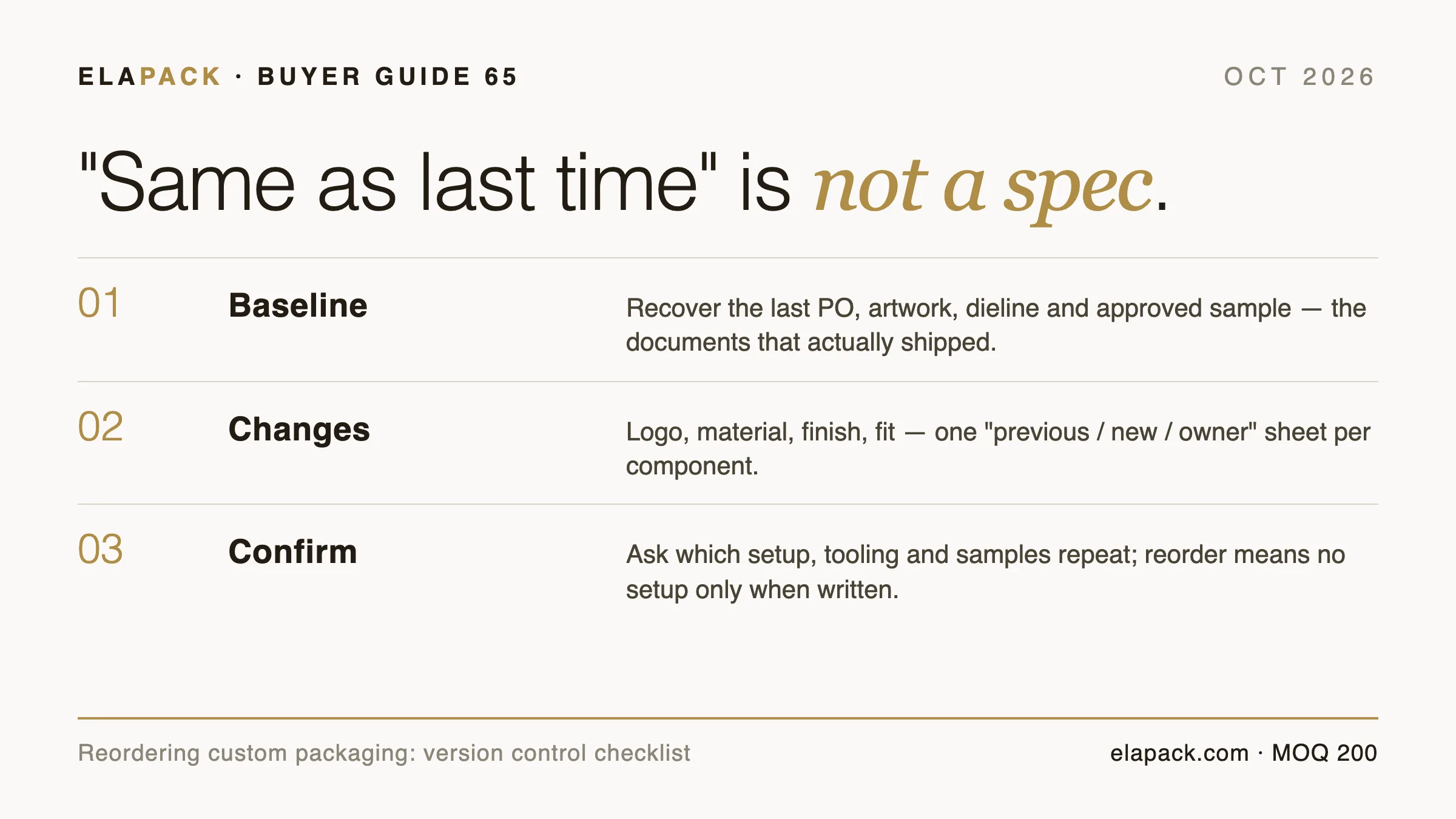
“Same as last time” is not a complete production instruction. Files, materials, decoration and shipping needs can change between orders, even when the product name remains the same. A repeat order works best when the buyer points to a specific approved version and lists every intended difference.
Classify the reorder before you contact anyone
Every repeat request is one of three kinds, and the kind decides what gets re-approved, what gets re-quoted, and which clock restarts:
- Unchanged repeat. The same approved specification end to end — structure, dimensions, materials, artwork, finish, inserts and packing. The tooling and approvals carry over, and the order simply re-enters the schedule.
- Artwork revision. New graphics or updated text on an untouched structure — a corrected address, a new barcode, a seasonal colourway, a revised ingredient block. The dieline does not move, so the question narrows to the proof and the print.
- Structural or material change. New dimensions, a different board or fabric, a new insert layout — effectively a new product in an old reference code, with its own sample and fit check.
Most reorder guidance still frames the choice as repeat-or-redesign, which leaves the middle lane — the cheapest change a repeat order can carry — without a road. The structure is untouched and the fit is already proven; only the print approval is new.
Keep the two decisions separate when you classify your own order. A new logo does not change what the box must hold; a new product does not change what the box must say. An order that changes both is two revisions wearing one purchase order number, and each of them needs its own approval line in the brief below.
Recover the last approved baseline
Collect the last purchase order, production artwork, dieline, physical approved sample, material description, finish, colour reference, insert or pouch details, and any approved deviation. Identify which documents actually governed the last shipment. An early sample may differ from the final bulk approval; using the wrong reference can recreate an old problem. PackMojo's repeat-run guidance likewise calls for documenting changes in size, material, artwork and finish. This is a market practice example, not an ELAPACK process guarantee.
Build a simple comparison sheet with “previous approved,” “new request” and “change owner” columns. A logo update, new barcode, revised contact details or changed language should trigger artwork review. A new jewelry size may require a fit check even if the outer box remains the same. The jewelry box category and pouches and bags category describe different component types; each component needs its own version line in a set.
If the supplier proposes an alternative paper, fabric or finish because the previous one is unavailable, ask for a physical comparison and written acceptance. Do not infer that a material with a similar name will look, feel or perform identically. ELAPACK's colour tolerance guide addresses the appearance side of a repeat run; the reorder checklist also covers fit, construction and component count.
If the original order used foil or another tooled decoration, ask whether the prior tool can be reused and whether the current art still matches it. Tool condition, storage and artwork changes may affect that decision; a fixed impression count is not a reliable replacement rule. Likewise, request the actual retained colour reference and sample-keeping arrangement for this order instead of assuming a universal archive period or guaranteed numerical colour match.
Time the reorder against usable stock
Stock on a shelf is not stock available to sell. Before setting the reorder date, strip the count down to usable units: remove damaged bundles, reserved quantities, superseded design editions and anything ordered but not yet arrived or confirmed. Count what remains by packaging reference and revision, not by product name — and count the components too, because the binding constraint is the shortest pile. Box bodies without matching lids are work in progress, not inventory.
Work the timing backwards from the date packaging must be ready at the packing location, not forwards from today. Your own consumption history, plus a margin for demand and supply uncertainty, gives the reorder point; from there the calendar runs through the production window after sample approval and payment and transit to the warehouse. No universal number of weeks from another brand's buying policy substitutes for that arithmetic.
If the previous order still has a balance held at the factory, the same timing question applies to it before a new order is placed: how split deliveries and stored balances are planned determines whether the first cartons arrive from existing stock or a new run.
Recheck cost and sample assumptions
A previous unit price may not apply to a new quantity, route or component mix. Put the current order quantity next to the previous quantity and state each colour, size and artwork version. Ask what setup, tooling, proof or sample steps are reused, and which need updating. Avoid assuming that “reorder” means no setup work or no sample.
| Version-control item | Buyer question |
|---|---|
| Artwork | Is the exact production file revision named? |
| Material | Is the same paper, fabric, finish and lining available? |
| Structure | Are dimensions, closure and insert unchanged? |
| Components | Does each set contain the same parts and counts? |
| Approval | What changes require a new physical sample? |
| Delivery | Have destination and packing instructions changed? |
This table is a procurement checklist. It does not guarantee that an unchanged file will produce an identical result. Printing and material batches may vary within agreed tolerances; the acceptance reference should be defined before the repeat run. If the set includes a ring box product format, validate the current item fit rather than relying only on the box name.
What a change does to the price and the clock
A pure repeat is the cheap lane. As PakFactory's reorder analysis puts it, the reorder path carries almost none of the one-time costs of a redesign: existing tooling stays in use, the specification is already approved, and the quantity simply re-enters the schedule. Compare like with like anyway — a previous unit price belongs to a previous quantity, freight rate and component mix, not automatically to this one.
An artwork revision changes the print, not the structure. Where the dieline is unchanged, no new die is quoted; where one is genuinely needed, at ELAPACK it is itemised separately at USD 50–100 — never folded into the unit price. Confirm re-use rather than assume it, because tool condition and storage affect the decision. What an artwork revision cannot skip is the proof: a fresh print approval against the new file, with the colour tolerance agreed before the run.
The third class pays the full toll: its own sample and fit check, a production clock that starts from the new approval, and pricing that returns to first-order terms for the affected components. The total comparison is not unit price alone — setup, freight, storage and the risk of stranding the old version all belong in the ledger.
Issue one controlled reorder brief
Send the supplier the baseline version, marked changes, current quantity by version, product samples if fit matters, and the required approval route. Ask them to return a revised specification for sign-off. If no changes are intended, explicitly say so and request confirmation that the quoted materials and process match the approved baseline. Keep the signed comparison sheet with the purchase order and sample record.
The multi-component packaging quote guide can help if the reorder includes several pieces, while the product catalogue helps identify the current box or pouch family. Send the previous approval record and the new quantity for a conditional reorder review. Any sample scope, mixed-version quote or delivery option should be confirmed for this order.
Keep the two versions from mixing
Two versions of one package coexist from the moment a revision is approved until the last old carton leaves the building, and coexistence is where the expensive mistakes happen. A mixed shipment is not a cosmetic flaw. In marketplace fulfilment, a superseded barcode in the carton scans as a different item — stranded stock, relabelling work and fees charged back to the seller. In retail, if the revision carried a mandatory labelling update — an allergen warning, a recycling symbol — mixed vintage cartons are a compliance finding, and compliance findings end in chargebacks or recalls, not warnings.
Give the changeover a written rule before production starts: the switch happens at a defined boundary — a batch, a date, a destination or a reference code — and one named person approves it. A changeover left to individual packers on the floor is a mixed pallet waiting to be discovered by a customer.
Label the boundary in the goods themselves. The new version carries its own identifier or effective date on the carton mark, and superseded artwork is archived with its status, so purchasing, design and production are all reading from the same live file.
At receipt, inspect the delivery against the approved reference before the cartons join general stock: match the purchase order, the reference code and the revision first, and count obsolete editions out of usable inventory the moment they are identified.
And if the archive is thinner than this checklist assumes, start with what exists — the order reference, photographs of the current packaging, a marked-up list of the changes. A reorder review can rebuild the baseline from there; a perfect filing system is not the entry requirement.
Questions buyers ask about reorders
Does a reorder need a new sample?
Depends on the class. An unchanged repeat rides the last approved baseline within the agreed tolerance; an artwork revision needs a fresh print proof; a structural or material change needs its own sample and fit check before production.
Is the reorder minimum the same as the first order?
For bags and boxes the minimum stays 200 pieces — a repeat order does not reset the commitment a first order already met.
Can the artwork change without new tooling?
If the dieline is unchanged, the existing cutting die normally serves the revision. Where a change does require a new die, it is quoted separately at USD 50–100 rather than buried in the unit price.