
A launch may need a small first delivery for photography, retail setup or initial sales, followed by the balance later. That is a logistics request with cost and quality implications, not simply a note to “send some early.” The buyer should define the split in the RFQ and ask the supplier whether it is feasible for the chosen packaging.
Separate production quantity from delivery quantity
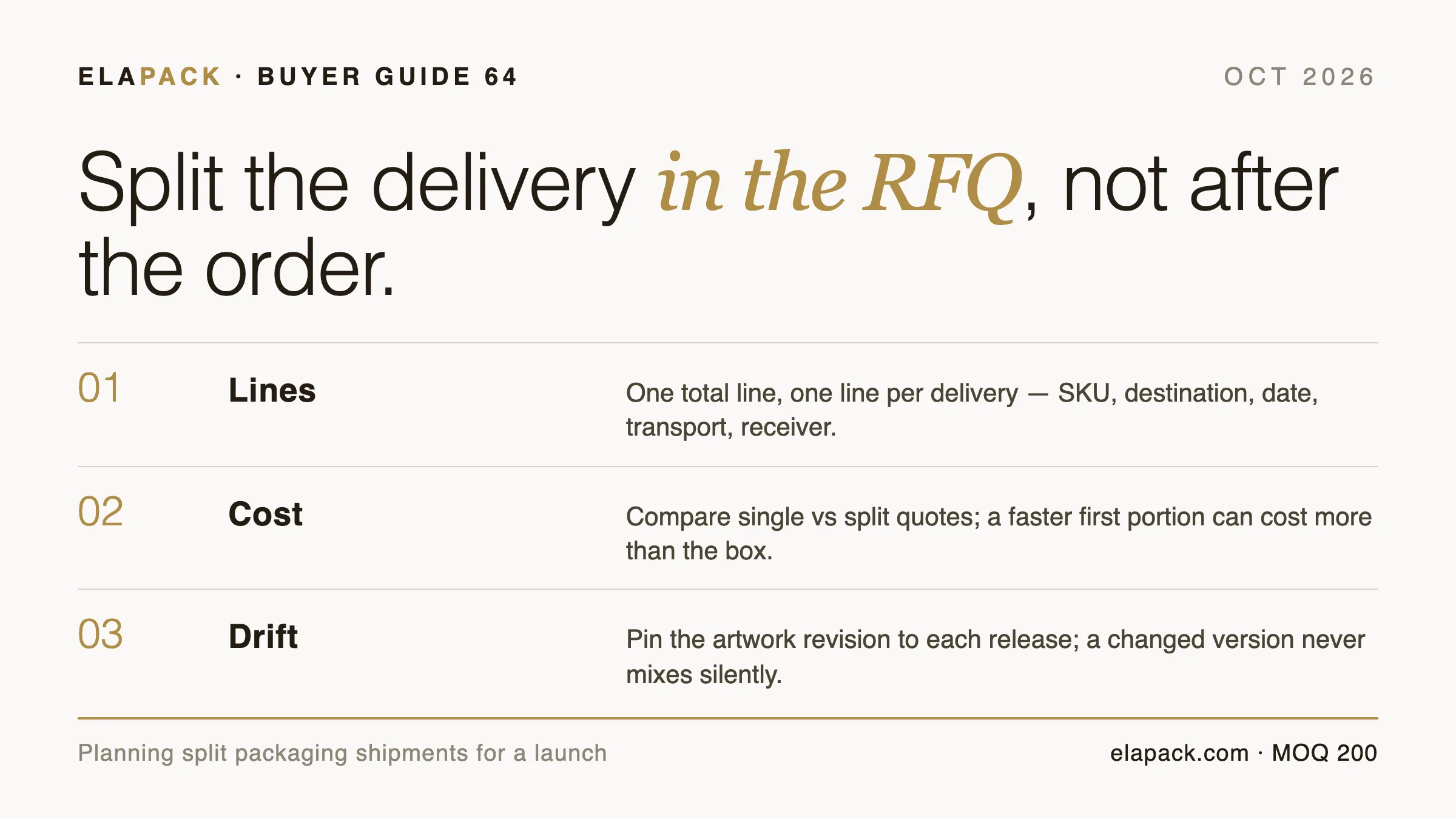
Write one line for the total order and a separate line for each proposed delivery: units by SKU or artwork, destination, required date, transport mode and who receives it. If a gift set includes a box, pouch and card, say whether each partial shipment must contain complete sets or whether components may travel separately. The multi-component gift set quote guide provides the bill-of-materials starting point.
Some packaging providers advertise split deliveries. PackMojo's platform description mentions multiple destinations and different shipping methods as examples of its own service. That shows the question is commercially relevant; it does not prove ELAPACK offers the same arrangement, routes or pricing. Ask for an explicit written response for the actual project.
If the first delivery is needed for retail photography, ensure it uses the production-approved artwork and material. A prototype or pre-production sample may be useful for preparation, but it is not automatically equivalent to sellable bulk stock. Identify which item you need and which acceptance rules apply. If the initial shipment precedes the balance, ask whether it is drawn from the same production lot and how the remaining goods are stored.
Work the calendar backwards from the launch date
A split plan is built backwards, not forwards. Start from the date stock must be sellable, then work back through the steps that cannot overlap or slip — that dependency chain is the critical path. For a split packaging delivery it runs: launch date, receiving and launch checks, transit, production window, sample approval, locked specification.
Transit is the widest variable, and the transport mode sets the band. Forwarder-published rules of thumb for China to the US: around three days for express courier, 8–10 days for standard air freight, and 30–40 days door-to-door for ocean. To Europe, sea runs 30–45 or more days, rail 14–25, air 4–7, and LCL sea adds a week or two over a full container. The split exists precisely because these bands differ: the first delivery rides the fast band, the balance rides the cheap one.
Transit bands are not just about time; they dictate packaging margin. A rigid setup box travels primarily as trapped air. While LCL ocean bills by the cubic metre, air express bills by volumetric weight — a carton's length × width × height in centimetres divided by 5,000. Shipping 100% of a rigid box order via air express can cost more than the manufacturing run itself. The split schedule is an operational lever to rescue your unit economics: commit only the emergency volume to the air tier, while the ocean container absorbs the bulk volume at fractional freight costs.
Between transit and production sit gates, not guessed weeks: specification locked, golden sample locked, the production window after sample approval and payment, freight booked, receiving appointment made. Most launch delays cluster in four places — scattered approvals, ambiguous specs, a QC plan defined too late, and freight realities ignored until goods are ready. Buffers belong where reality breaks projects: keep the spare days in front of the launch date for receiving checks and last-mile issues, not spread evenly across the plan.
Receiving is part of the calendar, not an afterthought — allow time to inspect the first delivery against the approved sample before photography or retail setup consumes it.
Make the quote show the cost of each route
Compare a single-shipment quote with a split-shipment quote using the same packaging specification and total quantity. Ask the supplier to show separate carton counts, packing, freight, handling and any destination-specific requirements. A faster first portion may cost more even when the box unit cost is unchanged. Do not assume a universal premium or savings rate; routes, volume and terms determine the result.
Size the first release from actual launch demand: photography or seeding units, initial retail allocation, expected sales until replenishment, and a buffer chosen by the buyer. Subtract usable stock already on hand before asking how many finished sets must travel early. The resulting share may be quite different from a generic 10%/90% split. Confirm when goods are ready to leave the factory and obtain route-specific transit estimates; neither an air label nor a sea label by itself guarantees the arrival date.
| RFQ field | First delivery | Balance delivery |
|---|---|---|
| SKU and quantity | State exact mix | State remaining mix |
| Destination | Address and receiver | Address and receiver |
| Date | Required arrival date | Required arrival date |
| Evidence | Sample/inspection documents | Lot and carton records |
| Cost | Freight and handling line | Freight and handling line |
This chart is a planning template, not a promise about transit time or delivery terms. If the two deliveries go to different countries, ask who handles labelling, customs paperwork and local receiving requirements. The final Incoterm and responsibilities should be explicit in the written quote.
Size the first delivery by the horizon, not a percentage
The first batch has one job: cover demand until the balance clears receiving. If the balance travels by sea, that horizon is a 30–40 day door-to-door window plus your launch buffer. Sell-through across that window, plus the buffer, minus usable stock on hand — that is the first delivery, and it may be far from a round percentage of the order.
A practical sizing scenario
If your target market consumes 500 boxes weekly, and ocean transit to your US 3PL runs 35 days (5 weeks) plus a 1-week receiving buffer:
- Required horizon cover: 6 weeks × 500 units = 3,000 units
- Usable on-hand inventory: 500 units
- First delivery minimum: 2,500 units, shipped via express or air
Cutting the first delivery to an arbitrary 10% of a 10,000-unit PO (1,000 units) leaves fulfilment lines idle from week three until the balance clears receiving — three empty weeks that end in an emergency mid-launch air top-up at premium per-kilo spot rates.
Guess wrong in either direction and the error has a price:
- Too small, and the top-up that saves the launch rides express air — the top freight tier, per kilo the most expensive way a box ever flies.
- Too large, and version-one stock is still on the shelf when the first replenishment lands — stock a later revision can strand.
Put the sizing arithmetic next to the split table in the RFQ: expected sales until the balance arrives, buffer, stock on hand. The supplier's feasibility answer then covers both quantities with dates attached.
The change gate between first release and balance
Between the first release and the balance, three states exist, and each changes what a change request means:
- Balance not yet produced. A revision is possible but it is a re-approval: new sample or photos, possibly new tooling or setup, and the production clock effectively restarts for the affected quantity.
- Balance in production. The request becomes a stop-or-hold decision with scrap and rework on one side of the ledger. Late changes after production begins are a named cause of packaging launch failure.
- Balance produced and stored. The question turns commercial: ship as version one, rework or repack, or treat the change as the first reorder — a decision the reorder version checklist exists to structure.
Whatever the state, the gate itself is one discipline: request in writing, affected quantity identified, cost and date impact answered, one named approver. The record it leaves is what the version rules below build on.
Producing the full quantity in one pass and staging only the dispatch protects the volume price tier: a second production run re-pays setup and resets the unit price. At ELAPACK, the balance of a completed run can be held at the factory free of charge for three months and dispatched in phases against vessel sailings. With any supplier, get the holding conditions in writing: duration, storage fees beyond the free window, insurance, and who re-inspects before each dispatch.
Decide what can change between deliveries
Version drift is easy when a later delivery is held or produced separately. Record the approved artwork revision, colour reference, material and closure on both release instructions. If a change is requested after the first release, ask whether the balance can change and how the affected quantity will be identified. A revised version should never be silently mixed into cartons marked with the original specification.
Use the gift box category and pouches and bags category to define which components need to travel together; the magnetic closure gift box is a product-page reference for a box line. Send the target in-store date, product dimensions and destination alongside the split table, and the feasibility response comes back mapped as a reverse critical path — specification freeze dates, air and sea volume splits, and the cost of each leg. Send the split-delivery table with the product specification for a conditional feasibility and cost response.
Questions buyers ask about split deliveries
How big should the first delivery be?
As big as the horizon demands: sell-through until the balance clears receiving, plus your buffer, minus stock on hand. If the balance moves by sea towards the US, plan around a 30–40 day door-to-door window — the first batch covers demand across that whole gap, not a fixed share of the order.
Can the artwork change for the balance after the first release?
It depends on where the balance stands: unproduced means re-approval and a restarted production clock; in production means a stop-or-hold decision; already made means a commercial choice between shipping as version one and reworking. A revised version is never mixed silently into cartons marked with the original specification.