# Custom Subscription Boxes: How to Order, What to Compare, and What a Monthly Run Demands
Custom subscription boxes are the one piece of packaging your subscribers touch every single month. A one-off retail box that ships slightly late or prints slightly off-brand is an annoyance; a subscription box that does the same thing repeats the mistake thirty times a year in front of the same customer. That single difference — recurrence — should drive every decision in this guide: which box structure you pick, which print method makes sense at your volume, how you stage a sample, and how you schedule reorders so month ten arrives as reliably as month one.
This guide covers the ordering side of custom subscription boxes: how the major vendor models differ, which specifications actually separate quotes, and how to run a monthly box program without betting the whole subscriber base on a single large order. If you are still deciding what goes inside the box, our subscription box packaging buyer's guide covers programme planning; and the cost breakdown article handles budgeting layer by layer.
Key takeaways
Vendor model, structure and spec discipline — not unit price — decide whether a monthly box programme runs smoothly.
- Digital-first shops sell from a single box; manufacturers quote from 200 pieces and win on price and stability once a programme passes its first hundred subscribers.
- Structure follows contents: a roll-end front tuck mailer for light presentation packs, a shipper-rated structure for heavy, glass or damage-prone goods.
- Compare quotes on the seven spec lines — dimensions, board and flute, print coverage, finishing, tooling ownership, proofing and reorder terms — never on unit price alone.
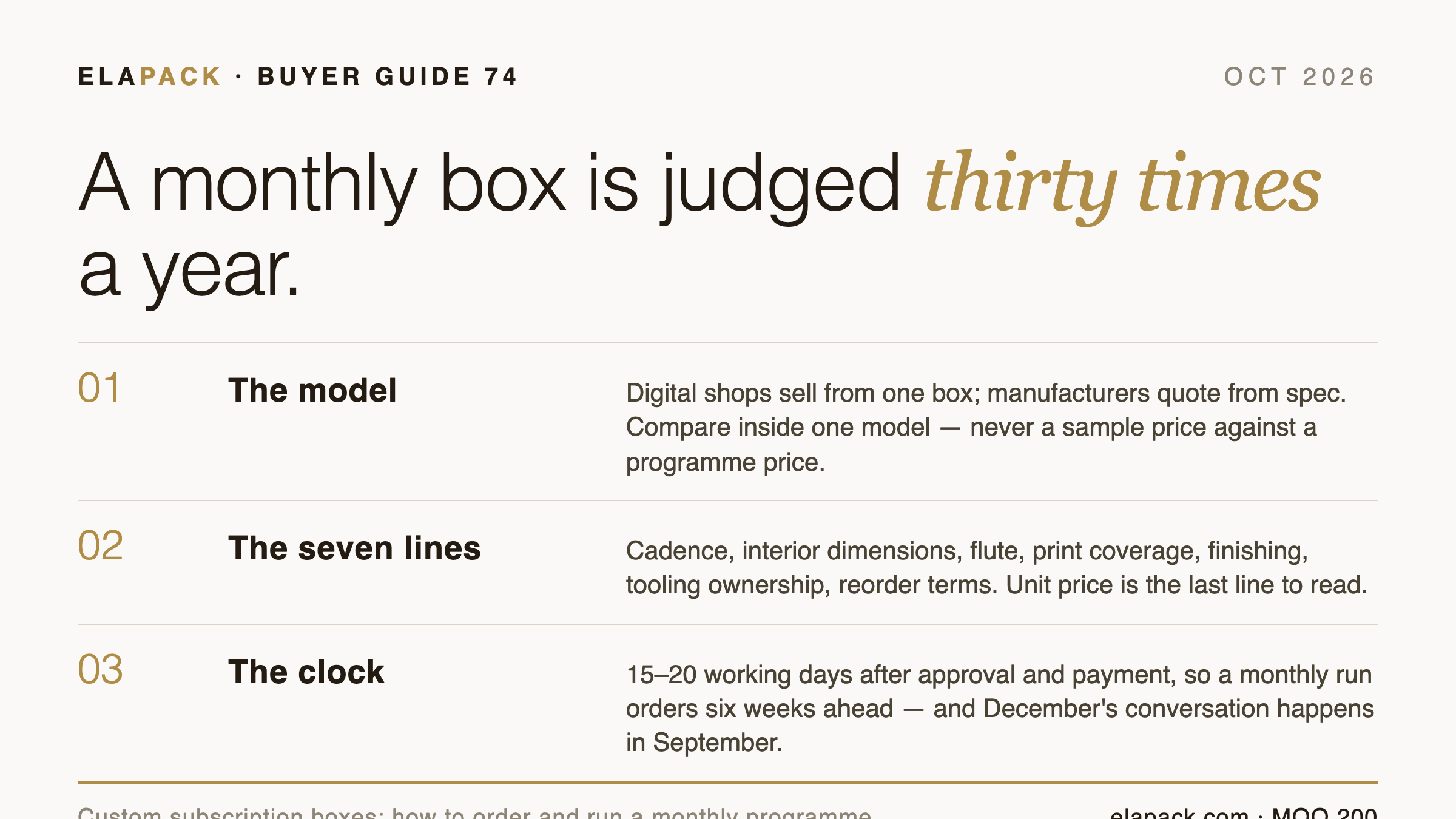
- A monthly cadence needs the box order placed about six weeks ahead of ship date; production alone runs 15–20 days after sample approval and payment receipt.
Last updated October 2026.
What is a custom subscription box?
A custom subscription box is a printed box made to your dimensions, your artwork, and your recurring cadence — as opposed to a stock mailer with a label stuck on it. The custom part usually means three things:
- Custom dimensions. The box is cut to your packed product set, not the nearest stock size. Right-sizing matters twice as much in subscriptions because you pay for the dead volume every month, and loose products shift and damage on repeat shipments.
- Custom print. Your artwork on the outside, the inside, or both, in one to full colour. Inside printing is what turns the opening moment into the unboxing experience subscribers photograph.
- Recurring production. The vendor can reproduce the same box — same board, same colour, same cut — on a monthly or quarterly schedule without a new setup each time.
The market for these boxes splits into two vendor models, and knowing which one you are talking to explains most of the differences between quotes.
The two vendor models for subscription boxes
Digital-first packaging shops sell configured boxes through a web flow: you enter dimensions, pick a board and finish, get an instant price, and order quantities as low as one. Packlane is the best-known example — its mailer box starts at a quantity of one, shows live pricing (250 boxes at 3.40 US dollars each at the time of publishing), and promises a PDF proof within 24 hours. PrintPlace works the same way: dimensions from 3 by 2 by 1 inch up to 25 by 25 by 15 inches, a free PDF proof before anything prints, sample boxes in 3–5 business days, and bulk production in 10–15.
Manufacturers and converters — including factories like ours — quote from your specification rather than from a configurator. The minimum order is higher (ours is 200 pieces), the unit price at programme volumes is lower, and the relationship is built around the repeat run: same board lot behaviour, Pantone-matched colour across editions, and a production slot you can plan a season around. For a monthly programme past its first hundred subscribers, this is usually the cheaper and more stable lane; for a pre-launch test of ten boxes, the digital shops win on flexibility.
Neither model is better in the abstract. The mistake is comparing a one-box sample price from one model against a 5,000-piece programme price from the other and concluding the manufacturer is expensive.
Mailer box or shipping box: which structure does a monthly run need?
Almost every subscription programme starts with one of two structures, and the choice follows the product, not the aesthetic.
- Roll-end front tuck mailers (REFT) are the default subscription box. One piece of E-flute or B-flute corrugated, folding into a self-locking box with dust flaps, shipping flat and assembling by hand at the packing table. Packlane's mailer, Fantastapack's subscription line, and the boxes in most unboxing videos are all variants of this structure. It opens like a presentation box, which is why beauty, snack, and apparel programmes use it.
- Regular slotted containers (RSC) — the standard four-flap shipping box — are the right call when contents are heavy, sharp, or fragile: candle vessels, glass jars, anything that arrives broken if the structure flexes. Box Genie's guidance is representative: use the mailer for most programmes, step up to a shipper-rated structure for damage-prone goods.
Between them sit the speciality structures — book mailers, five-panel folders, full-overlap boxes — that earn their place when product geometry demands them. A rigid lift-off lid box belongs at the top tier of a programme: annual editions, collector drops, flagship gifting. It costs more per unit than a folded corrugated mailer, and most monthly tiers do not need it every month.
Which specification lines actually separate quotes?
When quotes from different vendors land in your inbox, the unit price line is the least useful number on the page. These are the lines that determine what you actually bought:
- Board grade and flute. E-flute (about 1/16 inch) prints more finely and suits lighter contents; B-flute (about 1/8 inch) is stiffer for heavier packs. Board is also graded by strength test — 32 ECT edge crush and 200-pound Mullen burst are the common single-wall e-commerce baselines — so a like-for-like quote names flute and strength grade both. Some shops auto-select by box size; a manufacturer should tell you which and why. A quote that does not name the flute is a quote you cannot compare.
- Print method and coverage. Digital CMYK has no plate cost and suits short, changing runs; flexographic and litho-laminated print cost more to set up but price better at volume. Ink coverage — one colour outside, full colour inside and out — moves price more than most buyers expect.
- Sides printed. Outside-only is cheapest; a printed inside is what the camera sees first in an unboxing. Decide this once, at the design stage, not order by order.
- Proofing and colour matching. A free PDF proof is standard at digital shops; a physical proof or Pantone-matched drawdown is what keeps month one and month ten the same colour. For a recurring programme, colour consistency across editions is worth paying setup for once.
- Tooling and dielines. Custom dimensions need a cutting die. Ask who owns it, what it costs, and whether reorders reuse it — at monthly cadence, die amortisation quietly becomes a real line in the budget.
- Turnaround and the reorder pipeline. Sample in days, bulk in one to three weeks is typical across the market. What matters for subscriptions is the reorder: can the vendor hold the spec and repeat in the same window every month, and what happens in your peak season when every other programme is reordering too.
The seven-line spec sheet that makes quotes comparable
The practical fix for quote chaos is to send every vendor the same seven-line specification and to read what comes back against it, line by line. A spec sheet you write once — before the first quotation — is also what you reuse every month when the reorder conversation happens.
- Quantity and cadence. Not just 500 boxes, but 500 per month for twelve months, first run in March. Volume alone changes the price; cadence changes the vendor's willingness to hold a production slot and freeze your board and colour references.
- Interior dimensions and structure. Interior, not exterior — the packed products define the inside, and wall thickness does the rest. Name the structure (roll-end front tuck mailer, regular slotted container) so vendors quote like for like.
- Board grade and flute. E-flute or B-flute by name, with the reason (print fineness versus stacking stiffness). A vendor who answers this line with a shrug is telling you what reorders will look like.
- Print method, colours, and coverage. Digital or flexographic, how many colours, and exactly which surfaces print — outside only, inside lid, full interior. Coverage is the line buyers forget and the line that moves price most.
- Finishing. Matte or gloss lamination, spot coating, or none. Most programmes print fine without lamination; deciding it once beats paying for it by accident every month.
- Tooling. Who cuts the die, what it costs, who owns it, and whether reorders reuse it at no tooling charge. At monthly cadence this is not a footnote — it is the difference between a one-time cost and a subscription of its own.
- Proofing, turnaround, and reorder terms. PDF proof or physical proof, Pantone reference if colour consistency matters across editions, bulk turnaround in working days, and the reorder window the vendor commits to at programme volume.
When two quotes come back, read them against these seven lines before looking at the unit price. The cheaper quote is usually cheaper on a line you did not specify — a lighter flute, outside-only print, tooling billed again on the reorder — and the spec sheet is what makes that visible instead of discoverable in month four.
How to stage the first order of a monthly run
The programmes that run smoothly stage their first order in three steps instead of betting a full season on untested artwork.
Step one: sample the board and the print. Order a sample before committing to the run. Digital shops sell sample kits or single boxes cheaply; manufacturers including us make a custom printed sample — ours is 25 US dollars plus 20 US dollars shipping, produced in 3–5 days — so you see your own artwork on the exact board, not a generic demo. Check the finish under the lighting your subscribers actually use, because a satin finish that looks premium in a showroom can look grey in a hallway.
Step two: run a small first production batch. Use it to test three things the sample cannot show: how the flat boxes handle your packing line, how the printed surface survives your fulfilment process, and how the structure arrives after the real carrier journey. This is where a 200-piece first order earns its place — big enough to test at real speed, small enough to revise the dieline without pain.
Step three: lock the spec, then schedule, not reorder from scratch. Once the spec is locked — dimensions, flute, print method, colour reference, die number — a recurring programme should be a scheduling conversation, not a new quotation cycle. Every re-quote is a chance for drift: a substituted board, a slightly different white, a different flute because the old one went out of stock. The vendor's willingness to freeze your specification is, over twelve months, worth more than a few cents off the unit price.
What custom subscription boxes cost to keep running
The box purchase price is one line of four. A monthly programme also pays for inserts and interior fit-out (a corrugated or paper insert that holds items in position beats loose fill for both protection and presentation), kitting labour at packing, and outbound shipping — where dimensional weight means the empty headspace you paid for in the box comes back as a shipping surcharge every month. Our cost breakdown article walks the full stack with worked numbers; the short version is that right-sizing the box is the single decision that reduces all four lines at once.
US programmes shipping parcels under 20 pounds should also check cubic pricing before the dieline is cut. USPS cubic rates bill on outside volume rather than weight, in five tiers up to the 0.5 cubic foot line — 864 cubic inches, length times width times height divided by 1,728 — and each dimension is rounded down to the nearest quarter inch when the tier is calculated, a small engineered bonus for boxes sized just under a tier edge. A box that drifts over 0.5 cubic feet loses Priority Mail cubic eligibility and falls back to weight or dimensional-weight billing; Ground Advantage cubic extends the same tier logic to 1 cubic foot, so the cliff is real but graded. Because the tiers are measured on outside dimensions, board thickness and a half inch of headspace can push a finished box across the line — which is why right-sizing is a freight decision, not only a fit decision. Our box dimensions guide covers the measurement conventions and the dimensional-weight divisor behind these rules.
Scheduling a subscription box programme
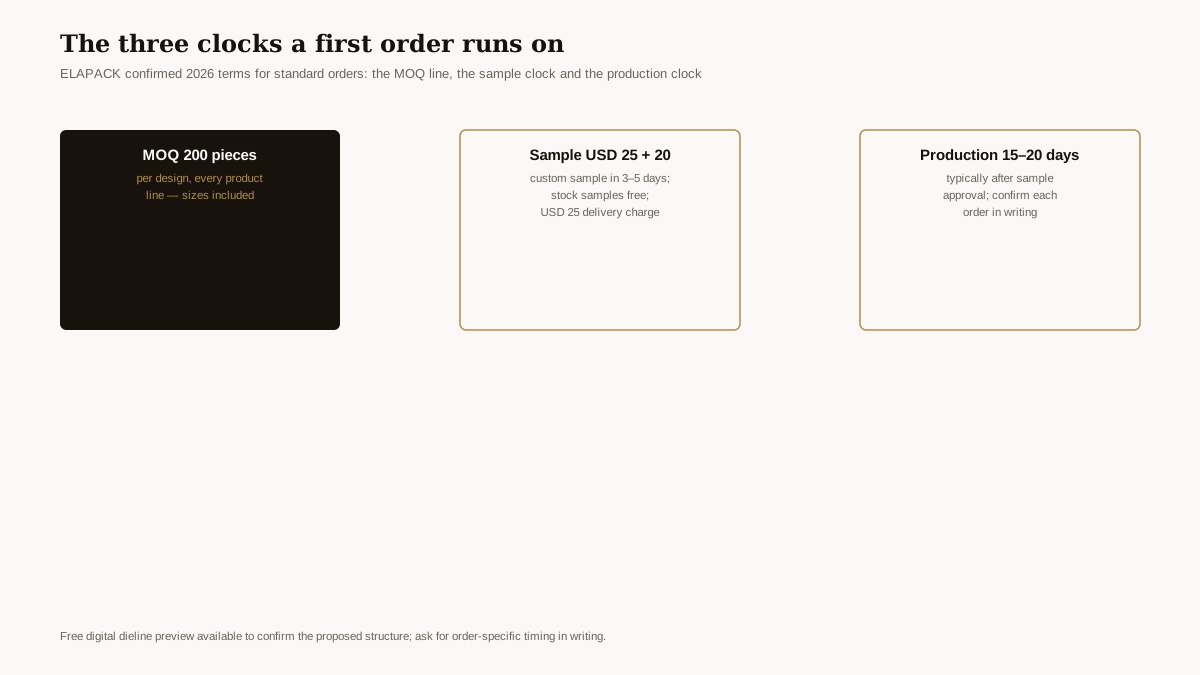
The three clocks a first order runs on: the 200-piece MOQ line, the custom sample (USD 30 plus USD 25 shipping, 3–5 days) and the production window — each confirmed in writing per order.
Lead time discipline is what separates a calm programme from a panicked one. Work backwards from the month you want on the subscriber's doorstep: production of 15–20 days after sample approval and payment receipt (our standard; digital shops publish similar 7–15 day windows), plus transit, plus your kitting time, plus a week of buffer for the month everything goes wrong. A programme on a monthly cadence effectively needs its box order placed six weeks ahead of ship date, which means the artwork conversation for December happens in October. Programmes that discover this in November pay rush fees or ship late — and late is the one mistake subscribers punish fastest.
Q4: the peak season problem nobody prices in until it bites
Every constraint above tightens in the fourth quarter, because every programme — gift boxes, retail, and subscriptions alike — is reordering at the same time. Peak season shows up in three places. Production queues lengthen: the 7–15 day windows published by digital shops and our own 15–20 working day standard both assume normal load, and October through December is not normal load anywhere in the industry. Carrier capacity tightens on top of production, so transit buffers that were generous in June become optimistic in November. And rush fees appear exactly when your margin is already thinnest, because the December box is the one subscribers judge the programme by.
The programmes that survive Q4 calmly do three things. They move the December conversation to September — six weeks of standard lead time plus peak-season padding means the artwork for the holiday edition is frozen while others are still brainstorming it. They place one larger pre-peak order for the stable, non-themed components of the box — the structure, the unprinted interior, anything that does not carry the holiday artwork — so only the printed edition competes for peak slots. And they keep a January plan on paper before December ships, because the month after peak is when exhausted programmes make their sloppiest mistakes: reorders placed late, specs re-quoted from scratch, colour drift nobody catches until the complaints.
One structural note for gifting seasons: if the December edition doubles as a gift box — a rigid lift-off lid, foil, a heavier board — treat it as a separate SKU with its own spec sheet and its own sample, not as a variant of the monthly mailer. Annual-tier boxes deserve their own tooling decision, and trying to make one structure do both jobs is how programmes end up with a December box that neither ships nor gifts well.
Sources
- Packlane, “Mailer Boxes” product page — https://packlane.com/products/mailer-box
- PrintPlace, “Subscription Boxes” product page — https://www.printplace.com/subscription-boxes
- Fantastapack, subscription box structure catalogue — https://www.fantastapack.com/
- Box Genie, “Custom Subscription Boxes 101” — https://www.boxgenie.com/blogs/news/custom-subscription-box
Frequently asked questions
What is the minimum order for custom subscription boxes?
It depends on the vendor model. Digital packaging shops sell from a single box; manufacturers quote from higher minimums — ours is 200 pieces. The right question is not the lowest minimum but the minimum at which your monthly cadence prices sensibly: ordering 100 boxes every month at a premium beats warehousing 5,000 you cannot use if the design changes — but only if the vendor can repeat the order reliably at that size.
How long do custom subscription boxes take to produce?
Across the published market, sample boxes run 3–5 business days and bulk production 7–15 business days at digital shops. Our production window is 15–20 days after sample approval and payment receipt, which covers custom board, print, and die work — so plan the first order about six weeks ahead of the ship date, and reorders against the same window.
Should a subscription box be a mailer box or a shipping box?
Use a roll-end front tuck mailer for light, presentation-led contents — it opens like a gift and assembles without tape. Step up to a shipper-rated structure (regular slotted container, heavier flute) when contents are heavy, glass, or damage-prone, and use a rigid box only for top-tier or annual editions. The structure should follow what the products survive, not what photographed best on another brand's feed.
Can I order a sample before committing to a monthly run?
Yes, and you should. Digital shops offer sample kits or single printed boxes; we make a custom printed sample of your own artwork on your chosen board for 25 US dollars plus 20 US dollars shipping, delivered in 3–5 days. Test the sample for finish, colour, and hand-feel before the first production batch — revisions at the sample stage cost days; revisions after a full run cost the run.
Get your subscription box quoted
We make custom subscription boxes for monthly programmes shipping to the US and Europe — printed mailers and shipper structures, fabric pouches, and insert cards from one manufacturer, from 200 pieces, with a free dieline preview and a quote within one business day. If you are planning a recurring programme, start with the subscription box packaging collection page, or send your packed product dimensions and cadence and we will spec the box.