Sizes and paper weights below are industry figures quoted as published by the named print and paper suppliers. Ordering terms — minimum order 200 pieces, production typically 15–20 days after sample approval and payment receipt, custom sample at USD 30 plus USD 25 shipping, free digital dieline preview — are ELAPACK confirmed terms.
Quick answer: Thank you card sizes follow the envelope system they pair with — A1, A2, A6, A7. A2 (4.25×5.5″) is the workhorse flat note card and A7 (5×7″) the workhorse folded card, and folded cards are quoted by finished size. Enquire with finished size, paper weight, printing sides, envelope and finishes; minimum order 200 pieces.
Key facts at a glance
| Item | Figure | Source |
|---|---|---|
| Minimum order | 200 pieces | ELAPACK confirmed terms |
| Production lead time | typically 15–20 days after sample approval and payment receipt; confirm by order | ELAPACK confirmed terms |
| Custom sample | USD 30 plus USD 25 shipping, 3–5 days | ELAPACK confirmed terms |
| Digital dieline preview | Free for structure approval | ELAPACK confirmed terms |
| Size naming | Cards are named by the envelope system they pair with (A1/A2/A6/A7); folded cards are quoted by finished size | Industry references (named below) |
The commercial role: turning an unboxing into a reorder
A thank you card is not an etiquette formality; in e-commerce fulfilment, it is the primary physical vehicle for customer retention.
Independent consumer studies on e-commerce packaging (such as the Ryder 2025 benchmark) reveal a critical commercial divide: while luxury packaging elevates brand perception for 52% of buyers, premium presentation alone does not trigger repeat sales. The primary mechanism that actually drives customers back to repurchase is an enclosed incentive — specifically future discount offers (47%) and free trial vouchers (24%).
The thank you card is where that incentive lives. Whether formatted as a personal note card, an envelope-enclosed VIP voucher, or a dynamic QR loyalty portal, the size and paper of the card dictate how that secondary sale is presented.
Standard sizes at a glance
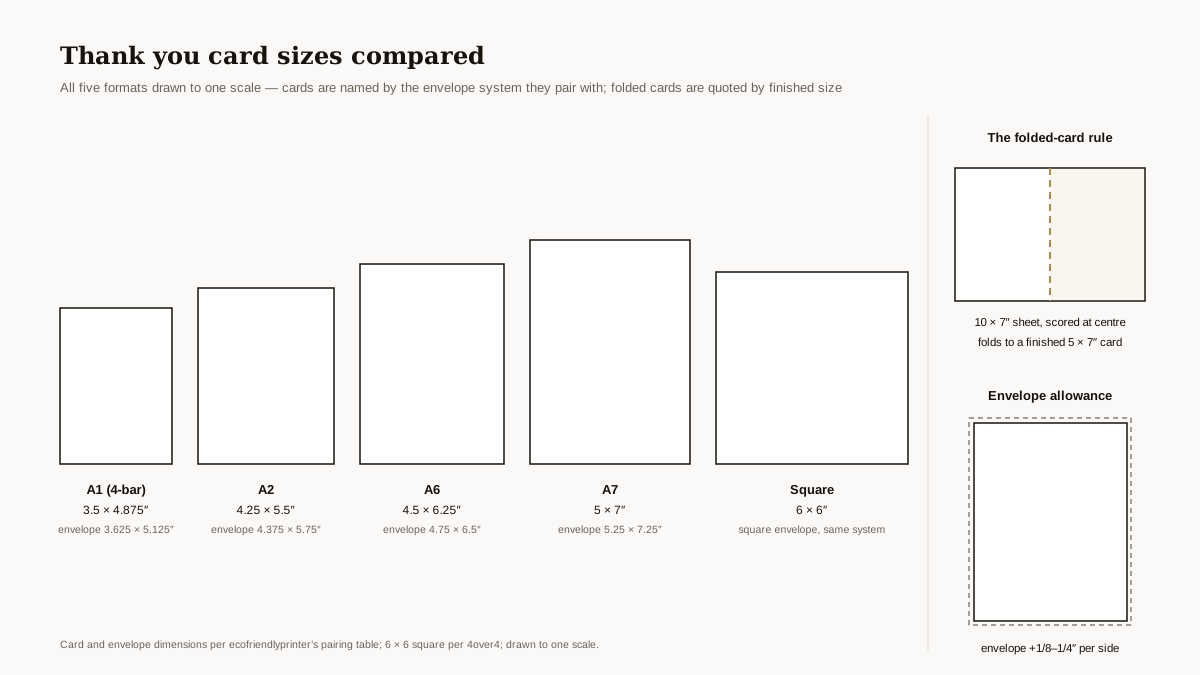
There is no single standard thank you card size — there is a size system named after its envelopes, and choosing a card size means choosing that envelope system.
| Card | Finished size | Paired envelope | Source |
|---|---|---|---|
| A1 (4-bar) | 3.5×4.875″ | 3.625×5.125″ | ecofriendlyprinter |
| A2 | 4.25×5.5″ | 4.375×5.75″ | ecofriendlyprinter; 4over4 default flat |
| A6 | 4.5×6.25″ | 4.75×6.5″ | ecofriendlyprinter |
| A7 | 5×7″ | 5.25×7.25″ | ecofriendlyprinter |
| Square | 6×6″ | square envelope in the same system | 4over4 |
| Folded 5×7 | 10×7″ sheet scored to 5×7″ | A7 envelope | 4over4; Red River same sheet spec |
A2: the workhorse for note cards and in-box inserts
At 4.25×5.5″, A2 is the size ecofriendlyprinter names as the most popular note card size, and it is 4over4's default flat card tier. It is the first choice for e-commerce box inserts and gift-bag cards: it fits box interiors and the matching envelope stock without special handling. Start at A2 unless there is a reason not to, then check it against the actual box interior.
A7 and 5×7: the folded-card workhorse
5×7″ is A7. 4over4's folded thank you card is a 10×7″ sheet, scored and folded to a 5×7″ finished card; Red River's 7×10″ pre-scored 360gsm card sheets are the same specification — that page lists the sheet size only, and the finished 5×7″ reading is corroborated by 4over4's identical spec rather than stated separately. ecofriendlyprinter lists A7 as the main invitation format. This is the tier for brand holiday cards, wedding-adjacent thank you cards and any card that needs a spread to open. Enquire folded cards as “finished 5×7″ from a 10×7″ sheet” — give both numbers.
A1 (4-bar) and the 6×6 square: small cards and square formats
A1 is 3.5×4.875″, the smallest of the four — short messages, minimal packaging, a small card tucked in alongside the product. The 6×6″ square (a 4over4 flat tier) earns its place where the card is meant to be seen, not just read. Small cards save paper and freight; square cards buy layout. Choose by the information the unfolded sheet has to carry, not by what sounds premium.
Flat vs folded: the labelling rule
The industry labels folded cards by finished size: a folded A2 starts life as a 5.5×8.5″ flat sheet (ecofriendlyprinter). The recurring ambiguity in quotations is a single number with no flat-or-finished qualifier. Keep drawings and quotations on a double label — finished size plus flat sheet size — and price the paper by the flat sheet.
Preventing fibre cracking along the score line
Heavy cardstock (≥300 gsm or 14 pt+) has significant structural rigidity. If a thick sheet is folded by hand without machine calibration, the outer paper coating tears apart, creating an unsightly, fractured white edge along the fold seam.
To maintain a razor-sharp, crack-free fold on A7 and A2 cards:
- Machine scoring prior to folding. Heavy board must be rotary or platen scored with a female channel matrix, stretching the internal cellulose fibres before folding.
- Aligning with grain direction. The fold line must run strictly parallel to the paper grain direction (grain parallel). Folding against the grain tears the surface fibres, particularly on cards with solid dark background printing.
- Protective lamination on creases. If your design features solid ink coverage across the fold line, specify a flexible polymer matte lamination to hold the printed ink film continuous across the curved hinge.
Envelope pairing
Across ecofriendlyprinter's table, envelopes run 1/8–1/4″ larger than the card on each side; 4over4 offers an optional White Wove A2 envelope. Set the envelope system first, then check envelope paper colour, windows and closure against it. Cards and envelopes are named by one system — sourcing them separately is how mismatched tiers happen.
Paper weight and hand feel
4over4's velvet tier is 16pt card; Red River's folded stock is 360gsm/96lb (16 mil). The industry band runs from light note stock to 16pt-and-heavier. ELAPACK does not pre-commit a single weight: the sheet and weight for a project are confirmed on the quotation, and only confirmed terms are quoted here.
Writable vs. sealed: the ink-smear engineering trap
A frequent quality failure in custom note cards is specifying an ultra-smooth coated substrate for cards meant to carry handwritten notes.
- Double-sided coated artboard (C2S) with matte/soft-touch film: delivers flawless, velvet-like tactile luxury and protects dark flood-coat inks from scuffing. However, pen ink, fountain pen ink and felt-tip signatures cannot penetrate the film barrier, resulting in wet ink smearing across luxury gift items.
- The writable solution (uncoated and cotton stocks): for luxury brands that handwrite client names or personalized messages at fulfilment, specify 300–350 gsm premium uncoated cotton card or uncoated woodfree offset paper. These fibres absorb liquid ink within seconds.
- The hybrid approach (one-side coated / C1S): apply full-colour branding, foil stamping and anti-scratch matte coating on the card exterior/front, while leaving the interior or back 100% uncoated for crisp, non-smear penmanship.
Printing and finish options
Printing is CMYK or spot colour. Surface finishes — foil stamping, embossing and debossing — and dieline items such as corner rounding are quoted per project; the surface finishes compared guide sets out how the main finishes differ in tooling and cost. Dieline items are confirmed on the free digital dieline preview before production.
Pairing with the packaging programme
The same card shows up in three places: laid flat in a box (a folded A2 fits most gift-box interiors), slipped into a gift bag, and enclosed in subscription-box mailers. Programme it together with the box, pouches and inserts on one specification. The neighbouring guides: custom gift card holders on the carrier side of the same question, and custom earring cards — the sizing-and-ordering-data sister page.
In-box clearance tolerances and placement geometry
When a thank you card is placed inside a rigid gift box or drawer tray, it cannot be cut to the exact inner dimensions of the box base. A zero-tolerance card will buckle at the corners or jam against the box walls, making it impossible for a customer to remove without digging their nails into the lining.
Enforce these three interior clearance rules:
- The perimeter clearance formula: the finished card dimensions must be at least 3–5 mm (0.12–0.20 in.) smaller than the internal box perimeter on all four sides.
- Recessed cavity sizing: if embedding the card into a custom EVA foam or molded pulp insert, die-cut a matching recessed card well with a 1.0 mm border clearance, combined with a half-moon thumb notch or an underlying satin lift ribbon for effortless removal.
- Top-layer tray placement: when laid flat over jewelry or delicate apparel, ensure the card stock is certified acid-free (pH ≥ 7.0) to prevent acidic paper gases from tarnishing precious metals during storage.
What to put in your enquiry
Finished size (plus flat sheet size if folded); paper weight; single- or double-sided printing; envelope — system, paper colour, window or not; finishes — foil position, emboss areas; vector artwork and Pantone references; quantity against the 200-piece minimum; need-by date.
The bottom line
Pick the size from the envelope system — A2 is the safe start — double-label folded cards, settle weight by hand-feel tier, and approve finishes on the physical sample.
Frequently asked questions
What is the most common thank you card size? A2, at 4.25×5.5″ — the most popular note card size in ecofriendlyprinter's table.
What do A2, A6 and A7 mean? Card size tiers named after the envelope system they pair with (ecofriendlyprinter's size table).
How are folded card sizes labelled? By finished size; a folded A2 starts from a 5.5×8.5″ flat sheet (ecofriendlyprinter).
How do I pair the envelope? 1/8–1/4″ larger than the card on each side, within the same system (ecofriendlyprinter).
What are the MOQ and lead time? 200 pieces minimum; production typically 15–20 days after sample approval and payment receipt; custom sample USD 30 plus USD 25 shipping in 3–5 days (ELAPACK confirmed terms).
Can a logo be foil-stamped on thank you cards? Yes — foil stamping and the other surface finishes are compared in the surface finishes compared guide.
Can I write on custom thank you cards with a standard pen? Yes, if the writing surface is uncoated or cotton stock — ballpoint and fountain ink absorb within seconds. Film-laminated and double-sided coated (C2S) surfaces resist ink and smear; for handwritten fulfilment, specify one-side-coated (C1S) or uncoated paper (see the ink-smear rules above).
How much clearance should I leave between the card and the gift box? At least 3–5 mm (0.12–0.20 in.) smaller than the internal box dimensions on all four sides — a zero-clearance card buckles and jams in the box (see the in-box clearance rules above).
Stop guessing card fits — get an engineered dieline in 2 hours
Don’t let cracked fold lines, smudged ink or oversized cards disrupt your e-commerce unboxing moment.
Send your gift box or pouch internal dimensions, target card quantity and handwriting requirements (pen-writable vs. fully printed) to ELAPACK’s structural desk. Within one business day, our packaging engineers will:
- Recommend the exact card format (A1, A2, A6, A7 or custom square) and matching envelope system.
- Calculate precise box cavity clearance tolerances and generate an artwork-ready vector dieline.
- Provide a transparent quotation from our agile MOQ 200 production tier, with custom physical prototypes dispatched in 3–5 days.
[Request Your Custom Card Dieline & Paper Swatch Kit →](https://elapack.com/contact/)